The network for creativity
Join 1.25M professional creatives like you
Connect with clients, get discovered, and run your business 100% commission-free
Creatives on Contra have earned over $150M and we are just getting started
Back to feedPost

"Success is a science. If you have the premises, you will get the results." – Oscar Wilde
This quote was the cornerstone of the XR Platform project, because great projects are not built on luck or chance, but rather on understanding the problem, analyzing its causes, and then developing appropriate solutions in a scientific and systematic way. Therefore, the goal from the outset was to transform complex industrial challenges into a smart work experience based on Extended Reality (XR) and artificial intelligence technologies, enabling workers and technicians to perform their tasks faster, more accurately, and with fewer errors.
When studying the client's needs, we found that the fundamental problem was not a lack of technology, but rather how to deliver the right information to the right person at the right time. In factories, mining environments, the automotive industry, and the pharmaceutical industry, a small delay or error can lead to significant financial losses or production line shutdowns for extended periods. Therefore, it was essential to find a way to make instructions, guidelines, and vital data readily available to the worker during task execution, without the need to refer to lengthy operating manuals or complex systems.
And from here began the scientific phase of the project. We analyzed user behavior within industrial environments, studying the thought processes of technicians and engineers as they performed daily tasks. We also focused on understanding the cognitive load users experience while navigating different steps, as information overload or poor organization can lead to costly operational errors. These studies were not merely preliminary; they formed the foundation for all subsequent design decisions.
Following this, an integrated information architecture was developed, connecting all parts of the platform, from login and progress dashboards to collaboration, task execution, and performance analysis. The goal was to create a logical and sequential user journey that allows users to move from one step to the next without losing context or feeling overwhelmed.
During the design process, several significant scientific challenges emerged. One of the most prominent was the issue of visual contrast within industrial environments, where unstable lighting and dark backgrounds can make reading information more difficult and increase eye strain. To address this, a visual system was developed that utilizes intelligent and variable gradients adapted to the nature of the task and the industrial environment, resulting in improved clarity of text and elements and reduced visual fatigue.
We also faced another challenge related to the cognitive coherence between work steps. Technicians need to move between multiple stages without losing their understanding of the core task. Therefore, a system was designed based on holographic layers and intelligent visual flows that connect each step to the next naturally and seamlessly, maintaining focus and reducing the likelihood of errors.
At the global collaboration level, the challenge was to display hundreds of teams, projects, and challenges within a single dashboard without creating visual or informational clutter. To address this, a global collaboration dashboard was designed that allows information to be categorized by industry sector, such as mining, pharmaceuticals, or automotive, while providing sorting and organization tools that make accessing information easier and more efficient.
Another crucial element of the project was linking the design to real-time data. Instead of displaying static information, the platform was able to directly display performance indicators, accuracy, and estimated execution times, giving users a clear view of the current situation and increasing their confidence in the system during operation.
Since the human element remains fundamental to the success of any technological system, we considered how to enhance user motivation. The challenge lay in adding motivational elements without compromising the professionalism of the industrial environment. Therefore, a separate incentive layer was designed, incorporating experience points, global rankings, and achievements, to encourage continuous improvement without distracting users from their core tasks.
Figma played a pivotal role in transforming these ideas into reality. By creating an integrated Design System, all visual components and elements were unified, ensuring complete consistency between design and development. Figma's real-time collaboration capabilities also accelerated communication between designers and developers, making all modifications and updates available instantly. This contributed to improved final product quality and reduced implementation time.
The project's impact extended beyond improving industrial processes, reaching into everyday life. The core principle of presenting the right information at the right time can be applied across numerous fields. In factories, the platform helps workers perform tasks with greater precision; in hospitals, doctors can monitor patient data in real time; and in education, students can learn through realistic, interactive experiences that simulate real-world work environments.
The platform also contributes to reducing human error by providing information and guidance during implementation, accelerating training processes through interactive simulations, and enhancing collaboration between different teams worldwide through a unified work environment that allows for more efficient knowledge and experience sharing.
Looking at the project as a whole, we find that it represents a practical and direct application of Oscar Wilde's maxim. The results achieved were not accidental, but rather the product of a series of sound premises: user research, problem analysis, understanding the industrial environment, building an integrated design system, leveraging artificial intelligence, linking live data with visual experience, and continuously testing the solutions.
Therefore, the XR Platform project is not merely a design model or a digital interface, but a living example that success can be achieved when scientific knowledge is combined with professional execution and a clear vision. And when the premises are built on With proper research, analysis, and planning, the results become a natural extension of the process. This embodies the true meaning of the saying: "Success is a science; if you have the premises, you will get the results."
[Link to the blog explaining the project in detail: https://hassanonlineprojects.blogspot.com/2026/06/the-humanmachine-harmony-how-figma-and.html]
[Link to the project: https://admin-scene-57807586.figma.site]
[Link to the project: https://www.figma.com/community/file/1648277395328344334]



nice work!
The network for creativity
Join 1.25M professional creatives like you
Connect with clients, get discovered, and run your business 100% commission-free
Creatives on Contra have earned over $150M and we are just getting started
Related posts


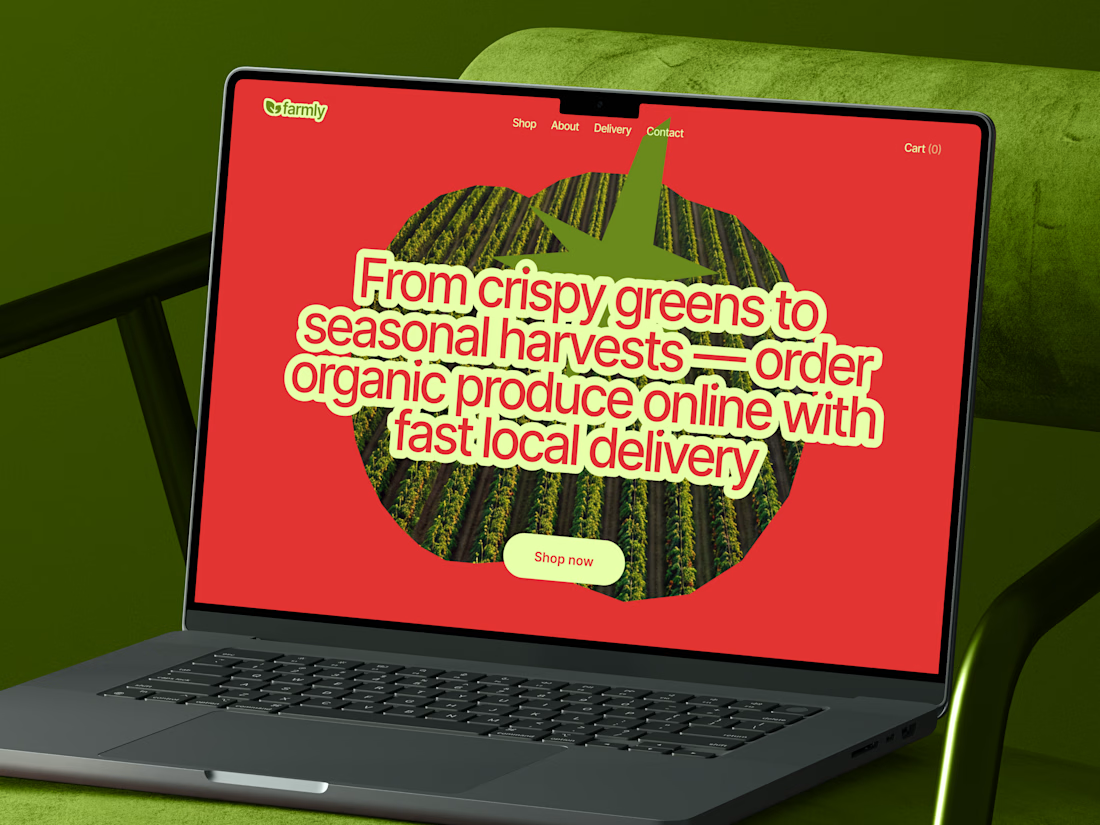
New concept of grocery store website. Excited to hear your feedback! 🚀



Such a vibrant and refreshing take on grocery e-commerce! The bold color choice, heavy typography, and clever tomato image mask create an incredibly memorable hero section. Love this! 🥦🍅

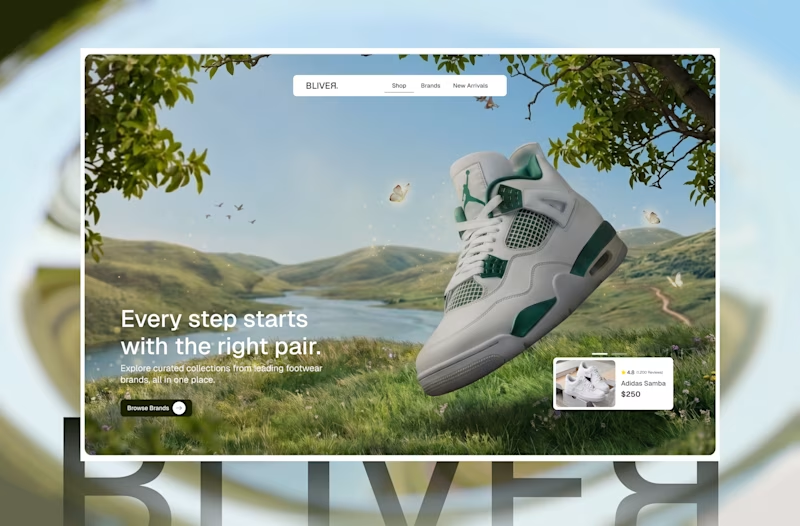
Working on A NEW PROJECT
So we are exploring the Hero Section, which of these will make you stay in the site and buy the product
- Static Hero
- Motion Hero

13 voted
34%
25 voted
66%
38 votes
Closed

For conversion, I'd vote static



congratulations








Trending

Claude
Claude has entered the design space. How are you using Claude Design?

Contra University
Learn from expert creatives how to earn more using next-gen AI tools.
fifaworldcup2026
The World Cup is here and the whole world's watching. How are you designing for the world stage?
creativeaiflow
Creative AI workflows are evolving. What tools do you use, and what are their strengths and weaknesses?
freelancerlife
Freelancer life is wins, pivots, and everything in between. What’s yours right now?