The network for creativity
Join 1.25M professional creatives like you
Connect with clients, get discovered, and run your business 100% commission-free
Creatives on Contra have earned over $150M and we are just getting started
Back to feedPost

Program Notes/Essay from a staged performance of T. S. Eliot's The Wasteland
T. S. Eliot’s The Waste Land portrays a poetic purgatory where life ebbs and flows between dream and nightmare. Through the poem’s cacophonous voices and shifting images, Eliot suggests that the only way out of such limbo is through—through learning to balance within the in-between, to forge the middle path as the Buddhists might say.
Life is paradox: opposition yields unity. Yet this unity—long sought by humanity—remains elusive. Throughout The Waste Land, Grail imagery recurs as a symbol of this perennial longing—for union with Self, with Other, with World. The Grail embodies the ineffable yearning we all feel for something we cannot fully name, yet endlessly pursue: unrequited love, artistic expression, material achievement, spiritual realization.
In this sense, the Grail represents utopian possibility—a remnant of a world we mourn, that may never have truly existed. Perfection cannot endure within the relative; without yearning there is no evolution, only stagnation.
It is precisely this tension between fragmentation and unity that gives The Waste Land its enduring power. The poem assembles a collage of voices, images and cultural allusions—discordant yet ultimately coherent. I do not claim to understand every allusion literally, despite years spent reading annotated and critical editions. Instead, I have always understood the poem psychophysically: through its rhythm, rhyme, sound, and structure. Like the poem itself, we all contain multitudes. The work of life is the attempt to weave said multitudes, the strands of being, into something resembling coherence.
The poem’s fragmented voices—echoing both the Eastern and Western canon—accelerate through its final movement, dissolving into something approaching gnosis. Eliot acutely describes such a realization in his later work Four Quartets:
Not known, because not looked for
But heard, half-heard, in the stillness
Between two waves of the sea.
Part of me would like to explain every allusion and motif—to provide a detailed map of Eliot’s poetic score. Yet focusing too closely on literal comprehension risks missing the larger point, particularly when the poem is performed aloud. The Waste Land is meant to be encountered holistically rather than merely decoded.
Perhaps hearing it tonight will inspire you to return to the text later and explore its labyrinth of references at your own pace. For now, I hope the experience resembles what I felt when first encountering the poem twenty-one years ago: something visceral rather than merely cerebral.
Eliot composed something akin to a sonata, weaving musicality throughout the poem’s lyric meter. In that spirit, tonight’s presentation includes musical interpolations—songs that comment upon, echo or extend the poem’s emotional landscape.
If shamanistic ceremony represents humanity’s earliest performance art, then performance today may be understood simply as a ritual we invite others to witness. So witness this poem as a kind of scored sound bath. Allow its rhythms and images to wash over you rather than rushing to catalogue them intellectually.
Call it transcendence, self-knowledge, God, or simply the impulse to create—these forces represent the regenerative Grail Eliot sought in the aftermath of World War I. In writing the poem, Eliot undertook his own Grail odyssey and discovered that beyond destruction, ennui, and the numbness of ordinary living, some possibility for renewal always remains.
The Waste Land is, in many ways, a dream play in poetic form. As one critic observed, the poem reflects “the inextricable tangle of the sordid and the beautiful that make up life.” Like dreams themselves, it need not make perfect sense to be resonant and illuminating.
For each time we wake from the swirl of dreams, we are reminded that even in the bleakest outer wasteland there still abides some inner Eden—or at least the possibility of one.
The network for creativity
Join 1.25M professional creatives like you
Connect with clients, get discovered, and run your business 100% commission-free
Creatives on Contra have earned over $150M and we are just getting started










Related posts

Who gets the spotlight when the lead doesn’t show?
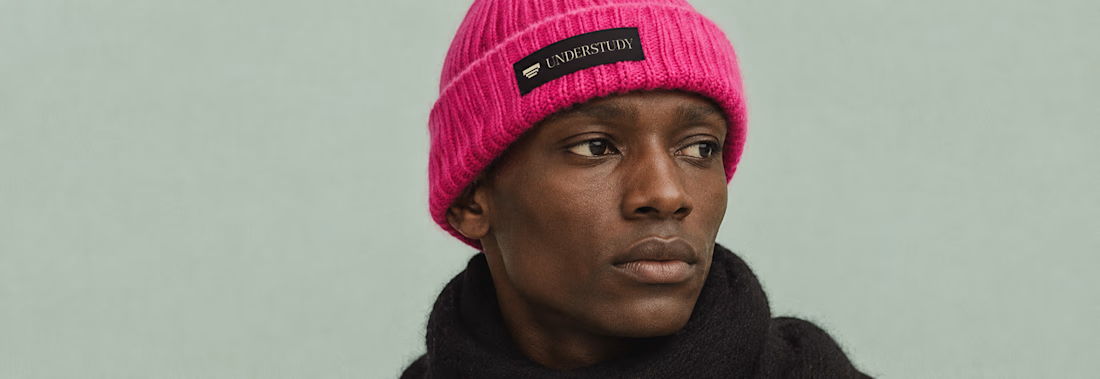
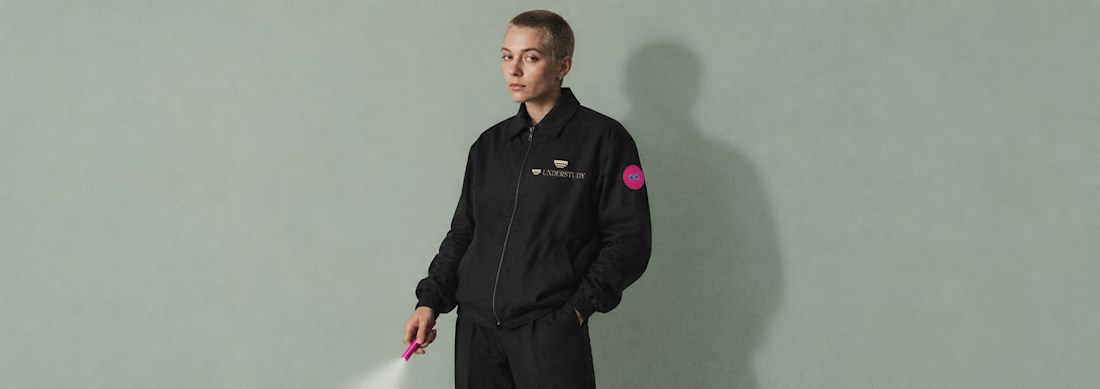
UNDERSTUDY is a theatre for the second cast, in hot pink Didone, pale sage and circles cut through faces.
Case study live soon.
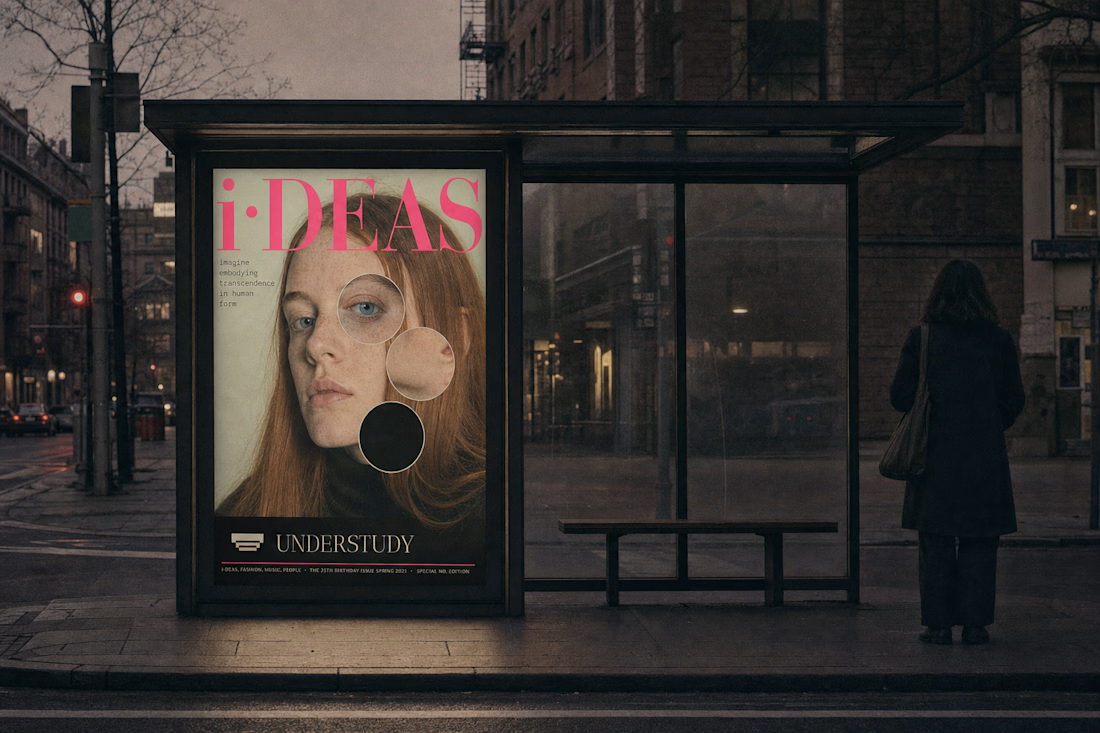

as a theatre BFA, i'm so fascinated by this concept & these visuals!

Stepping Through Art History to CapCut World LA 🎨✨ → 📍Audrey Irmas Pavilion
For the "Unexpected Arrival" theme, I wanted to blur the boundary between classic human artistry and next-gen AI filmmaking. Instead of a standard commute to Los Angeles, the journey pulls me directly through living, breathing masterpieces—from the swirling skies of Van Gogh’s The Starry Night and the crashing barrels of Hokusai’s The Great Wave, all the way to the iconic trapezoidal facade and barrel-vaulted ceiling of the Audrey Irmas Pavilion for CapCut World LA.
How I built it:
AI Generation & Continuity: Built as a connected 9-scene sequence using Seedance 2.5 inside CapCut, maintaining character consistency and fluid motion across completely distinct artistic styles and eras.
Editing & Polish in CapCut: Stitched and paced the transitions so each painting seamlessly morphs into the next dimension, combining keyframe camera momentum, color matching, and immersive sound design to make the final arrival in LA hit with maximum impact.
Why I built it:
Every era of art had its own medium—from oil on canvas and woodblock prints to digital timelines. AI and CapCut are the new canvas. I built this piece to celebrate how creative technology lets us step inside our wildest visual ideas and bring them to life in seconds.

Brilliant concept Pedro! 🎨 Stepping through Art History for an "Unexpected Arrival" is genius - blurring classic human artistry with next-gen AI filmmaking is such a powerful angle. Love the creative take on the journey to Audrey Irmas Pavilion instead of a standard commute. Can't wait to see the full piece!

This single line made me more than $30K in 4 projects in contra
This might be cringe if everyone writes this kind of stuff in their applications, but I hope everyone just takes inspiration and doesn't just copy and paste it
"Let me know your worth of time, I will make it worth it by my research before our meeting"