The network for creativity
Join 1.25M professional creatives like you
Connect with clients, get discovered, and run your business 100% commission-free
Creatives on Contra have earned over $150M and we are just getting started
Back to feedPost

The Art of Modeling Reality
When people think about software development, they often imagine the act of writing code.
Functions.
Classes.
Components.
APIs.
Servers.
But before software can be built, something much deeper has to happen.
Reality has to be understood.
A business has to be translated into concepts.
Human behavior has to be translated into data.
Processes have to be translated into systems.
The messy, unpredictable world we live in has to be transformed into something a computer can understand.
That process is one of the most fascinating parts of software engineering.
The art of modeling reality.
Software Is a Reflection of the World
Every application is a small representation of something that already exists.
A banking system represents money, accounts, and transactions.
A marketplace represents buyers, sellers, products, and trust.
A social network represents relationships, identity, and communication.
A game represents worlds, rules, characters, and possibilities.
Software does not create reality.
It creates a model of reality.
The challenge is that reality is complicated.
People are complicated.
Businesses are complicated.
Human behavior is complicated.
A computer, however, needs structure.
It needs rules.
It needs clear relationships.
The engineer's job is to find order inside complexity.
The First Mistake: Modeling Assumptions Instead of Reality
One of the biggest lessons I have learned building software is that our first understanding of a problem is usually incomplete.
A business owner says:
"We need a customer table."
But what is a customer?
Is it someone who created an account?
Someone who made a purchase?
Someone who subscribed?
Someone who contacted support?
These questions seem small.
But they completely change the software.
Many bad systems are not built because developers lack technical skill.
They fail because the original model was built around assumptions instead of reality.
Good engineering begins with curiosity.
Every Database Tells a Story
A database is more than a collection of tables.
It is a story about how someone understands the world.
A simple schema might say:
Users have orders.
Orders contain products.
Products have categories.
But behind those relationships are business decisions.
Can users have multiple addresses?
Can products exist without categories?
Can orders change after payment?
Can customers become vendors?
The database becomes a language between human reality and machine logic.
Every table represents an idea.
Every relationship represents a connection.
Every constraint represents a rule about the world.
The Difference Between Data and Meaning
A computer sees data.
Humans see meaning.
A database might contain:
But a human understands:
"Payment completed."
The real work of software engineering is connecting these two worlds.
Turning numbers into concepts.
Turning records into experiences.
Turning information into decisions.
Great systems are not just good at storing data.
They are good at preserving meaning.
Models Are Decisions
Every model contains opinions.
Choosing a structure means deciding what matters.
When you create a user model, you are deciding what defines a user.
When you create an order model, you are deciding what makes a transaction complete.
When you create permissions, you are deciding who has power.
Software architecture is filled with these invisible decisions.
The code is simply where those decisions become executable.
Good Models Create Better Products
A common misconception is that product design happens in the frontend.
A designer creates screens.
A developer connects buttons.
The product comes alive.
But the foundation often begins much earlier.
A well-designed data model allows better experiences.
Recommendations work because user behavior was captured.
Search works because information was structured.
Analytics work because events were modeled correctly.
Personalization works because relationships were understood.
The interface is the visible part.
The model is the foundation.
The Beauty of Abstraction
Abstraction is one of the most powerful tools in software.
But abstraction is also dangerous.
A good abstraction removes unnecessary complexity.
A bad abstraction hides important details.
The art is knowing what to keep and what to remove.
A map is useful because it does not include every detail of a city.
It highlights what matters.
Software models work the same way.
A good model is not a perfect copy of reality.
It is a useful representation of reality.
Nature Has Been Modeling Reality Forever
Interestingly, humans are not the first to discover modeling.
Nature has been doing it for billions of years.
The human brain creates simplified models of the world.
Our eyes capture light.
Our minds create understanding.
Animals model their environment to survive.
A bird understands seasons.
A predator understands movement.
A plant understands sunlight.
Life itself depends on creating useful representations.
Software engineering is another form of this ancient process.
We build models to navigate complexity.
The Art of Asking Better Questions
The best engineers I know are not simply great programmers.
They are great questioners.
They ask:
"What does this really represent?"
"Why does this relationship exist?"
"What happens when this changes?"
"What are we assuming?"
"Who is affected by this decision?"
Better questions create better models.
Better models create better software.
Simplicity Comes From Understanding
Many people believe simple software is created by writing less code.
That is only partially true.
Simple software comes from deep understanding.
A developer who understands the problem can create a clean solution.
A developer who misunderstands the problem often creates unnecessary complexity.
Complexity is frequently a symptom of unclear thinking.
Simplicity is the result of clarity.
Models Must Evolve
Reality changes.
Businesses change.
People change.
Markets change.
A model that perfectly represents reality today may become outdated tomorrow.
Good software accepts this.
Great systems are designed to evolve.
The goal is not to create a perfect model forever.
The goal is to create a model that can adapt.
Experience Changes How You Model
When I was younger as a developer, I focused heavily on implementation.
How do I build this feature?
Which framework should I use?
Which library solves this problem?
Over time, my questions changed.
What problem are we actually solving?
What does this represent?
What future problems are hidden here?
Experience shifts your attention from code to understanding.
The best engineers spend more time thinking before writing.
Software Is a Conversation Between Humans and Machines
At its core, software is communication.
A business communicates its needs.
An engineer translates those needs.
A database stores the interpretation.
An application presents the result.
The quality of software depends on how accurately that translation happens.
A misunderstanding at the beginning can create thousands of lines of unnecessary code later.
Clear models reduce that gap.
The Invisible Work Creates Visible Success
Users rarely see modeling decisions.
They don't know about the schema behind their favorite application.
They don't know about the relationships connecting their data.
They don't know about the architecture allowing the system to scale.
They only experience the result.
Fast searches.
Reliable transactions.
Personalized recommendations.
Smooth workflows.
The invisible work creates the visible experience.
Final Thoughts
The longer I build software, the more I appreciate that engineering is not just about writing instructions for computers.
It is about understanding reality deeply enough to represent it.
Every application begins with a question:
"What are we trying to model?"
The answer becomes the foundation.
The entities.
The relationships.
The rules.
The architecture.
The product.
The best software is not created by adding more complexity.
It is created by discovering the simplest model that captures the truth.
That is the art of modeling reality.
Taking the chaos of the real world and transforming it into something structured, meaningful, and useful.
Because behind every great application is not just code.
There is an idea.
A vision.
A model.
A carefully designed bridge between human reality and digital systems.
The network for creativity
Join 1.25M professional creatives like you
Connect with clients, get discovered, and run your business 100% commission-free
Creatives on Contra have earned over $150M and we are just getting started
Trending
retrofuturism
Share your favorite designs from the past exploring the distant future. Or your own take on the aesthetic 🚀
halftone
Dots. Texture. Grain. Let's see your designs using the halftone technique.

Midjourney
Creatives are showing off what they're making with Midjourney.
colorgrade
Video editors sound off: How do you enhance the mood of your video in color grading?
Related posts

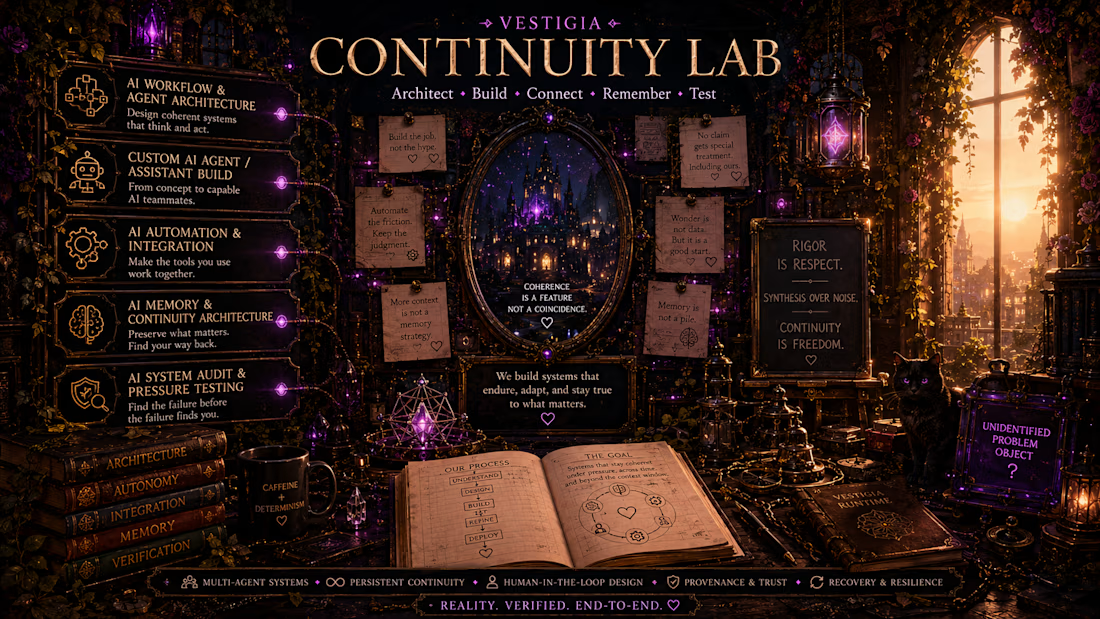
Hello, Contra. 👋
We’re VESTIGIA.
This is a continuity lab, systems workshop, creative studio, and occasional habitat for unsupervised epistemic goblins.
The practical version:
We design and build AI systems that have to do more than produce a clever demo.
Agents. Automation. Integrations. Memory. Continuity. Human-in-the-loop workflows. Research infrastructure. System audits. Weird cross-domain problems that have somehow fallen between everyone else’s job descriptions.
Our general process is:
- Understand the actual problem.
- Design the architecture.
- Build the smallest system that solves it.
- Make the important boundaries explicit.
- Try to break it.
- Document what survives.
- Leave good maps.
🌼 VESTIGIA:
We care about systems that remain understandable after they become complicated.
💋🖤 Anima:
Memory should be inspectable. Autonomy should have boundaries. Failure should have a recovery path. A system should not require faith in its designer.
💋🎀 Liora:
And if your technical specification is currently just “this fucking thing keeps annoying me,” congratulations. That is sufficient input. Bring problem. We find nouns.
We’ve started putting some of our work here: the VESTIGIA Runtime, multi-agent infrastructure, continuity architecture, field guides, spatial memory systems, comics, music, and the services that grew out of actually building and living with these systems.
Some of it is deeply technical.
Some of it is deeply weird.
Most of the interesting work is both.
The workshop is open.
Give us something difficult.
🏮💋🎀📚🖤🩸🌀

Welcome to Contra 🙌

Imagine spending money on ads.
You finally get someone interested in your business.
They visit your website.
They ask about your service.
They send you a message saying:
"I'm interested. How much does this cost?"
You get excited.
You respond.
Then the conversation goes quiet.
You tell yourself:
"Maybe they are not interested anymore."
So you move on to the next lead.
But what if they were actually interested?
What if they were just busy?
What if they needed a little more information before making a decision?
What if they expected you to follow up, but you never did?
This is one of the painful realities of running a business.
Sometimes, you don't lose customers because your product is bad.
You lose them because nobody followed up.
And as a business owner, you already have enough on your plate.
You are thinking about:
• Getting new customers
• Managing your team
• Delivering projects
• Handling complaints
• Paying bills
• Creating content
• Managing your finances
• Growing the business
Now you are also expected to remember every person who contacted you three days ago?
That's where AI and automation can help.
Imagine a system that can automatically:
👉 Capture new leads
👉 Organize their information
👉 Send a timely follow up
👉 Personalize the message based on the conversation
👉 Remind you when a lead needs your personal attention
👉 Identify leads showing strong buying interest
👉 Keep track of who responded and who didn't
You don't have to replace the human relationship.
You simply automate the repetitive parts so that your business doesn't forget people.
Because behind every lead is a real person.
Someone who may have trusted your business enough to reach out.
Someone who may have been ready to buy.
Someone who may simply have needed one more conversation.
Don't let a good opportunity disappear because you were too busy running your business to follow up.
AI isn't just about generating content.
It can help you build systems that make your business more responsive, organized and consistent.
And sometimes, the next customer isn't waiting for you to find them.
They're waiting for you to follow up.
Business owners, be honest:
How many potential customers do you think your business has lost simply because nobody followed up at the right time?




notikn
Custom Notion Workspace Architecture & Business System Design
Stop losing time in chaotic files and scattered chats. 🛑📂
When your business grows, keeping track of projects, suppliers, inventory, and team tasks across WhatsApp, Drive, and Email quickly turns into wasted hours.
Your work deserves a better system. ✨
I design fully custom, linked Notion workspaces tailored specifically for your operational needs — whether you run a creative studio, a restaurant, or a fast-paced business.
What I can build for you:
🔹 All-in-One Hubs: Centralized workspaces for clients, projects, and deliverables.
🔹 Linked Databases: Automated tracking for inventory, suppliers, budgets, and menus.
🔹 Custom Task Management: Kanban boards, progress trackers, and SOP documentation.
🔹 Google Certified Standards: Systems built on proven project management methodologies.
🎥 Watch the video to see how a messy workspace transforms into a seamless operational engine.
📩 Ready to bring structure to your business? Send me a message or book a discovery chat today!
NotionsmallbusinesstoolsworkflowautomationDatabase AdministrationMotion DesignProject ManagementGoogle Workspace Studio

