The network for creativity
Join 1.25M professional creatives like you
Connect with clients, get discovered, and run your business 100% commission-free
Creatives on Contra have earned over $150M and we are just getting started

The network for creativity
Join 1.25M professional creatives like you
Connect with clients, get discovered, and run your business 100% commission-free
Creatives on Contra have earned over $150M and we are just getting started


Related posts


This is a quick look at how an MCP workflow handles a request from start to finish.
When a prompt comes in, the MCP host and client check the server for available tools and pass those options along to the LLM.
Once the model picks the right tool for the job, the client runs the call across your code repo, database, or API, pulls in the context, and sends it back so the LLM can generate the final output.
It makes connecting an AI model to multiple tools much simpler than setting up separate custom integrations for each one.

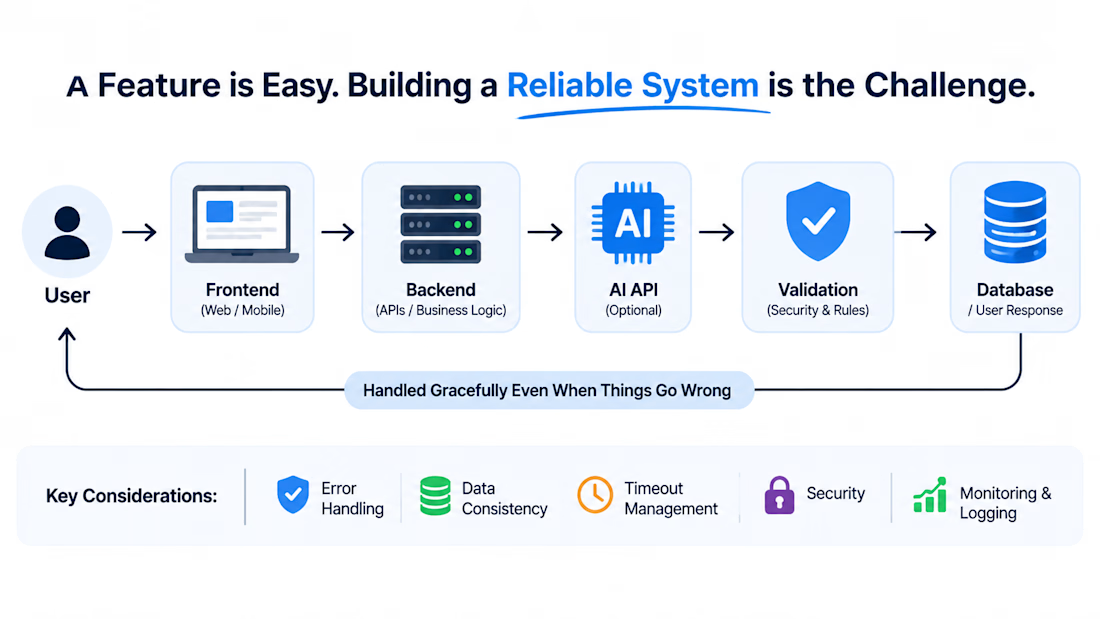
Adding AI to an application is relatively easy.
Making that AI feature reliable enough for real users is a different challenge.
When integrating AI into a web application, I think developers need to consider more than just the API call.
There are several important questions:
→ What happens when the model returns an unexpected response?
→ How do we handle timeouts and failed requests?
→ How do we protect sensitive user information?
→ Can users review or correct AI-generated results?
→ How do we monitor usage, cost and response quality?
An AI feature should fit naturally into the existing application architecture.
It needs proper backend validation, error handling, security and a clear fallback when something goes wrong.
I've worked across web applications, APIs and AI integrations, and I believe the real engineering challenge is making these pieces work together reliably.
AI should improve the product, not make the application unpredictable.


Validating model output as untrusted input is the right frame, and it catches shape and rule violations. The gap is the plausible-but-wrong answer: it passes schema and business rules and still misleads, because the rule set only knows what someone already thought to encode....