The network for creativity
Join 1.25M professional creatives like you
Connect with clients, get discovered, and run your business 100% commission-free
Creatives on Contra have earned over $150M and we are just getting started
Back to feedPost
🚀 Day — Learning and Building GraphRAG from Scratch!
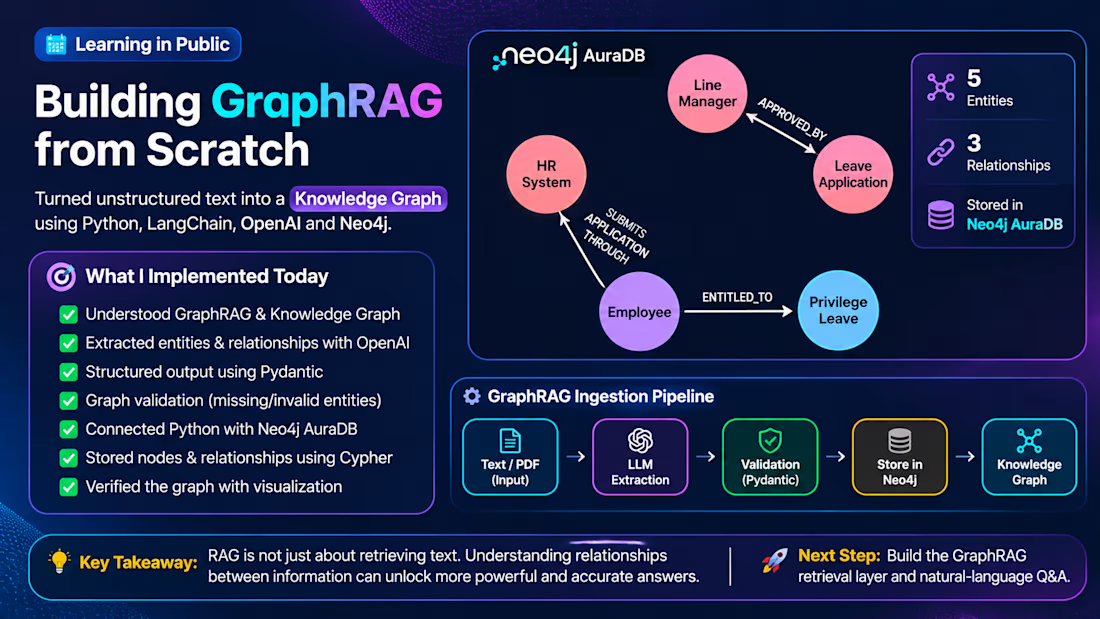
Today, I explored how GraphRAG works and implemented my first Knowledge Graph using Python, LangChain, OpenAI, and Neo4j.
Unlike traditional RAG, which primarily retrieves relevant text chunks, GraphRAG focuses on understanding entities and the relationships between them.
What I implemented today:
✅ Understood GraphRAG architecture and Knowledge Graph fundamentals.
✅ Created structured entity and relationship schemas using Pydantic.
✅ Used OpenAI's structured output to extract entities and relationships from text.
✅ Built graph validation to detect missing entities and invalid connections.
✅ Connected Python with Neo4j AuraDB.
✅ Stored entities and relationships in Neo4j using Cypher queries.
✅ Verified the complete graph through Neo4j visualization.
My first Knowledge Graph contains:
5 entities
3 relationships
Example:
Employee → ENTITLED_TO → Privilege Leave
Employee → SUBMITS_APPLICATION_THROUGH → HR System
Leave Application → APPROVED_BY → Line Manager
The biggest takeaway: RAG is not just about retrieving text. Understanding relationships between information can unlock more powerful ways to answer complex questions.
Next step: Building the GraphRAG retrieval layer and querying the knowledge graph using natural language.
Learning by building, testing, and understanding every step. 🚀
#GraphRAG #AgenticAI #RAG #GenerativeAI #Python #LangChain #Neo4j #AIEngineering #LearningInPublic


The network for creativity
Join 1.25M professional creatives like you
Connect with clients, get discovered, and run your business 100% commission-free
Creatives on Contra have earned over $150M and we are just getting started



Related posts

Built Diyar — a modern real estate platform designed to make property discovery simple, intuitive, and visually refined.
— Modern property listings
— Advanced search and filtering
— Detailed property pages
— Saved properties interface
— Agent and company sections
— Dark & light mode
— Fully responsive layouts
— Smooth animations and interactions
— SEO-focused front-end structure
Built with Next.js, React, TypeScript, and Tailwind CSS, using an AI-assisted workflow while keeping full control over the architecture, code, UI decisions, and final quality.
Diyar is presented as a front-end demo with sample property and company data. Backend, database, authentication, and live property management are not included.
Explore Diyar → https://diyar-real-estate1.vercel.app/



Catchy

A full-stack RAG application that answers questions from a team's own documents, with every answer cited to the source document and page. I designed, built, tested and deployed it end to end:
document ingestion with content-based file validation;
semantic search with PostgreSQL + pgvector;
streaming answers over Server-Sent Events, with server-side citation verification;
multi-tenant workspaces with role-based access;
usage metering with quotas and a cost dashboard;
a crash-safe PostgreSQL job queue.
Deployed as a public demo on free tiers (Vercel, Render, Supabase) with hard caps on AI spend.
Citations verified against the retrieved passages; unsupported answers return "not found"
Tenant isolation in every query; Supabase Data API locked down (verified on production)
Durable ingestion queue (SKIP LOCKED, leases, retries): kill -9 under load lost nothing
Costs reserved before every AI call; per-user, per-workspace and deployment-wide caps
Data-driven model migration (5 configurations evaluated; about 74% cheaper per answer)
1,099 backend + 393 frontend tests; load-tested; encrypted, restore-verified backups
https://knowledgepilot-ai-olive.vercel.app/


The reservation before the AI call is the detail most teams miss: you can add cost metering later, but you cannot un-spend the money after a runaway loop. On the crash-safe queue, with SKIP LOCKED plus leases, what happens to a lease held by a worker that is alive but stuck, do...

NEXUS is an AI-powered knowledge and workflow assistant that combines intelligent information retrieval, contextual AI assistance, and workflow automation into