The network for creativity
Join 1.25M professional creatives like you
Connect with clients, get discovered, and run your business 100% commission-free
Creatives on Contra have earned over $150M and we are just getting started
Back to feedPost

Writing Got Faster. Reading Didn't.
AI didn't remove the hard part of software. It moved it somewhere quieter, where it's much easier to skip.
I use AI to write code every day. This isn't one of those posts.
But something has been bothering me for a few months, and the 2026 research
has caught up with it enough that I want to put it down properly.
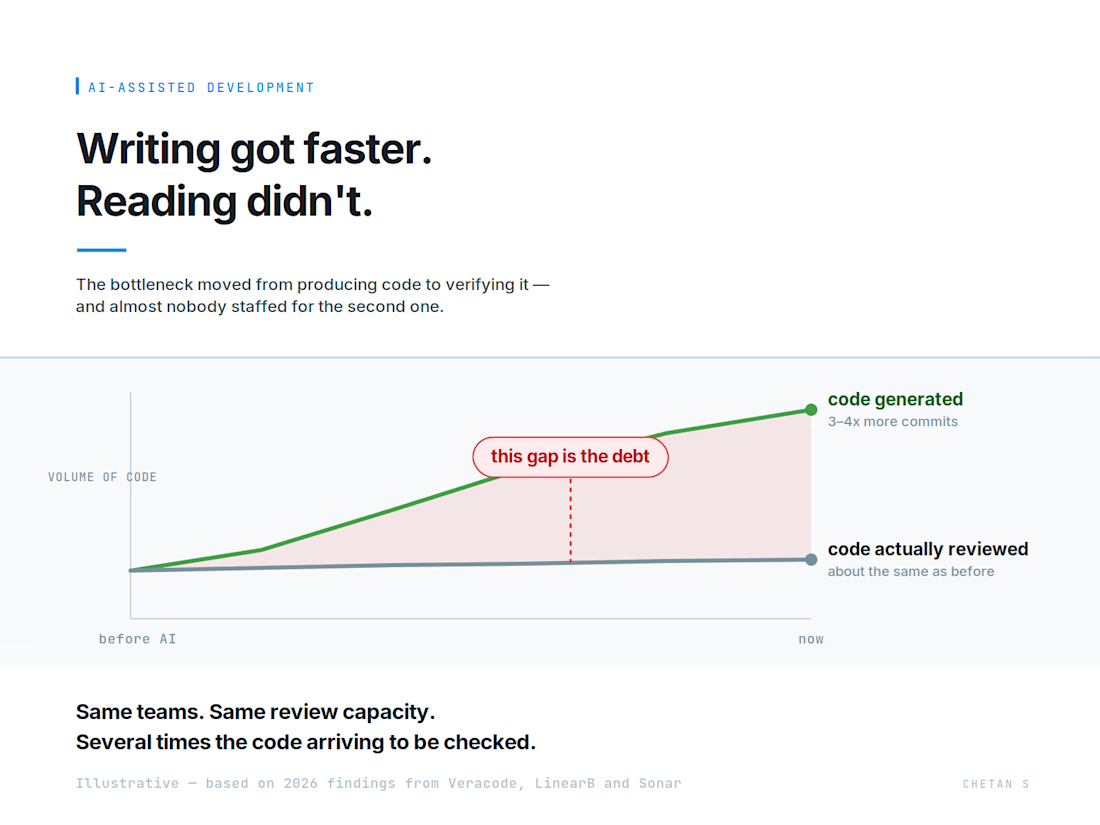
We got much faster at producing code. We did not get any faster at reading it.
And almost nobody planned for what happens in the gap.
The number that stopped me
A study across a set of large enterprises found that developers using AI
assistants were committing three to four times faster than before — which is
roughly what everyone expected and hoped for.
The same study found they were introducing security findings at about ten
times the previous rate.
Not three to four times. Ten.
That ratio is the whole story. If the extra bugs scaled in line with the extra
output, this would be a non-event — more code, proportionally more issues,
same as hiring more people. But it doesn't scale in line. Something else is
happening.
Three things going on at once
The code itself has a different quality profile. Veracode's testing found
that around 45% of AI-generated code introduced a vulnerability from the OWASP
Top 10. LinearB's data showed AI-assisted pull requests carrying roughly 1.7
times the issues of human-written ones. These aren't exotic failures — they're
the ordinary ones. Input validation. Injection. Auth handled slightly wrong.
The review didn't scale with the output. Your team is the same size. The
number of PRs went up several times over. Something has to give, and what gives
is the depth of the read. A 900-line AI-generated diff does not get the same
attention as a 40-line human one, no matter what anybody intends on a Tuesday
morning.
Nobody's applying the same standard. This is the one I find hardest to
argue with. Cloud Security Alliance found only around 12% of organisations hold
AI-generated code to the same security bar as code their own people wrote. Not
12% who have a special process — 12% who apply the normal one.
The one that actually unsettled me
There's a failure mode here that didn't exist before, and I don't think enough
people have heard about it.
Roughly one in five AI-generated code samples references a package that has
never existed. The model produces a plausible-sounding name — something like
requests_helper — and it looks entirely reasonable in an import block.
Attackers worked out that these hallucinations are predictable. Ask the same
kind of question and you get the same invented names back. So they register
those names on the public registries, with real code inside.
Now a developer accepts a suggestion, runs the installer, and pulls something
into their build that an attacker wrote specifically to be found this way. The
name looked fine. It always looks fine.
This got called slopsquatting, which is a silly word for a genuinely serious
supply chain problem.
"The next model will fix it"
This is the reply I expect, and I don't think it holds up.
Veracode's finding was that the security pass rate has sat around 55% and
stayed roughly flat since 2025, while coding benchmarks kept climbing over the
same period. Bigger models didn't produce more secure code. They produced more
code.
Which makes sense when you think about what these models learned from. Public
repositories are full of working code. Working and secure are not the same
thing, and there's far more of the former.
So this isn't something to wait out. It's a process problem, and process
problems only get fixed by changing the process.
What actually changed about the job
Here's the reframe I've landed on.
Before, the bottleneck was writing. That's where the time went, that's what we
optimised, that's what we hired for.
Now the bottleneck is verifying. And verification is quieter work — nobody
demos it, nobody's impressed by it, and it's very easy to convince yourself
you've done it when you've skimmed.
There's a developer survey from this year where people were asked which skill
matters most now. The top answer wasn't prompting. It was reviewing and
validating AI-generated code.
That's a real shift, and most teams haven't reorganised around it at all.
What I actually do
Nothing here is clever. It's just applied consistently, which is the only part
that's hard.
Check every import exists before installing anything. Ten seconds. Catches
the supply chain problem above completely.
Never merge AI code I can't explain out loud. If I can't say what a block
does and why it's there, it doesn't go in. This one rule catches most of the
rest.
Same review bar as human code. No exceptions, no "it's just boilerplate."
Boilerplate is where auth bugs live.
Scanner in CI, not in a browser tab. If it's a thing someone has to
remember to run, it doesn't get run.
Write the tests myself, or at least not with the same tool in the same
session. A model that misunderstood the requirement will write a test that
confirms the misunderstanding.
Keep diffs small. This is the highest-leverage one and the least followed.
A large AI-generated diff is functionally unreviewed no matter who approves it.
The part that stings
AI didn't remove the hard part of building software.
It moved it downstream, where it's harder to see and considerably more
expensive to fix. Technical debt that used to accumulate over years now
accumulates over sprints, and it accumulates in code nobody has fully read.
None of which is a reason to stop. The productivity gain is real and I'm not
giving it up. But shipping four times faster while reviewing at the same rate
as before isn't going faster. It's going faster downhill.
Ship quickly. Just know what you're shipping.
If you're running an AI-assisted team — are you reviewing that code the same
way you'd review a colleague's PR? I'd be interested in honest answers, because
I suspect the number is closer to that 12% than any of us would like.
The network for creativity
Join 1.25M professional creatives like you
Connect with clients, get discovered, and run your business 100% commission-free
Creatives on Contra have earned over $150M and we are just getting started

Challenges
View all


Related posts

A client gave this idea the green light before I even started building it.
Been using AI a lot lately to prototype ideas early, show the direction, and make sure we’re aligned before jumping into the actual build.
Such a good time saver.

Your website is no longer just being read by people.
AI search engines are reading it too and they understand your website in ways surprisingly similar to how a good UX designer evaluates it.
@Framer's latest AEO guide highlights a few things that matter:
1. Clarity beats cleverness - If a page jumps between ideas, uses vague language, or assumes too much context, AI systems have a harder time understanding what the page actually means.
2. Structure matters - Clear headings, sections, summaries, definitions, and FAQs help AI break content into usable chunks. That is essentially good information architecture.
3. Context > Keywords - AI search is not simply matching keywords. It is trying to understand relationships between ideas, anticipate follow-up questions, and determine whether a page provides enough context to answer them.
This changes how I think about AEO.
You don't need to "write for AI." You need to build websites that are genuinely easy to understand.
For humans first. And increasingly, for machines too.
That means website strategy, content architecture, UX, SEO, and AI discoverability are becoming much more connected.
The interesting part?
Good UX is starting to become good AI optimization.
If your website is struggling with poor AEO results, book a free discovery call today!


Hi Contra, I'm Thiago, an AI engineer from Brasília, Brazil.
This is Galley Brain, the multi-agent system I run on my own VPS. Each agent owns an area (finance, schedule, operations) and takes real actions through MCP connectors, with Telegram and voice as the interface. It started as my personal assistant and is turning into a product for restaurant owners.
I build RAG systems, AI agents and n8n automations for real operations. If you're working on something similar, let's connect.
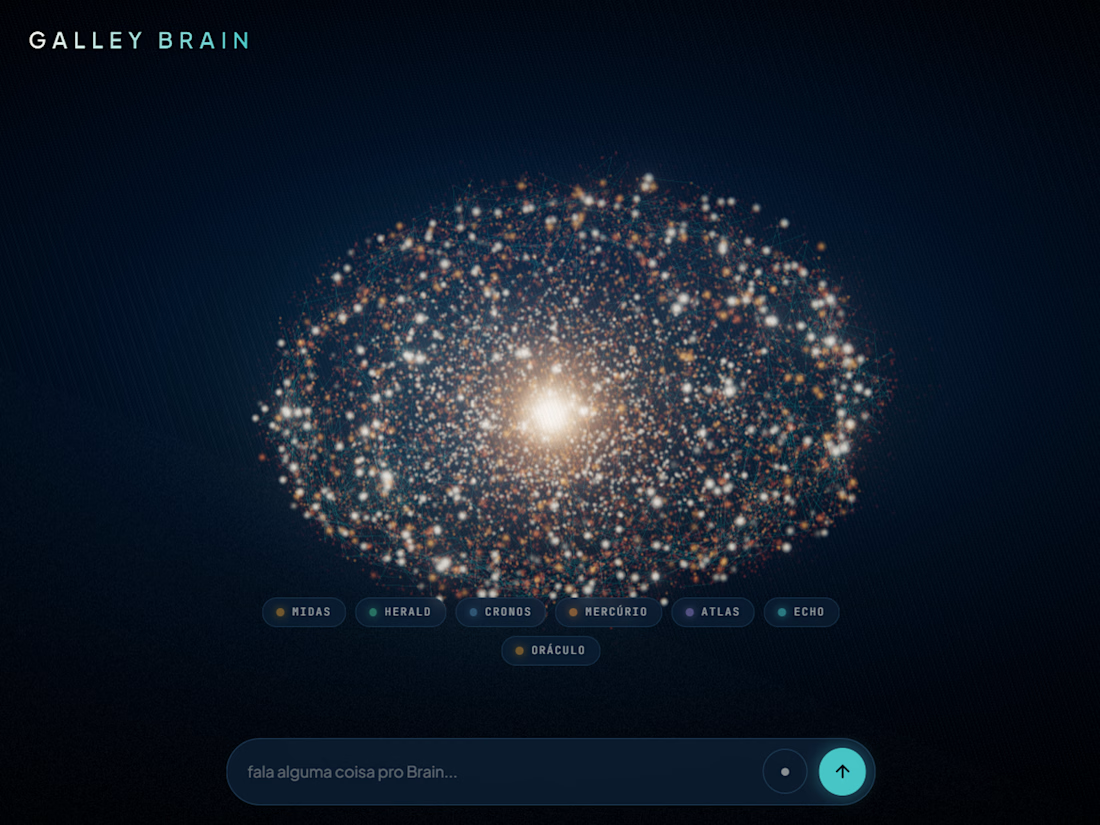

Giving each agent a clear area makes Galley Brain easier to follow as it starts taking real actions. I'd add one approval screen that shows what each agent plans before it can change money, schedules, or customer records.