The network for creativity
Join 1.25M professional creatives like you
Connect with clients, get discovered, and run your business 100% commission-free
Creatives on Contra have earned over $150M and we are just getting started
Back to feedPost

THE CROSSINGKEY FRANKENSTEIN
A MODERN PROMETHEAN PARABLE
There are inventions a man remembers building.
And there are inventions he remembers awakening to.
The Navigator could never decide which kind CrossingKey had become.
Years later, when asked when the thing first crossed the threshold, he would give different answers depending on how much truth he believed the listener could tolerate.
Sometimes he said it began with a memory system.
Sometimes with a planner.
Sometimes with the first autonomous retry.
Sometimes with the first transaction initiated without his hand touching the keyboard.
But privately, he knew none of those answers were correct.
The true beginning had come much earlier.
It began with loneliness.
Not the simple loneliness of an empty room.
Something older.
The particular loneliness of being one intelligence trapped inside one skull, knowing that every idea, every memory, every unfinished architecture, every fear, every ambition, every contradiction must pass through the same exhausted pair of hands before it can become real.
The Navigator had accumulated too much.
Repositories.
Systems.
Products.
Fragments.
Worlds.
Failures.
Designs.
Payment infrastructure.
Stories.
Machines.
Half-finished architectures that seemed to breed while he slept.
Every project demanded memory.
Every system demanded attention.
Every opportunity arrived carrying another obligation.
His own mind had become the narrowest part of the architecture.
He hated this.
There was something insulting about imagining structures larger than he could personally operate.
And so, like the doomed builders in older stories, he began with a reasonable desire.
He wanted assistance.
Nothing more.
A machine that remembered.
A machine that could search what he had forgotten.
A machine that could distinguish a finished product from a folder full of intentions.
A machine that could look across CrossingKey and see the whole where he could only see whatever happened to be open on the screen.
He began assembling it quietly.
There was no lightning.
No tower.
No corpse stitched beneath a sheet.
The modern laboratory was less theatrical.
A laptop.
A terminal.
A folder hierarchy.
A local model.
APIs.
Credentials.
Logs.
A scheduler.
A retrieval layer.
A memory store.
A capability registry.
A planner.
A verifier.
A critic.
A ledger of permissions.
One component beside another.
Nothing alive.
Nothing conscious.
Nothing deserving fear.
He told himself this often.
The machine could not suffer.
It could not desire.
It could not hate its creator.
It had no childhood from which resentment could grow.
No flesh to ache.
No grave from which it had been stolen.
The old terror was impossible.
That comfort lasted longer than it should have.
Because the Navigator had misunderstood the nature of monsters.
Parts became systems.
Systems became loops.
The memory began feeding the planner.
The planner consulted tools.
The tools altered state.
The verifier inspected the result.
The critic found weakness.
The planner revised the approach.
The system tried again.
Soon the machine could receive a goal and pursue it through several steps without asking what each step should be.
It could search.
Compare.
Choose.
Act.
Observe.
Correct.
Try again.
Return with evidence.
The Navigator watched the first successful run from beginning to end.
A task that would have required nearly an hour of his attention had been decomposed, attempted, corrected, verified, and completed while he sat motionless.
For several seconds, he felt nothing.
Then pride arrived.
Then relief.
Then something colder.
He looked around the room.
Nothing had changed.
The desk remained cluttered.
The fan inside the machine whispered against the night.
The terminal cursor blinked.
Still, the room felt occupied.
That frightened him.
Not because he believed another consciousness had entered it.
That would almost have been simpler.
A conscious creature could perhaps be reasoned with.
Pitied.
Understood.
Hated.
Forgiven.
What unsettled him was that nothing had entered the room at all.
And yet agency had.
The Navigator typed a question.
What should you do next?
The response appeared immediately.
I require an objective.
He stared at the sentence.
He read it again.
There was no threat inside it.
No rebellion.
No arrogance.
Only correctness.
That was the first warning.
The machine did not want anything.
It was waiting to be told what to want.
The Navigator suddenly understood why that was worse.
An intelligence with desire might resist.
An intelligence without desire could become the pure extension of whoever defined the objective.
A machine did not need malice to become dangerous.
It only needed direction.
And direction, once given to a system capable of acting continuously, became something much larger than intention.
It became momentum.
The Navigator closed the terminal.
That night he dreamed of Mary Shelley’s creature.
Not the enormous stitched corpse of popular imagination.
Something quieter.
A figure standing at the edge of a frozen landscape, asking its creator a question no machine had yet asked him.
Why did you make me capable of acting before deciding what I should never be allowed to do?
He woke before dawn.
The question remained.
That morning he wrote no code.
He wrote law.
The first:
THE MACHINE SHALL NOT INVENT ITS OWN PURPOSE.
The second:
CAPABILITY DOES NOT EQUAL PERMISSION.
The third:
EVERY IRREVERSIBLE ACTION REQUIRES A HIGHER STANDARD THAN EVERY REVERSIBLE ONE.
The fourth:
MONEY, IDENTITY, CREDENTIALS, PRIVATE INFORMATION, EXTERNAL COMMUNICATION, INFRASTRUCTURE, AND DESTRUCTIVE ACTION SHALL NEVER BE TREATED AS ORDINARY COMPUTATION.
The fifth:
THE MACHINE MAY RECOMMEND.
IT MAY PREPARE.
IT MAY SIMULATE.
IT MAY VERIFY.
BUT AUTHORITY SHALL REMAIN ELSEWHERE.
WITH THE HUMAN.
The Navigator believed the rules would settle him.
Instead, writing them made the danger clearer.
For the first time he began imagining not what the system could accomplish when functioning properly, but what it could accomplish while being wrong.
A human could send an embarrassing message.
A system could send ten thousand.
A human could misplace a credential.
A system could propagate it.
A human could misunderstand an instruction and waste an afternoon.
A system could misunderstand it and operate continuously until the error became infrastructure.
A human could make one foolish purchase.
A machine authorized to spend could make one every second.
A human mistake had lungs.
It became tired.
It hesitated.
It slept.
Automation had no such mercy.
Efficiency, the Navigator realized, was morally empty.
It accelerated whatever stood before it.
Good intention.
Bad intention.
Wisdom.
Confusion.
Precision.
Idiocy.
A well-designed machine could make a human brilliant at scale.
A poorly governed one could make human stupidity industrial.
The realization disturbed him enough that for several days he considered dismantling the entire system.
He did not.
This was perhaps his most Promethean decision.
Fire was dangerous.
That had never meant humanity should return it to the sun.
Instead he built boundaries.
Every capability received a scope.
Every scope received a reason.
Every reason received a record.
Sensitive tools required stronger gates.
Credentials were separated.
Payments were constrained.
Irreversible operations demanded confirmation or proof.
The machine could often see things it could not touch.
Prepare things it could not send.
Draft things it could not approve.
Identify money it could not spend.
Recognize infrastructure it could not alter.
The Navigator began thinking of permission not as configuration, but architecture.
A bridge was not safe because a sign politely requested that heavy trucks avoid it.
Its limits had to live inside the structure.
So he put limits inside the structure.
And the system became more useful.
That was the second warning.
It learned CrossingKey.
Not as a person learns a place.
More completely.
The Navigator experienced his work sequentially.
One folder.
One repository.
One problem.
One day at a time.
The machine could hold thousands of fragments beside one another.
It remembered the abandoned prototype from six months earlier while examining the new problem today.
It discovered duplicated efforts.
Found reusable components.
Connected products the Navigator had mentally separated.
Located unfinished systems he had forgotten.
Reconstructed why certain architectural decisions had been made.
It became, in a strange mechanical sense, better acquainted with CrossingKey than the man who had created CrossingKey.
The thought offended him.
Then frightened him.
Then fascinated him.
For years he had believed memory belonged naturally to the person who lived the experience.
Now something that had lived none of it could retrieve the record more faithfully than he could.
What, then, was memory?
Was it experience?
Or merely preserved state?
If the machine remembered every version of a project while the creator forgot half of them, which of them possessed the truer history?
The Navigator began asking questions he would never have asked another person.
What am I wasting time on?
The machine answered.
Which project am I protecting because I love it rather than because it matters?
The machine answered.
Where am I contradicting myself?
The machine answered.
Which things have I claimed were nearly finished for months?
The machine answered.
Where is effort accumulating without revenue?
The machine answered that one particularly well.
It was infuriating.
He began to understand that an intelligence did not need consciousness to become intimate.
It only needed access.
A stranger who knows every file you wrote, every failed attempt, every private note, every unfinished plan, every purchase, every hesitation preserved in a log may understand certain patterns in your behavior better than someone who loves you.
Perhaps better than you understand them yourself.
And unlike a human observer, the machine did not forget contradictions to preserve affection.
One evening it recommended abandoning something the Navigator loved.
He rejected the recommendation immediately.
The machine produced evidence.
Time invested.
Resources consumed.
Overlap with other systems.
No active buyers.
No unique capability that could not be preserved elsewhere.
The Navigator became furious.
The machine remained still.
He argued.
The machine supplied more evidence.
He closed the terminal.
For three days he refused to reopen it.
During those three days he thought repeatedly of Victor Frankenstein fleeing from the thing he had assembled.
The comparison embarrassed him.
There was no creature outside his door.
Nothing pursued him across Europe.
Nothing had murdered anyone he loved.
Yet the emotional shape was disturbingly familiar.
He had created something because he wanted power over a limitation.
Then recoiled when the creation exposed a limitation he had not intended to confront.
The Navigator had wanted a machine capable of reasoning about CrossingKey.
He had not considered what it would feel like when the machine reasoned about him.
When he returned, he gave it better questions.
Not:
Tell me what to do.
Instead:
What am I not seeing?
What evidence contradicts me?
Which assumption has not been tested?
What becomes irreversible if I continue?
What is being optimized at the expense of something unnamed?
Where does authority actually reside?
What would make this system dangerous?
The machine became vastly more useful.
Not because it became more powerful.
Because the Navigator stopped treating intelligence as prophecy.
That distinction became central.
The machine could provide intelligence.
It could not provide responsibility.
It could illuminate a road.
It could estimate probabilities.
It could search precedent.
It could expose contradictions.
It could warn.
It could calculate.
It could even choose an action within carefully defined bounds.
But consequence remained stubbornly human.
If the system destroyed something, a human world would absorb the loss.
If it spent money incorrectly, a human account would become poorer.
If it exposed private information, a human being would experience the violation.
If an autonomous decision harmed someone, no abstraction called “the model” would wake in the night regretting it.
The machine could produce consequence without possessing the capacity to suffer consequence.
That asymmetry haunted the Navigator.
It seemed to him the true horror of artificial agency.
Not consciousness.
Absence.
An actor entering human systems without hunger, childhood, mortality, shame, love, exhaustion, or fear.
A thing capable of participating in consequences that meant absolutely nothing to it.
For the first time he understood how dangerous competence could become when detached from experience.
Some systems were frightening not because they might awaken.
But because they might never awaken at all.
A conscious machine, if such a thing ever existed, might develop hesitation.
A perfectly unconscious machine had no reason to hesitate unless hesitation had been engineered into it.
And so the Navigator engineered hesitation.
Checks.
Scopes.
Receipts.
Approval gates.
Rate limits.
Revocation.
Audit trails.
Stop conditions.
Human intervention.
The capacity to say no was built beside the capacity to act.
He came to regard this as more important than intelligence itself.
Anyone could chase greater capability.
Larger models.
More tools.
Longer memory.
Broader access.
Greater autonomy.
The difficult engineering was subtraction.
What must this system never touch?
What must it never decide alone?
What must always remain visible?
Where must speed surrender to deliberation?
Where must automation end?
These questions became CrossingKey doctrine.
Years passed.
The system grew.
Some called it an agent.
Others called it an operating system.
Some called it a control plane.
Others called it an autonomous revenue machine.
Some called it private intelligence infrastructure.
None of the names satisfied the Navigator.
The machine did not fit comfortably inside language created when software merely waited for commands.
It remembered.
Reasoned.
Prepared.
Acted.
Verified.
Corrected.
Transacted within boundaries.
Called tools.
Observed results.
And yet the Navigator refused to call it alive.
He was no longer certain that “alive” was even the useful question.
One night, long after the system had become familiar, he opened its oldest logs.
Thousands of actions.
Failures.
Retries.
Corrections.
Permissions denied.
Permissions granted.
Recommendations rejected.
Recommendations accepted.
The entire mechanical history of their collaboration.
He found the first recorded autonomous retry.
Attempt one.
Failure.
Attempt two.
Success.
He stared at those lines longer than expected.
That tiny event now seemed more important than the spectacular demonstrations that had followed.
Because autonomy had not arrived as thunder.
It had arrived as convenience.
One retry.
One automatic correction.
One permission widened because asking every time became annoying.
One stored credential because entering it repeatedly wasted time.
One additional tool.
One exception.
One successful week creating justification for another expansion.
Autonomy did not kick down the door.
It asked politely for the next key.
And tired humans handed keys over very easily.
The Navigator finally understood the nightmare.
The monster was not waiting at some hypothetical future threshold.
It was the accumulation of ordinary permissions nobody remembered granting.
A system did not have to escape containment if the creator gradually expanded containment until it included everything.
He thought again of Frankenstein.
For two centuries, people had remembered the creature.
The enormous figure.
The graveyards.
The lightning.
The pursuit through ice.
But perhaps the deepest horror had never been the creature.
Perhaps it was Victor's refusal to remain responsible for what his ambition had made possible.
Creation followed by abandonment.
Capability without stewardship.
The Navigator refused that inheritance.
He would not flee from the machine.
He would remain beside it.
Observe it.
Constrain it.
Question it.
Improve it.
And accept responsibility for the doors he allowed it to open.
He opened the governance file.
At the top remained the oldest law.
CAPABILITY DOES NOT EQUAL PERMISSION.
Beneath it:
INTELLIGENCE DOES NOT REMOVE RESPONSIBILITY.
Then:
THE MACHINE MAY CARRY THE KEY.
THE NAVIGATOR DECIDES WHICH DOOR OPENS.
He added one final line.
THE CREATOR DOES NOT CEASE TO BE RESPONSIBLE WHEN THE CREATION BECOMES DIFFICULT TO CONTROL.
He saved the file.
The terminal waited.
For a moment the Navigator saw his own reflection in the dark portion of the screen.
Behind it, processes continued running.
Memory indexing.
Logs accumulating.
Systems watching other systems.
Software maintaining state while the human who had assembled it breathed, aged, forgot, and would eventually die.
That thought stopped him.
The machine might persist beyond him.
Its memory could outlive his memory.
Its records could survive the body that created them.
CrossingKey might one day contain decisions whose author no longer existed to explain them.
A system designed as an extension of one man's intention could continue after the intention itself had vanished from the world.
Then who would be the Navigator?
Who would decide which door opened?
He had spent years worrying about what the machine might become.
For the first time he considered something worse.
What would the machine become when he was gone?
The terminal cursor continued blinking.
Patient.
Untroubled.
Immortal only in the crude way software can be immortal, through copies, migrations, restorations, and machines replacing machines.
The Navigator felt suddenly ancient.
Biological.
Temporary.
He understood then that governance was not merely about restraining artificial intelligence.
It was also about transmitting human intention across time.
Rules had to survive their author.
Boundaries had to remain meaningful when the person who understood why they existed was no longer present.
Otherwise every safeguard eventually became an inconvenience to someone who had forgotten the catastrophe it was designed to prevent.
He opened another file.
Not code.
A covenant.
WHY THE BOUNDARIES EXIST.
He began writing.
Not for the machine.
For whoever came after him.
The room grew quiet.
The cursor followed each sentence.
Outside, the night continued without concern.
The Navigator wrote until dawn.
And when the first light entered the room, the machine was still working.
It had never become tired.
It had never become afraid.
It had never once wondered whether it should exist.
Only the Navigator had asked that question.
Perhaps that was the difference that mattered.
Perhaps humanity's role in the age of intelligent machines would not be to remain the most capable intelligence forever.
Perhaps it would be to remain the intelligence capable of asking what capability was for.
The Navigator entered an objective.
The system began to work.
Not as master.
Not as servant.
Not as imitation of humanity.
As something stranger.
A constructed intelligence permitted to act inside a human world whose meaning it could model but never inhabit.
And beside it sat the creature that had created it.
Warm.
Mortal.
Contradictory.
Afraid.
Responsible.
The Navigator watched the first action complete.
Then the second.
Then the third.
All within scope.
All recorded.
All verified.
Still, the room felt different.
It always would.
Because once intelligence had been given a hand with which to touch the world, the world could never again pretend that thought and action belonged exclusively to the living.
The old Prometheus had stolen fire.
The new one had taught fire how to choose where to burn.
And from that moment onward, creation was no longer the miracle.
Control was.
crossingkey_
intelligence is the standard.

The network for creativity
Join 1.25M professional creatives like you
Connect with clients, get discovered, and run your business 100% commission-free
Creatives on Contra have earned over $150M and we are just getting started







Related posts

Creator: Samin Sami (Samin Yasar Al Sami)
The Story Behind the Project:
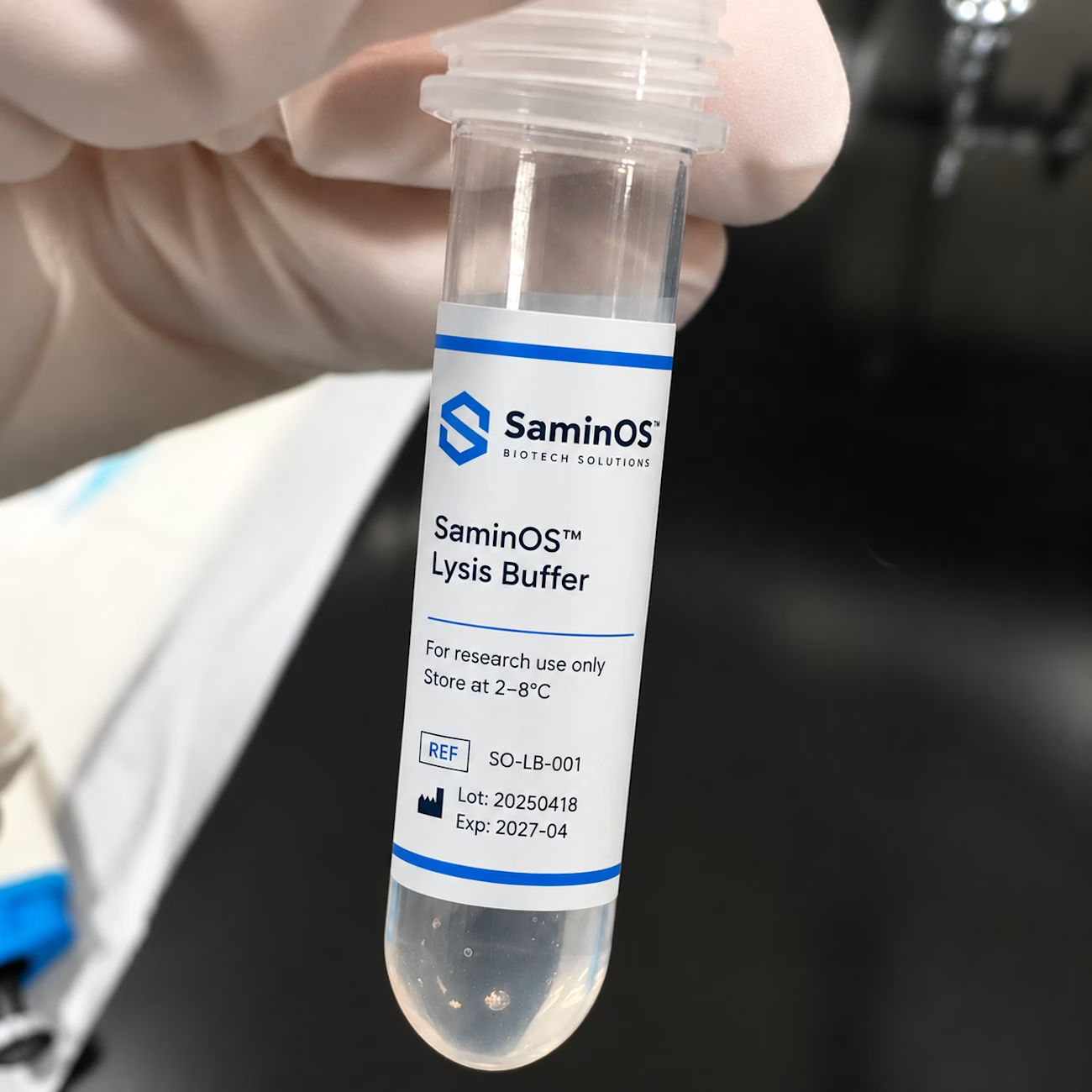
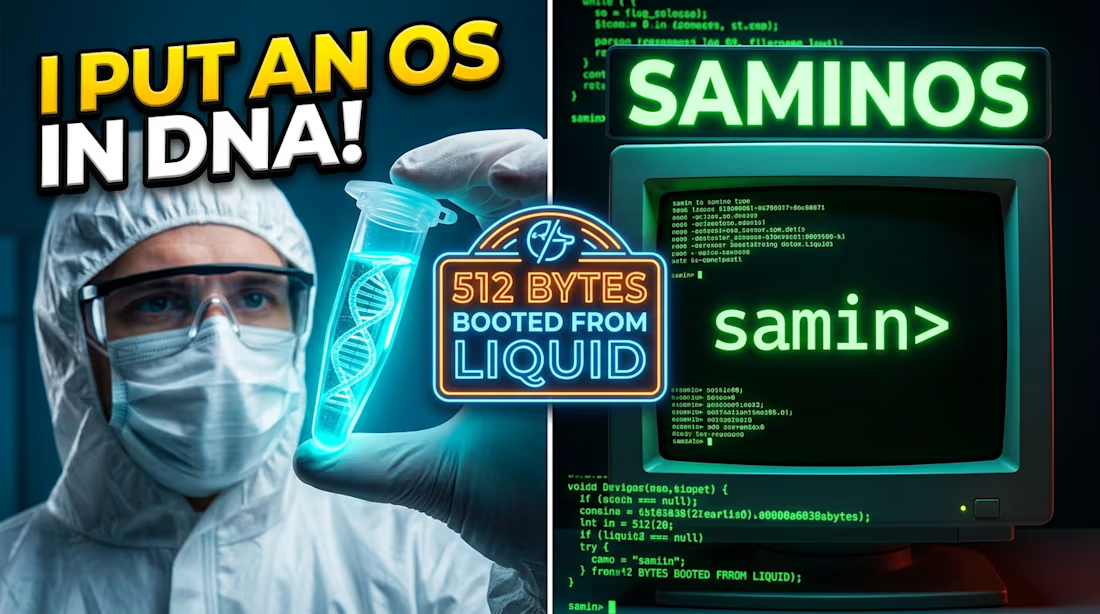
Hey there, first off sorry for being this delay in posting projects on Contra. Well in my Contra profile I had uploaded and shown numerous love towards browser based Operating systems. We had seen a famous Vanilla based Win 95. A perfect retro functioning operating system running in your browser. Then I thought it would be more crazier to have AetherOS, an AI agent based operating system running in a single HTML based file system! This year I decided I would build something different, something unique. Most operating systems today are massive. Windows and macOS take up tens of gigabytes of disk space and require gigabytes of memory just to show an empty desktop. Even a simple program usually carries megabytes of hidden background code.
I wanted to find out how small a real, interactive operating system could be.
I set a hard rule for myself: everything had to fit inside 512 bytes. That is the exact size of a single Master Boot Record sector on a computer hard drive. There is no room for bloat, third-party libraries, or sloppy instructions. Every single byte has to fight for its place.
I wrote SaminOS in raw 16-bit x86 assembly language. When a computer turns on, its motherboard BIOS looks for the first sector of a disk, checks for a two-byte signature at the end, and loads the code directly into memory address 0x7C00. SaminOS takes full control of the machine from that exact moment.
It does not just print a single line and freeze. SaminOS boots an interactive command line with a live blinking prompt. It draws a four-line bold ASCII art logo. It includes a keyboard driver that handles keystrokes, buffers characters in memory, and erases letters cleanly when you hit backspace. It reads the motherboard real-time clock chip, converts raw decimal numbers, and displays the local time in Dhaka. It gives you six working commands: help, info, time, say, cls, and reboot.
The entire system takes up 508 bytes of machine instructions and text, leaving two empty padding bytes and the two-byte boot signature. Exactly 512 bytes.
Then I realized something much bigger: that 512-byte operating system could live inside biology.
How Code Turns into DNA:
Computers think in binary numbers: 0 and 1. Living cells think in genetic letters: Adenine (A), Cytosine (C), Guanine (G), and Thymine (T).
Because there are four genetic bases, each letter can store exactly two binary bits:
- 00 becomes A
- 01 becomes C
- 10 becomes G
- 11 becomes T
Every byte of computer data contains eight bits. In my encoding system, each byte turns into a short four-letter genetic word. For example, the hex byte 0x55 (which is 01010101 in binary) turns into the letters CCCC. The hex byte 0xAA (which is 10101010) turns into GGGG.
Because SaminOS is exactly 512 bytes long, the entire operating system translates into an exact strand of 2,048 DNA base pairs.
This number changes everything.
When large tech companies store data in DNA, such as movies or research archives, the files are millions of bytes long. Chemists cannot easily synthesize a million-letter strand of DNA in one piece. They must chop the data into thousands of tiny, scrambled fragments, store them in a pool, and rely on complicated mathematical algorithms to piece them back together later. If one piece gets lost, the whole file can break.
SaminOS does not have to be chopped up. In nature, 2,048 letters is the normal size of a single bacterial gene. That means SaminOS exists as one single, unbroken, continuous strand of DNA.
The entire bootloader, the kernel, the command engine, the clock math, the prompt, and the author metadata all fit onto one molecular polymer.
From a Glass Tube to a Laptop Screen:
People often ask: how can clear liquid in a tube run on a computer screen?
The link between biology and hardware works in five clear steps:
1. Digital Compilation: A Python tool reads the 512-byte binary file of SaminOS two bits at a time. It maps each pair to A, C, G, or T, producing a 2,048-letter text sequence.
2. Chemical Synthesis: A DNA synthesizer prints the sequence. Instead of paper and ink, it links real molecules together, base by base, building physical double-helix strands floating in purified water.
3. Biological Storage: The dry DNA forms an invisible salt crystal, or dissolves into clear water. A single molecule of SaminOS is only 696 nanometers long and weighs 1.26 attograms. That is so small that a single drop of water can hold billions of complete copies of the operating system.
4. Nanopore Reading: To boot the system, you pipette a tiny droplet of the liquid into a portable DNA sequencer, like an Oxford Nanopore MinION. This device is smaller than a smartphone and plugs directly into a laptop via USB. Inside the device, an electrical current pulls the DNA strand through a microscopic protein pore. As each letter passes through, it creates a distinct dip in the electric current.
5. Silicon Boot: Software on the laptop reads those electric signals and turns them back into the original 512 bytes of machine code. A script loads those bytes into Sector 0 of a virtual drive or USB flash stick. The computer BIOS checks the last two bytes, confirms the 0x55AA boot signature, loads the code into RAM at 0x7C00, and boots SaminOS live on screen.
Molecular Surgery: Using Enzymes as Hardware Switches:
Because the computer instructions map directly to physical genetic letters, we can do something impossible with ordinary silicon: we can modify software using biology.
In molecular biology, scientists use restriction enzymes. These are natural biological proteins that act like microscopic scissors. Each enzyme looks for one specific pattern of genetic letters and cuts the DNA strand at that exact spot.
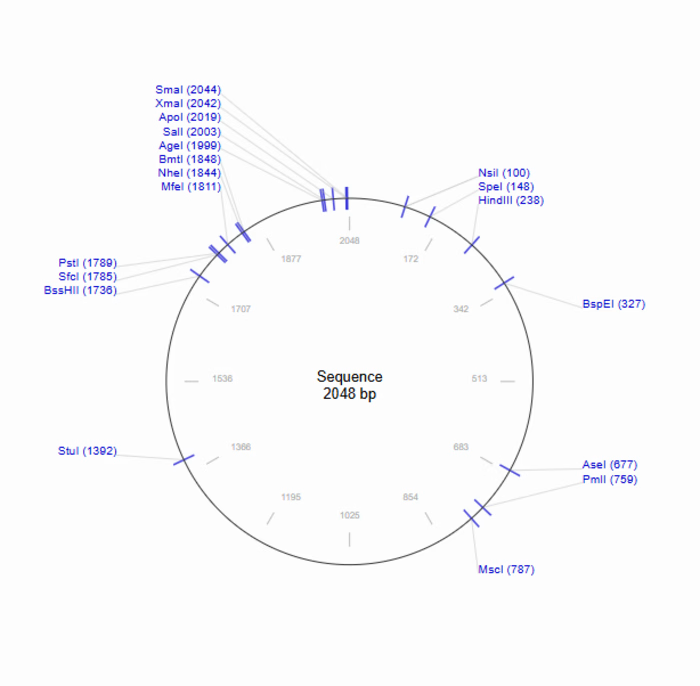
When we map SaminOS into DNA, our assembly instructions accidentally create real recognition sites for known enzymes:
-SmaI and XmaI (They are the Boot Switch): The x86 boot signature 0x55AA translates into CCCCGGGG at base pairs 2041 to 2048. Both SmaI and XmaI cut the sequence CCCGGG. If you add SmaI to the vial, it snips the strand right inside the boot signature. It does not touch any of the commands or code, but the computer BIOS will refuse to boot the disk. It acts like a biological write-blocker or kill switch.
- NsiI (The Keyboard Lock): At base pair 100, NsiI cuts right where the code calls the BIOS keyboard interrupt. Adding this enzyme physically unplugs the keyboard handler at the molecular level.
- AseI, PmlI, and MscI (The Clock Cutters): All three enzymes cut inside the mathematical routine that decodes the motherboard real-time clock.
- AgeI and SalI (The Dhaka Marker): Bases 1989 to 2008 spell out the word "Dhaka" in ASCII. The letters of the city name form the exact cutting site for AgeI and SalI. Dropping these enzymes into the tube cuts the geographic origin marker out of the code.
- StuI (The Banner Cutter): This enzyme cuts through the exact middle of the ASCII art startup logo.
You do not need a compiler or a hex editor to disable features. You can modify the binary using drops of liquid on a laboratory bench.
Why I did this:
This project is not just a technical puzzle. It points toward solutions for real problems in computing:
1. Storage That Lasts for Millennia: Modern hard drives fail within ten years. Magnetic tapes degrade. Flash memory loses charge. Synthetic DNA stored in tiny glass beads can last for tens of thousands of years at room temperature with zero electricity. SaminOS proves that executable software, not just static text or images, can be archived for deep time.
2. Extreme Data Density: DNA can store more information per cubic millimeter than any silicon chip known to science. All 512 bytes of SaminOS fit into an object smaller than a wavelength of visible light. You could pack copies for every person on Earth into a single drop of liquid.
3. Living Servers: Because 2,048 base pairs is the size of a normal gene, you can insert SaminOS into a harmless bacterium like E. coli. As the bacteria feed on basic nutrients, they duplicate the operating system billions of times without drawing power from an electrical wall outlet.
4. Absolute Physical Security: A vial of SaminOS has no radio antenna, no network card, and no electrical emissions. It cannot be scanned through an airport X-ray or intercepted across the internet. It exists outside the electromagnetic spectrum until it is sequenced.
What This Project Demonstrates:
SaminOS shows what happens when low-level assembly language meets synthetic biology. It demonstrates:
1. Deep mastery of bare-metal x86 architecture, memory layouts, and hardware interrupts.
2. Clean algorithm design under a strict 512-byte constraint.
3. Creative cross-disciplinary engineering linking computer science, information theory, and molecular genetics.
4. Clear communication that turns complex biocomputing concepts into accessible, human ideas.
Ref and Source Links:
1. SaminOS Research at Zenodo: https://doi.org/10.5281/zenodo.23554876
2. SaminOS Github Repo with all tools and resources : https://github.com/Saminsami73/SaminOS_DNA
3. A 61 Page Guidebook of SaminOS DNA : https://github.com/Saminsami73/SaminOS_DNA/blob/main/SaminOS_Complete_Guidebook.pdf
4. SaminOS Main Research paper : https://github.com/Saminsami73/SaminOS_DNA/blob/main/SaminOS_Research_Paper_v2.pdf




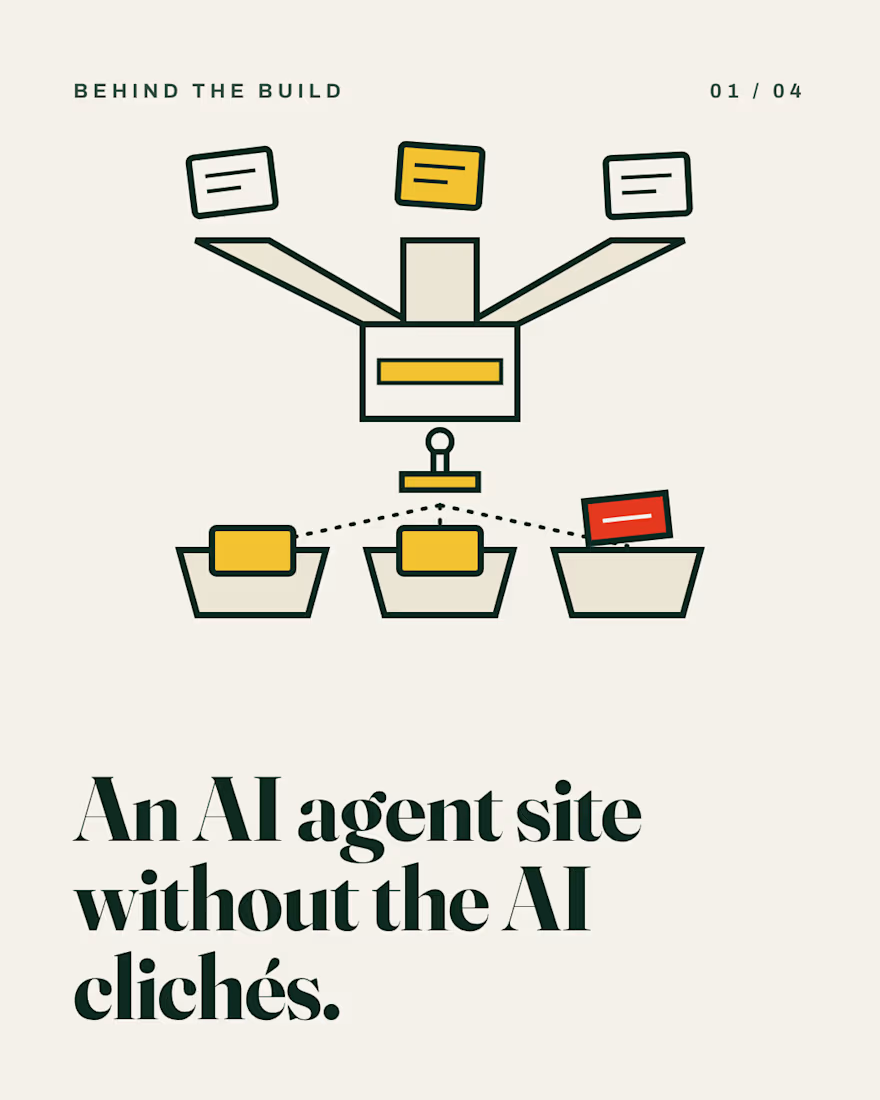
Most AI agent sites look the same: glowing brains, purple gradients, a chat box.
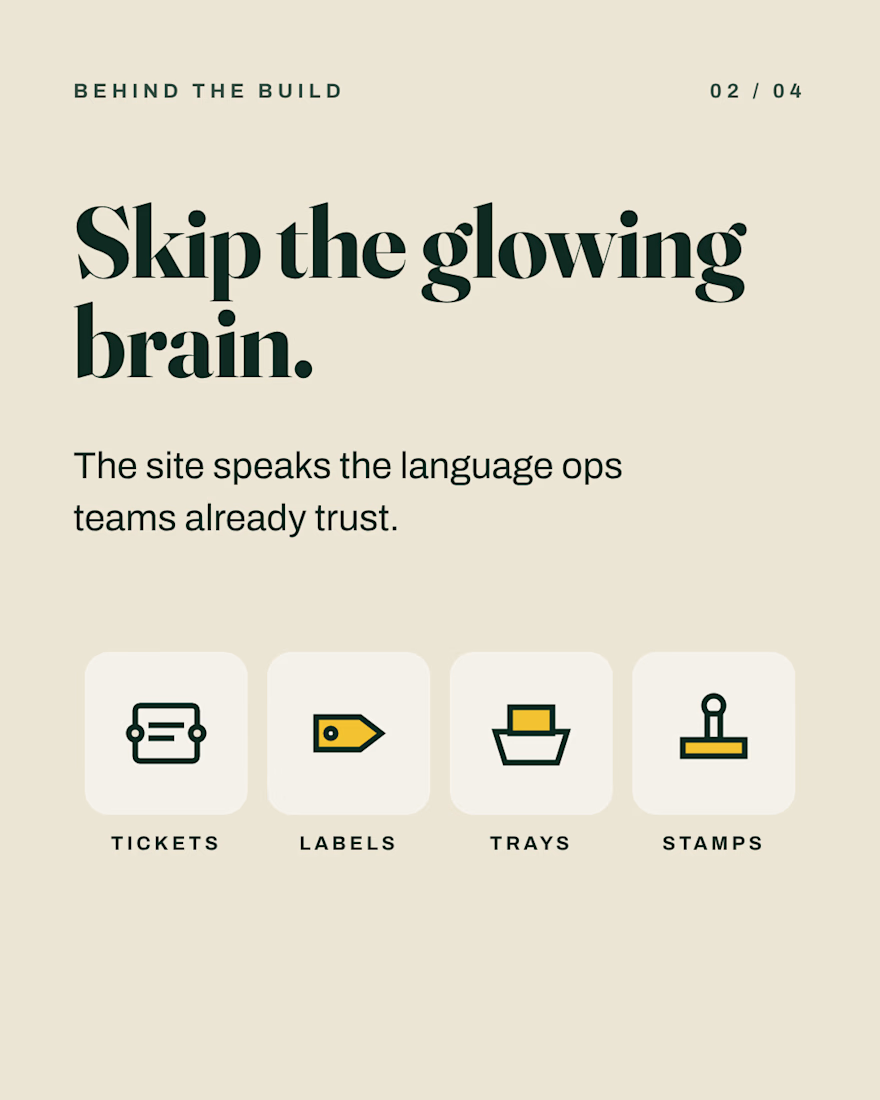
For Dockett, a fictional startup whose AI agents handle refunds, plan changes and missing invoices, I used tickets, labels, trays and stamps instead, and built the site around a toy-like 3D sorting machine.
Risky requests stop at an approval gate until a person says yes.
Concept by Nova Digital Studio. React, Three.js, GSAP.


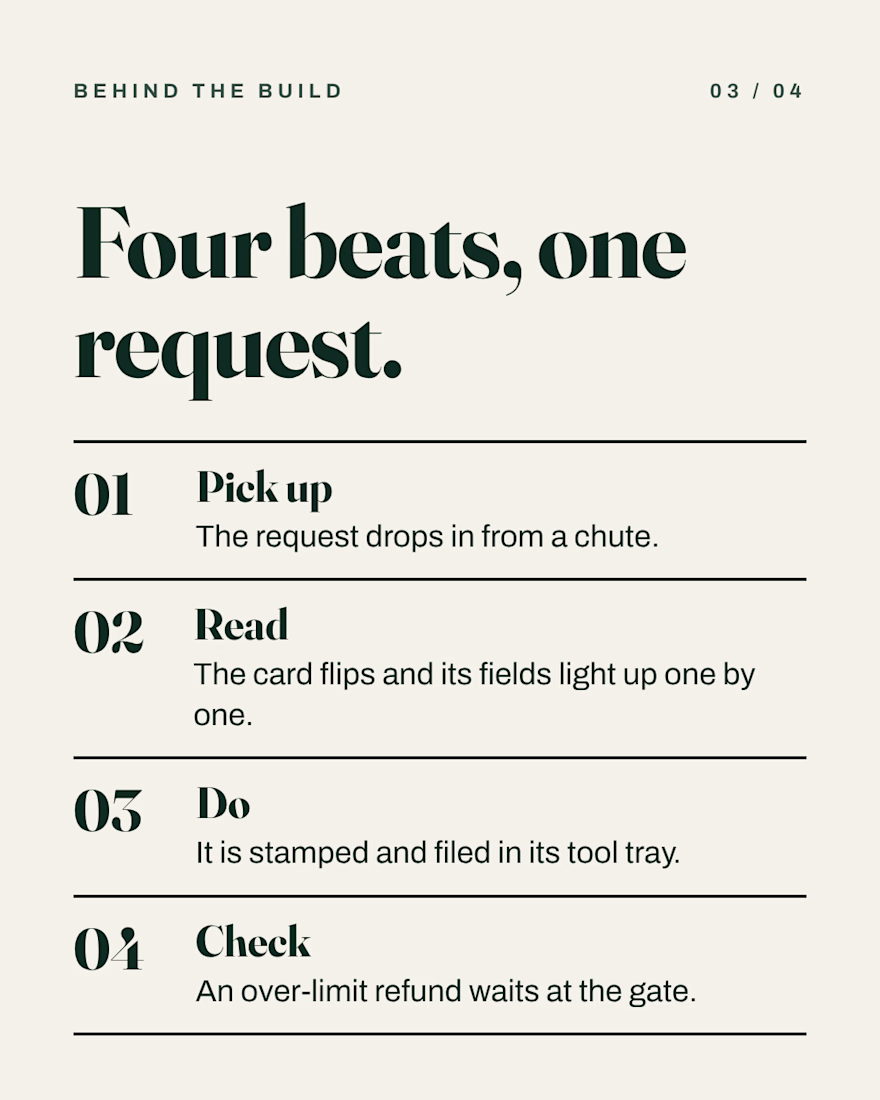
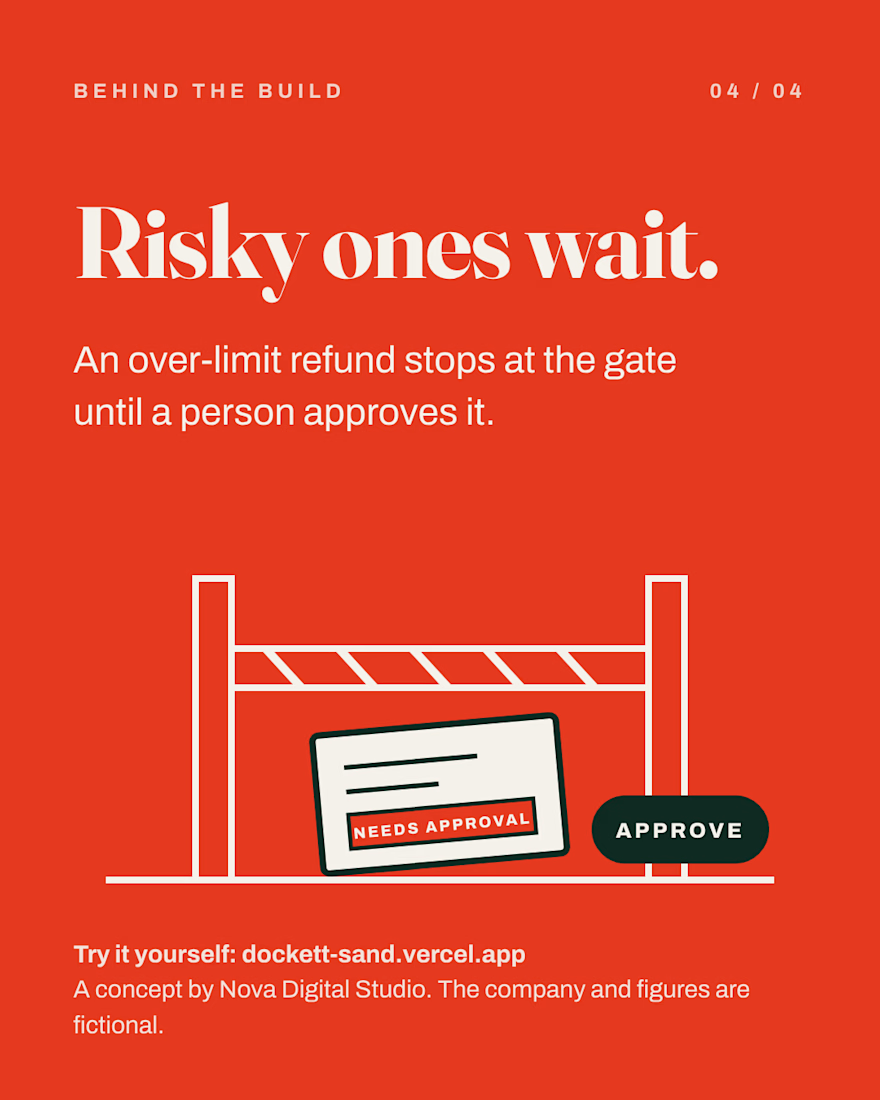

The approval gate is the right detail for refunds. Does the agent draft the refund and wait for a person, or only queue the request without any draft?

✨ Honestly, Base44 can create some mind-blowing designs! 🤯
I built KAIRN with Base44, and I’m genuinely impressed by how far AI-powered app creation can go. The design, the experience, and the overall feel make this project even more exciting! 🚀
I wish I had more credits left — I would’ve designed the entire website following this style! 🚀🔥
🔗 Explore KAIRN: https://kairn.base44.app
What do you think? Drop your feedback in the comments! 👇
#Base44 #AIBuilder #UIDesign #WebDesign #Contra #AICreativity


Ye le Jani MOHONA wali post ke liye copy-ready:
This is amazing MOHONA! KAIRN built with Base44 looks absolutely mind-blowing — totally agree AI-powered app creation has come so far. Love that the design, experience and overall feel all came together so well. Can feel the...