The network for creativity
Join 1.25M professional creatives like you
Connect with clients, get discovered, and run your business 100% commission-free
Creatives on Contra have earned over $150M and we are just getting started
Back to feedPost

A number can be accurate and still tell an incomplete story.
Tesla's FSD safety claim — stating that its vehicles drive more than seven times farther between crashes than average — made headlines this month when Reuters found those figures were self-produced and submitted to European regulators without independent verification. A Norwegian official noted they're nearly impossible to cross-reference with official accident statistics. Key methodology details remain redacted even in filings to U.S. regulators.
The number may very well be real. But the story that it's being used to tell is not the full one.
This pattern shows up everywhere data is used to make a public case — not just in autonomous vehicles or government surveys. It shows up in NPS scores that only reached satisfied customers. Employee engagement surveys administered during a good quarter. Conversion rates that don't account for who never made it to the funnel.
The question worth asking before you publish a number isn't just "is this accurate?" It's:
➡️ Who is and isn't in this sample?
➡️ What happened after this data was collected that changes how we read it?
➡️ What is this number being used to argue — and does the methodology actually support that argument?
Technical accuracy isn't the finish line. Context is.

The network for creativity
Join 1.25M professional creatives like you
Connect with clients, get discovered, and run your business 100% commission-free
Creatives on Contra have earned over $150M and we are just getting started
Trending

Claude
Claude has entered the design space. How are you using Claude Design?

Contra University
Learn from expert creatives how to earn more using next-gen AI tools.
creativeaiflow
Creative AI workflows are evolving. What tools do you use, and what are their strengths and weaknesses?
freelancerlife
Freelancer life is wins, pivots, and everything in between. What’s yours right now?








Related posts

"Luxury is no longer just consumed, it's owned, experienced, and compounded."
Two different ways to sell the dream.
Which hero makes you click "Explore"? 👇

16 voted
23%

53 voted
77%

69 votes
Closed

Cinematic twilight for me. 🌆 That golden-hour mood makes luxury feel like something you step into.

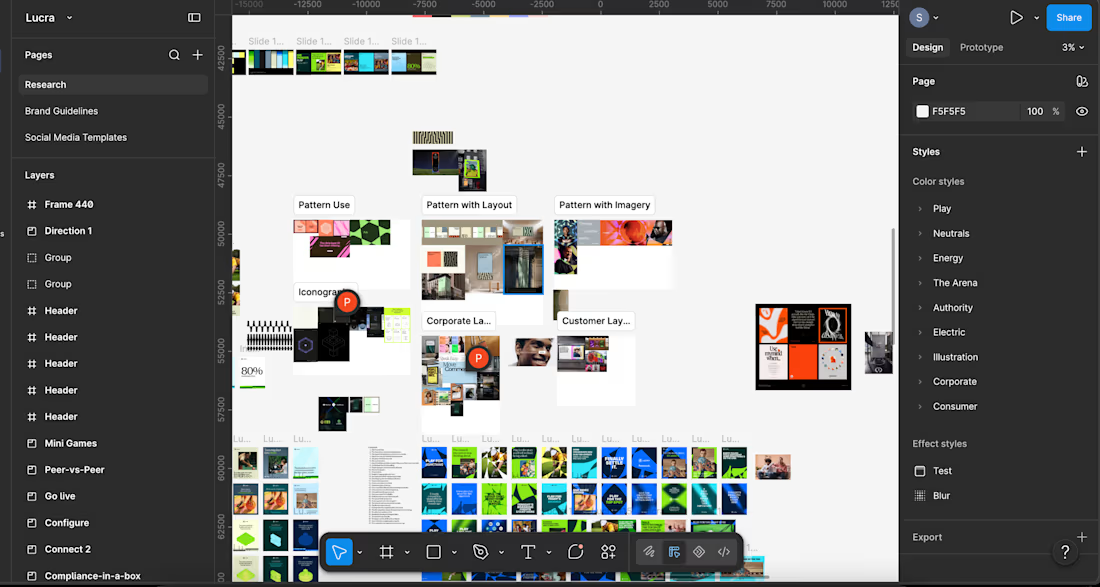
Competitive & Category Research
Before designing anything, we map the category.
Who else is in the space. What they look like. What they sound like. Where the gaps are. This isn't about copying, it's about understanding what "default" looks like in an industry, so we know exactly what to avoid and where there's room to stand out.
Research is 20% of the timeline and 80% of why the final direction feels inevitable instead of arbitrary.



Most startup websites are judged before they are fully understood.
The founder may know the product is strong.
The technology may be impressive.
The team may be credible.
But the visitor does not know any of that yet.
They begin with fragments:
A headline.
A visual style.
A logo.
A few interface details.
A general feeling of quality or lack of it.
That first impression determines how generously the rest of the website is interpreted.
If the company feels credible, people are more willing to explore.
If it feels unclear or unfinished, every claim has to work harder.
A practical five-second review:
What does the company appear to do?
Who does it appear to be for?
What level of company does it feel like?
What is the most obvious next action?
What emotion does the page create?
Do not evaluate only whether the hero looks good.
Evaluate the assumptions it encourages the visitor to make.
People often decide how seriously to take a company before they understand the details.
Design that moment deliberately.




Great design but presentation is even better. Good work!