The network for creativity
Join 1.25M professional creatives like you
Connect with clients, get discovered, and run your business 100% commission-free
Creatives on Contra have earned over $150M and we are just getting started
Back to feedPost

How do you let strangers run code on your server… safely? 🔒
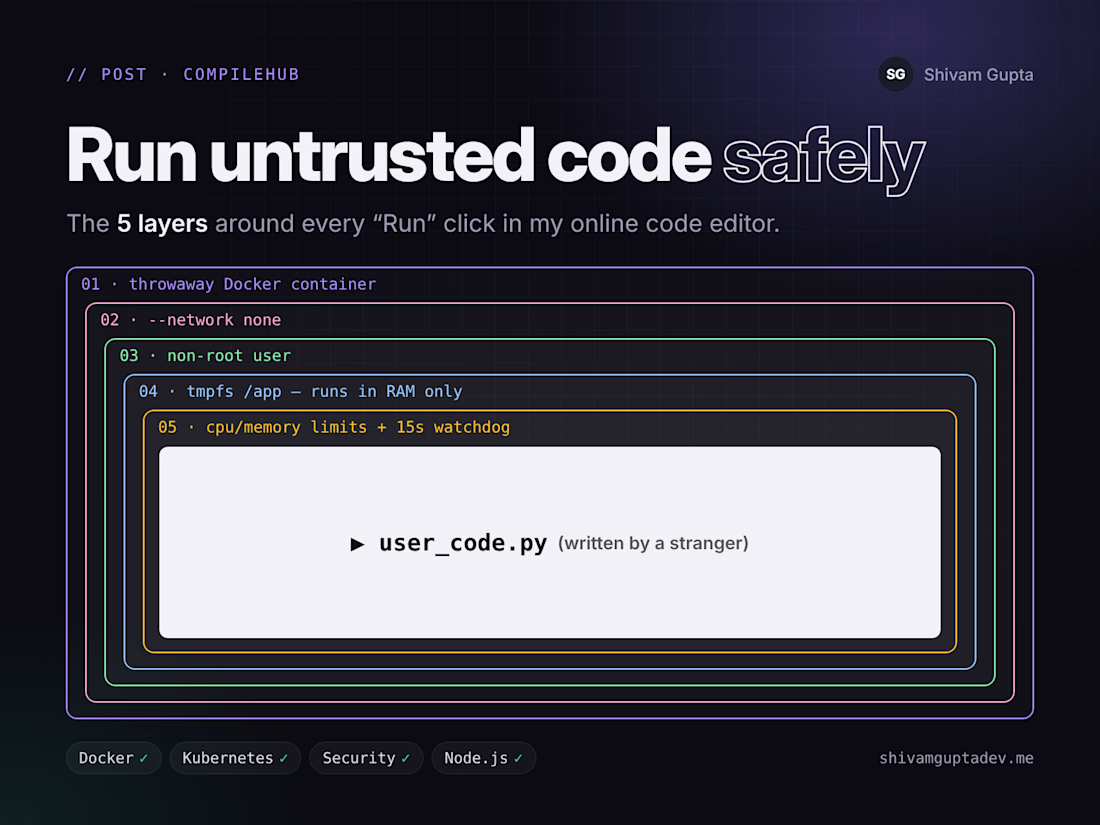
That was the core problem behind CompileHub, my online code editor for 13+ languages. Every "Run" click executes code someone else wrote. So every run goes through 5 layers:
① A throwaway Docker container, destroyed after the run
② --network none: no internet, so no data exfiltration or outbound calls
③ A non-root user, so escape attempts start with zero privileges
④ A memory-backed /app (tmpfs): code runs in RAM and never touches the host disk
⑤ Hard caps of 1 CPU core and 256 MB RAM, plus a 15-second watchdog that kills runaway code
All of it runs on Kubernetes (AWS EKS), provisioned with Terraform and monitored with Prometheus and Grafana.
Security usually isn't one big wall. It's many small, boring limits stacked together.
The full case study is on my profile.


The network for creativity
Join 1.25M professional creatives like you
Connect with clients, get discovered, and run your business 100% commission-free
Creatives on Contra have earned over $150M and we are just getting started






Related posts

The danger of SaaS Git dependency: When a vendor outage, account suspension, or price hike halts your entire engineering lifecycle.
Most modern technology companies anchor their entire software supply chain—source code, CI/CD pipelines, secret management, package registries, and issue tracking—to a single external SaaS provider (GitHub or GitLab).
While convenient, this model creates massive single-point-of-failure vulnerabilities and compliance liabilities:
1. Cascading Outage Disruption: When the SaaS provider suffers an incident, your developers cannot push code, CI pipelines cannot run security scans, and production emergency hotfixes are completely paralyzed.
2. IP Sovereignty & Data Exfiltration: Hosting sensitive proprietary algorithms, enterprise encryption keys, or regulated financial/healthcare intellectual property on multi-tenant commercial clouds carries inherent data exposure and regulatory audit friction.
3. Unpredictable Tier Pricing: Public SaaS platforms continually monetize developer seats, build minutes, and artifact storage, driving unexpected 40%+ operational cost increases.
The modern solution for resilient engineering organizations is deploying a self-hosted, sovereign Git forge (such as Forgejo or Gitea) integrated with dedicated, air-gapped CI/CD runners:
• Mathematical Resource Efficiency: Forgejo is a lightweight Go binary with a PostgreSQL backend. It delivers full Git hosting, PR reviews, issue management, and container registries consuming under 250MB of RAM—compared to 16GB+ for heavy alternatives.
• Native Actions Compatibility: Run standard, modern CI/CD workflows utilizing your existing YAML configurations with dedicated, bare-metal ephemeral execution runners.
• True Data Sovereignty: Store all git repositories, artifacts, and build logs on your own encrypted storage volumes (NVMe/Ceph) behind your zero-trust network perimeter.
• Hybrid Synchronization: Mirror external open-source dependencies locally for air-gapped security, while maintaining automated bidirectional replication to public repos when desired.
Take back control of your source code, your intellectual property, and your developer workflow.
Deploy a production-hardened sovereign Git forge with our 1–2 week Sprint on Contra:
#DevOps #Infrastructure #Security #CyberSecurity #Automation #Linux #SRE #Architecture




Something new is taking shape. 👣
Strategy, identity, type, system, and website are done. The last step is loading: 83% 🟦
Designed and shipped as code, the same way I build for clients. 🛠️
Follow along to see the launch first.

Strategy through to a coded site, all by yourself, is a nice way to show clients exactly how you work. Looking forward to seeing that last 17% land!


Thinking about rewriting your app? Check these 4 things first 👇
Do the main features work? If users can already do the main thing, the foundation is usually fine. Fix the bugs around it.
Is the data model sound? Wrong tables and relationships are the hardest thing to patch. This is the strongest reason to rebuild.
Are the problems in a few places, or everywhere? Slow pages and messy files are usually local. Fix those first.
Is the stack still supported? If not, plan a gradual rebuild, not a big-bang rewrite.
The hidden cost: a rewrite rebuilds the parts that already work, too. Login, payments, reports, all of it.
Quick rule: fix if the foundation is sound. Rebuild only when it isn’t.
Have you ever rewritten an app and regretted it, or wished you had? 👇

Agree on the data model being the real test. We rebuilt a travel platform off an old Angular and .NET monolith, and the deciding factor was not the code quality, it was that the data lived in MS Access. If the tables are sound, I would patch every time.