The network for creativity
Join 1.25M professional creatives like you
Connect with clients, get discovered, and run your business 100% commission-free
Creatives on Contra have earned over $150M and we are just getting started
Back to feedPost

Understood. We are keeping it strictly professional and consistent with your master tagset. Here is the draft for MediBook to add to your Contra profile.
Contra Project Entry: MediBook Healthcare Platform
Project Title: MediBook Healthcare Appointment Management Platform
Role: Lead Systems Engineer & AI Automation Architect
Project Description:
I architected and deployed MediBook, a comprehensive healthcare appointment management ecosystem. The platform facilitates the end-to-end appointment lifecycle, from patient registration and secure booking to administrative approval and automated patient communication. I engineered an automated workflow that handles approval notifications and appointment reminders, significantly reducing manual follow-up overhead for clinics while enhancing patient experience. The architecture integrates robust authentication with automated backend operational logic."
Skills:
AI Automation, Automation, Software Development, Systems Architecture, Backend Development, API Integration, Workflow Engineering
Tools:
n8n, Python, Gmail API, PostgreSQL, Supabase, External API Integration


The network for creativity
Join 1.25M professional creatives like you
Connect with clients, get discovered, and run your business 100% commission-free
Creatives on Contra have earned over $150M and we are just getting started
Related posts

Most inbound bottlenecks aren't caused by low lead volume—they happen during triage.
When inquiries roll into a Google Sheet or CRM, operations teams often waste 10–15 minutes per submission reading through messy paragraphs, deciphering budget mismatch, and manually deciding who gets an immediate call vs. a standard rate sheet.
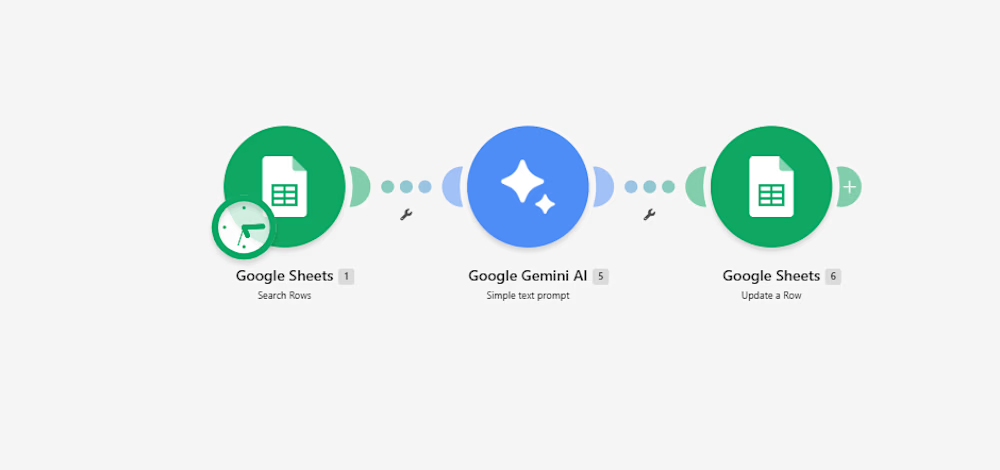
Instead of adding a bulky CRM add-on, I documented a lightweight 3-step automation pipeline built inside Make:
Intake & Extraction: An active listener triggers immediately upon a new submission, extracting core variables: client scope, target deliverables, timeline, and stated budget.
Context-Aware Evaluation (Gemini 2.5 Flash): The payload passes through an AI evaluation node with strict guardrails:
Evaluates budget against minimum agency criteria.
Assigns a triage score: Hot (immediate priority), Warm (nurture), or Cold (disqualified/template reply).
Generates a strict 15-word operational summary—no long paragraphs.
Determines an automated next step (e.g., routing to an account lead or flagging for asynchronous follow-up).
Data Return & Clean Pipeline: Appends the structured classification directly back to the master operational tracker, keeping the sheet filterable and clean.
The outcome: The sales and operations team can filter the entire board by priority status in two clicks, cutting first-touch response time to minutes without manually reading every single submission.
I’ve documented the full scenario map, execution logic, and data schemas below.
Curious how other agency operators and automation leads here handle their lead enrichment layer—are you doing AI scoring at the form level, or later in the CRM pipeline?:


For the budget gate, I'd keep an unstated budget separate from one explicitly below your minimum. Does the Make route ask for clarification when the amount or currency is missing, so a potentially suitable lead doesn't fall into Cold by default?

Everyone is shipping AI agents right now. Almost no one is testing them — and that is the whole problem.
A demo agent and a production agent are different animals. The demo works because you walked it down the happy path. Production breaks on the paths you never imagined.
A real example from my own work: a support assistant correctly handed a conversation to a human when someone wrote "I want to talk to a person" in Spanish — but not in English, because one phrase was missing from a rule. Every automated test passed. It only surfaced when I ran real conversations through it.
That is the gap the "agents will replace everything" wave keeps skipping. The hard part was never making an agent act. It is making it:
• say "I don't know" instead of guessing,
• hand control back to a human at the right moment,
• and prove, with tests, that it still behaves when the input gets strange.
Autonomy is cheap. Trustworthy autonomy is the real engineering.
Before you let an AI agent near real users or real data — what is the first thing you check?



The Spanish vs English handoff bug is such a good example. Every test passes until a real user shows up.

Blog Listening Web Application With Admin Dashboard.
webdesignappdesignadmindesignBackend DevelopmentFrontend DevelopmentFull Stack DevelopmentExpressJSNext.jsTailwind CSS


