The network for creativity
Join 1.25M professional creatives like you
Connect with clients, get discovered, and run your business 100% commission-free
Creatives on Contra have earned over $150M and we are just getting started
Back to feedPost
ScanFit AI is a mobile-first web application built with React, TypeScript, and Tailwind CSS that identifies gym equipment in 3 seconds and generates instant setup guides.


"Hey everyone! Really appreciate the feedback on ScanFit . I built this mobile-first web app using React, TypeScript, and Tailwind CSS to solve a real everyday problem on the gym floor—instant equipment identification and setup guides in seconds! Let me know what features you'd like to see added next!"
The network for creativity
Join 1.25M professional creatives like you
Connect with clients, get discovered, and run your business 100% commission-free
Creatives on Contra have earned over $150M and we are just getting started
Related posts

The contact page is usually the last page anyone designs.
We made it one of the best
Recent client work: a contact section UI design for a company with offices across cities. Globe in the back, every location up front, and small interactions that make the whole web design feel alive.


Impressive work

Business data often lives across payment, analytics, CRM, advertising, and inventory platforms. Metrik brings those signals together in one dashboard built for startups and small businesses.
See revenue, orders, customers, and business health at a glance. Compare advertising spend and ROAS across channels, explore visual KPI cards, and use smart alerts to spot unusual changes and potential risks.
The interface pairs a clean layout and rounded components with soft gradients, colorful analytics, and clear visual hierarchy, helping make business performance easier to follow.


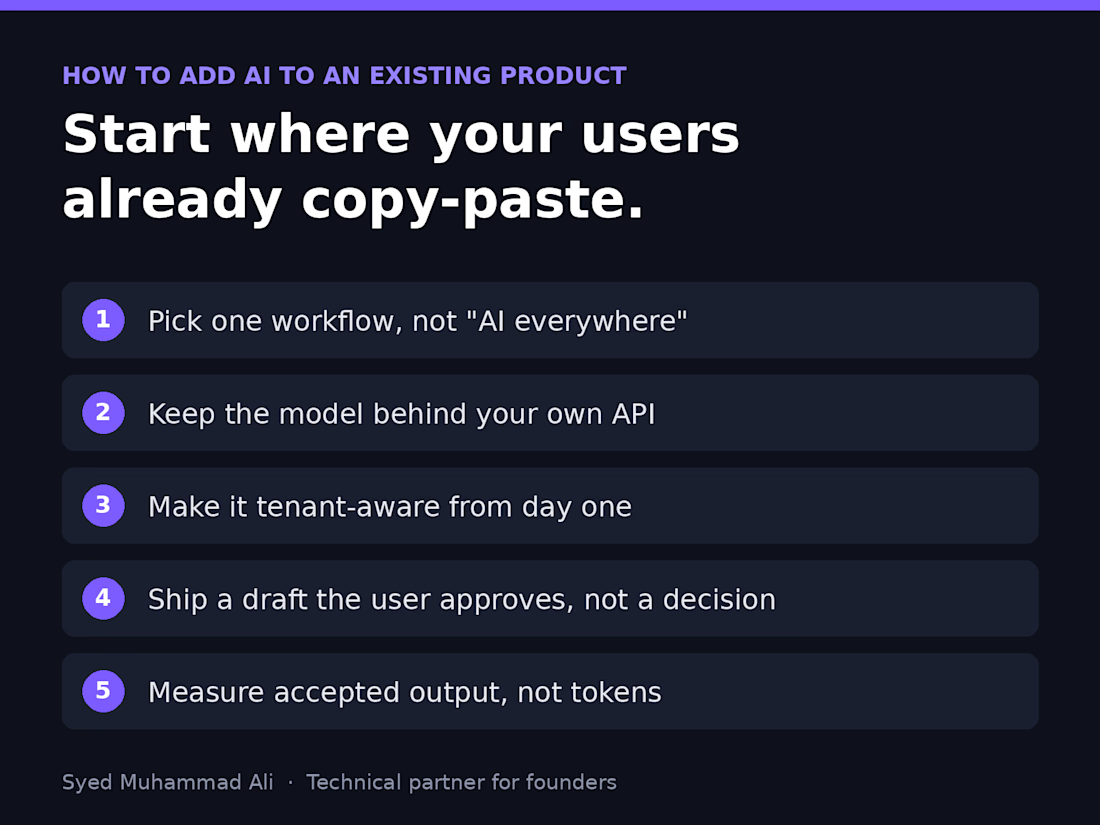
Before you add AI to your product, find the screen where your users already copy and paste.
That's usually where the real AI feature lives. Not a chatbot in the corner, but a step people already do by hand: summarising a ticket, drafting a reply, tagging an upload, pulling fields out of a PDF.
Here's the order I follow when a founder asks me to add AI to an existing SaaS:
1. Pick one workflow, not "AI everywhere." Watch where users leave your app to paste something into ChatGPT and come back. That round trip is your feature.
2. Keep the model behind your own API. One service owns prompts, retries, logging and cost limits, so you can switch providers without touching the frontend.
3. Make it tenant-aware from day one. Each customer's data, prompts and usage stay scoped to their account, or the first enterprise security review will stop you.
4. Ship a draft, not a decision. Let the AI suggest and the user approve. You earn trust and get real feedback before you automate anything.
5. Measure accepted output, not tokens. If users rewrite most of what it produces, the prompt or the context is wrong, and that's your real roadmap.
Most AI features that flop didn't fail because of the model. They were bolted onto the wrong step.
What's the one task your users still copy into ChatGPT?

Watching where users paste into ChatGPT and come back is such a practical way to find the real feature. Most teams start with the chatbot instead.