The network for creativity
Join 1.25M professional creatives like you
Connect with clients, get discovered, and run your business 100% commission-free
Creatives on Contra have earned over $150M and we are just getting started
Back to feedPost
How to update n8n in Docker without losing data, and what to do before you pull the new image.
The update itself is short. With Docker Compose: pull the new image, then recreate the container (docker compose pull, then docker compose up -d). Your workflows only survive if the data sits outside the container. Here is what my self-hosted template does, checked against the n8n docs:
Before the update
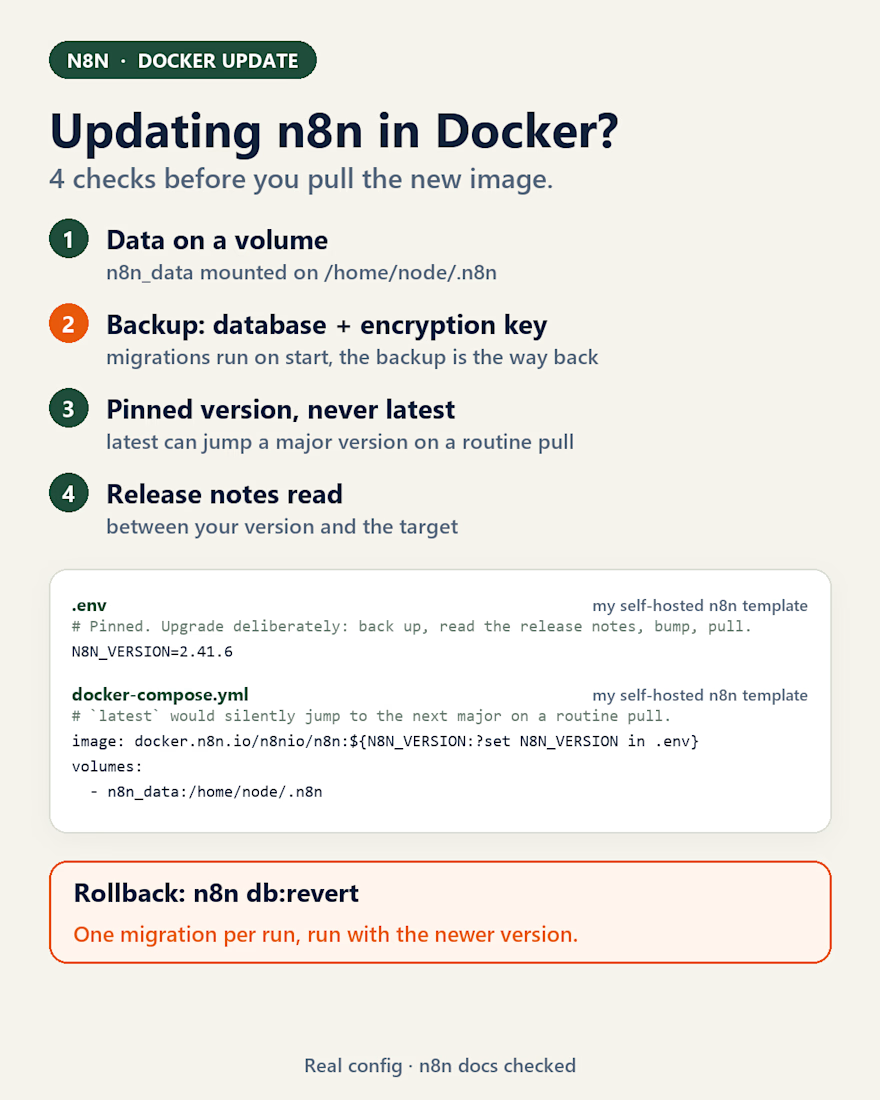
• Check where the data lives. The n8n_data volume must be mounted on /home/node/.n8n. Even with PostgreSQL, that folder still holds the encryption key. No volume means the new container starts empty.
• Back up the database and the encryption key. Migrations run when the new version starts. If one can't be reverted, the backup is the only way back.
• Pin the version. My .env says N8N_VERSION=2.41.6, never latest, because latest can jump a major version on a routine pull.
• Read the release notes between your version and the target. The docs advise updating at least once a month, so you never jump many versions at once.
If it goes wrong
• n8n db:revert undoes one migration per run, and it has to be run with the newer version.
• If that fails, restore the backup and go back to the old tag.
One more trap: after the update the n8n container gets a new IP, and a reverse proxy that cached the old one answers 502. Mine resolves the container on every request.
How do you update n8n today: pinned version, or latest and hope?



Pinning is the habit most self-hosted setups skip. One thing I add before every update: export all workflows to files next to the database backup, so even if a restore goes wrong you can rebuild on a clean instance fast. Do you test the new version on a copy first, or straight on the live one?

Good add, Michael. Workflow files next to the dump give you a second way back. On a copy first: the template has a restore drill file for that. It brings last night's backup up on a scratch machine where n8n has no internet access, because a restored n8n comes back with its...
The network for creativity
Join 1.25M professional creatives like you
Connect with clients, get discovered, and run your business 100% commission-free
Creatives on Contra have earned over $150M and we are just getting started



Related posts

I recently built VoltEdge Electronics as a sample project to explore how e-commerce operations can be automated beyond the storefront.
The challenge was connecting multiple business processes: order processing, pricing, payment tracking, customer notifications, and support into one seamless system without relying on manual intervention at every stage.
How I approached it:
Built the storefront website.
Used n8n to orchestrate order processing and business logic.
Integrated Supabase for structured data storage.
Automated pricing, including promotional discount calculations.
Connected Gmail and Slack for customer and internal notifications.
Integrated an AI customer support assistant with human escalation.
One of the biggest lessons from this project was that automation isn't simply about connecting tools. It's about designing reliable workflows, handling different outcomes, maintaining data consistency, and ensuring that each process works as expected.
The result is a connected e-commerce system where the storefront, backend, notifications, and customer support work together.
I'm always interested in helping businesses identify repetitive processes that can be simplified or automated.
If you're looking to automate your business operations, workflows, or customer processes, feel free to reach out.

Before / After: lead follow-ups, automated with n8n + OpenAI
Before: a new lead waited up to 2 days for a reply. Follow-ups were manual — 1 touch, easy to forget, easy to miss.
After: 1 n8n workflow watches the inbox, drafts the reply with OpenAI, and sends 3 follow-ups over 7 days. The first reply goes out within 5 minutes. A human still approves every message before it is sent.
In numbers: 2 days to first reply became 5 minutes. 1 touch became 3 touches. Built in 5 days — 1 workflow, 0 missed leads since.
What part of your follow-up would you automate first?

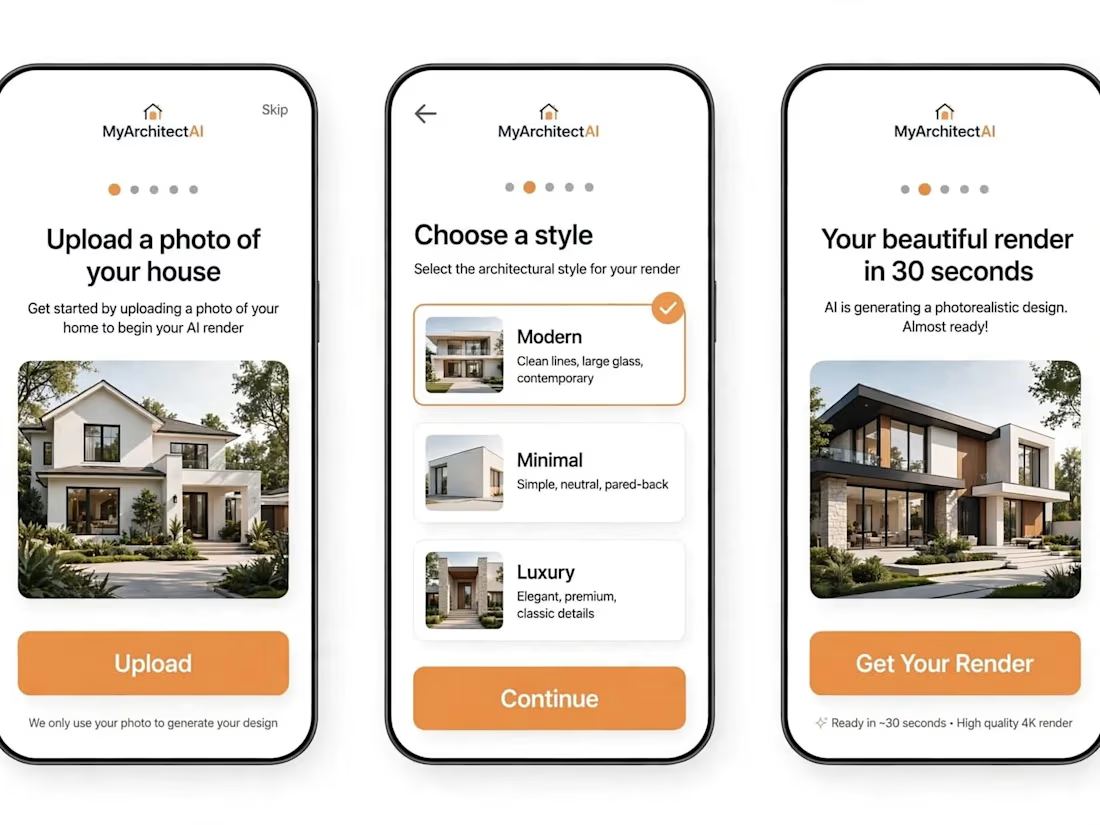
Redesigned MyArchitectAI onboarding to get first render in 30 seconds. 3 steps: Upload > Choose Style > Render.


Excellent work!