The network for creativity
Join 1.25M professional creatives like you
Connect with clients, get discovered, and run your business 100% commission-free
Creatives on Contra have earned over $150M and we are just getting started
Back to feedPost

🚀 Building in Public: Why we’re rethinking client management for high-ticket agencies.
Most agencies and dev shops juggle briefs on WhatsApp, project updates across Slack, and milestone sign-offs lost in messy email threads. It adds friction right where momentum matters most.
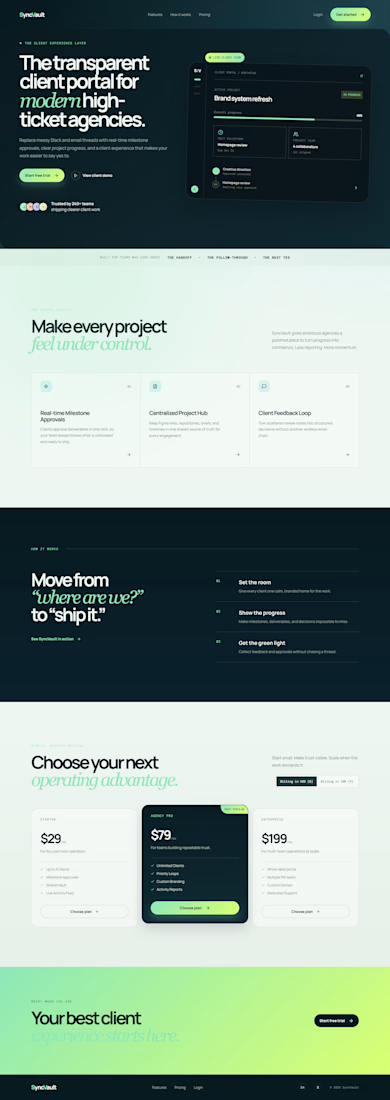
Over the past few weeks, I’ve been building SyncVault — a transparent, high-performance client portal engineered for modern agencies.
Key highlights so far:
• Ultra-clean dark workspace aesthetic built with React, Node, and Tailwind
• Clear milestone approvals so deliverables never get blocked
• Dedicated role-based access (Agency Control Room vs. Client Portal)
• Gated tiers with automated client handoff flows
We’re putting the final touches on our global billing infrastructure and custom domain deployment next.
Would love to hear from agency owners and fellow builders in the Contra community:
What is the single biggest bottleneck you face when managing client communications and milestone sign-offs?
Drop your thoughts below 👇
The network for creativity
Join 1.25M professional creatives like you
Connect with clients, get discovered, and run your business 100% commission-free
Creatives on Contra have earned over $150M and we are just getting started





Related posts

I use Lovable every. Single. Day. Weekends included. 😂
So when my favorite AI builder teams up with Contra for a competition, there’s no “should I enter?” Of course I’m in.
The challenge: take a small business from “can I book?” to “you’re confirmed” without the owner spending half their day chasing messages.
This one hits close to home. I’ve already built a booking flow for my own brand, pmcosta.dev, and reused it across multiple side projects. Because booking an appointment shouldn’t require twelve messages and a calendar negotiation.
Now I get to take that experience and push it further. Not just a nice-looking widget, but something that actually takes work off a business owner’s plate.
Daily habit meets competition. Let’s build. 🔥
@Lovable @Contra HQ #lovablechallenge

pmcosta.dev
Web Developer & GTM Consultant in Portugal — Pedro Costa
Freelance web developer and GTM consultant building websites, web apps, and automated lead systems for founders, local businesses, and e-commerce brands.


Built a real mobile booking site for my braiding salon in Westlands, Nairobi. Clients were missing in DMs, now they can book in 30 seconds with KSH 500 M-Pesa deposit + WhatsApp confirm. Made entirely on my phone with Lovable!


Don't forget to upload your demo video!

The Heron Dashboard page had to make an agent's work legible after the fact, which is a different job to explaining what the agent does.
The hierarchy leads on time saved rather than activity volume. Heron's positioning rests on hours lost to repetitive modelling, so the product reports back in the same unit, supported by model health, active and pending item counts, and a feed of agent actions. The second half of the page covers contextual code questions, answered against a specific layout and occupancy rather than quoted in isolation.
Mobile treated density as the core problem. The four headline figures are kept grouped so the summary survives a portrait screen, and tabular content is restructured into stacked cards rather than compressed into scrollable tables.


