The network for creativity
Join 1.25M professional creatives like you
Connect with clients, get discovered, and run your business 100% commission-free
Creatives on Contra have earned over $150M and we are just getting started
Back to feedPost

Overview
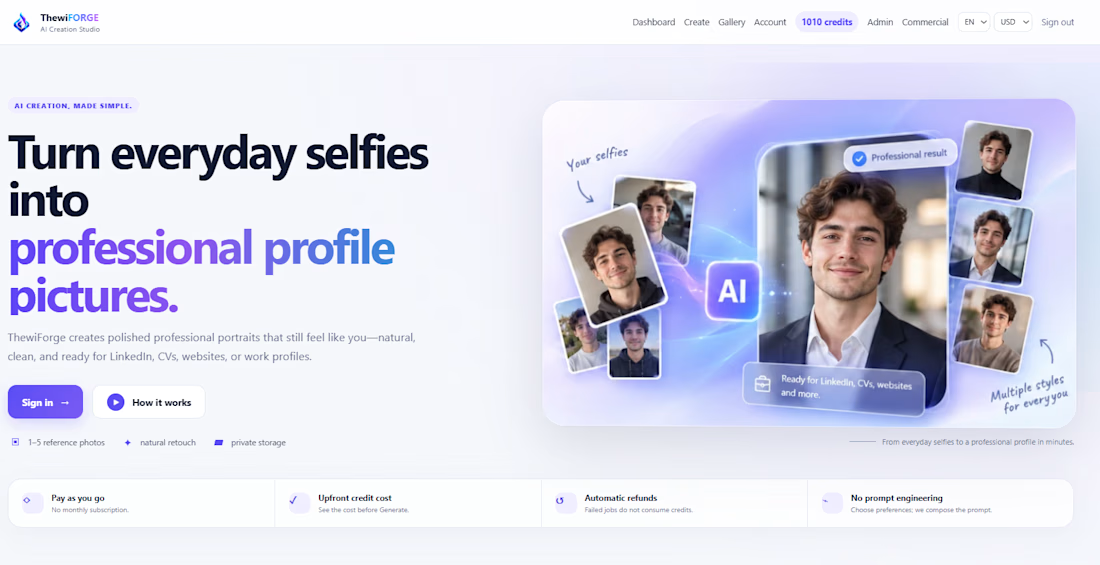
ThewiForge is an AI creation studio built around an extensible product architecture. Its first implemented creation product focuses on professional profile-picture and portrait generation, with a design intended to support additional creative studios over time.
Problem & design goal AI image generation can be difficult for nontechnical users because it requires prompt engineering, managing uploads, waiting for asynchronous jobs, and understanding generation costs. The project
makes that process more approachable through guided inputs, predefined options, clear credit consumption, and a private output gallery.
Key capabilities
- Guided professional image generation using source photos and selectable appearance, framing, outfit, pose, and background options.
- Standard/premium generation paths, configurable AI provider routing, asynchronous job handling, and status tracking.
- Credit-based usage, top-up/payment workflows, and administrative controls.
- Private uploads and galleries, watermarked previews, protected downloads, and ownership-aware media access.
- Web application and Flutter mobile integration through a dedicated API bridge.
- Modular product registry for future creative products; future studios are not presented as completed features.
My contribution : I worked on the product concept, Node.js/Express backend, PostgreSQL data model, AI integration, generation lifecycle, credit and billing rules, access controls, Flutter API connectivity, and deployment/testing workflows. The design addresses both technical concerns - background jobs, protected media, and idempotent requests -and commercial concerns such as per-generation costs and entitlements.
Technology: Node.js, Express, EJS, JavaScript, PostgreSQL, Flutter/Dart, OpenAI Image API, Midtrans (sandbox integration).


The network for creativity
Join 1.25M professional creatives like you
Connect with clients, get discovered, and run your business 100% commission-free
Creatives on Contra have earned over $150M and we are just getting started





Related posts

Then: 1 month, 1 template.
Now: 1 week, 15 templates.
Same designer, different workflow.
I wrote up how I built no-code.supply: fifteen website templates, each with its own brand, in HTML and React, and some in Framer too. Claude Code did most of the typing. I did the directing.

no-code.supply
How I built 15 website templates with an AI coding agent in a week
How I built 15 AI-ready website templates with Claude Code in a week: the workflow, the quality bar, and why a template is only the starting point.

Going from one template a month to fifteen a week is wild. How much of the design direction did you still do by hand?


Creative idea and perfect execution. love this man

How do you make an AI product feel genuinely human?
For YouSquared, we started with the product experience first. We tested UX patterns screen by screen, explored more than twelve visual directions with real users, and handcrafted every detail without using AI.
The final system expanded across app, website, illustration, motion, and marketing, creating a complete ecosystem that was easy to scale and hand off.
See the design:
https://dribbble.com/shots/27783565-Mobile-app-YouSquared
