The network for creativity
Join 1.25M professional creatives like you
Connect with clients, get discovered, and run your business 100% commission-free
Creatives on Contra have earned over $150M and we are just getting started
Back to feedPost

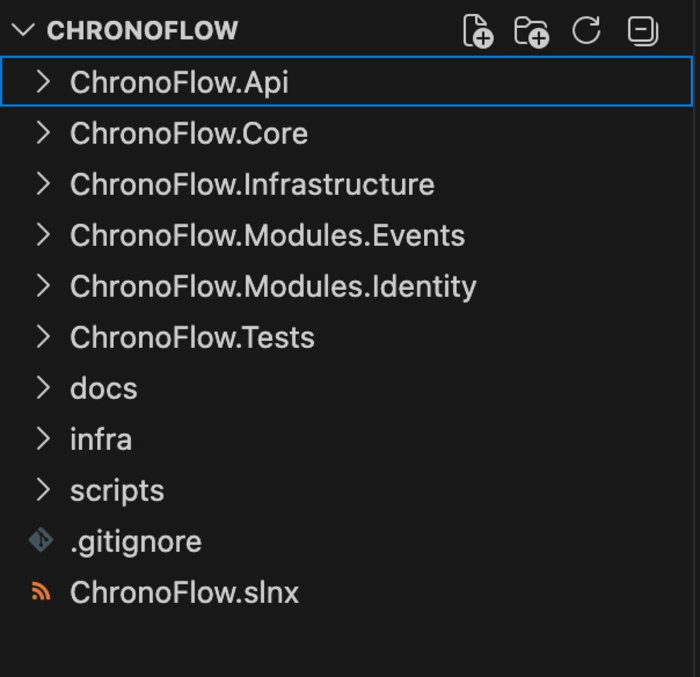
ChronoFlow is a backend platform designed to manage and process event streams in a structured and scalable way. The system is built using a modular monolith architecture with strict boundaries between core logic, infrastructure, and feature modules.
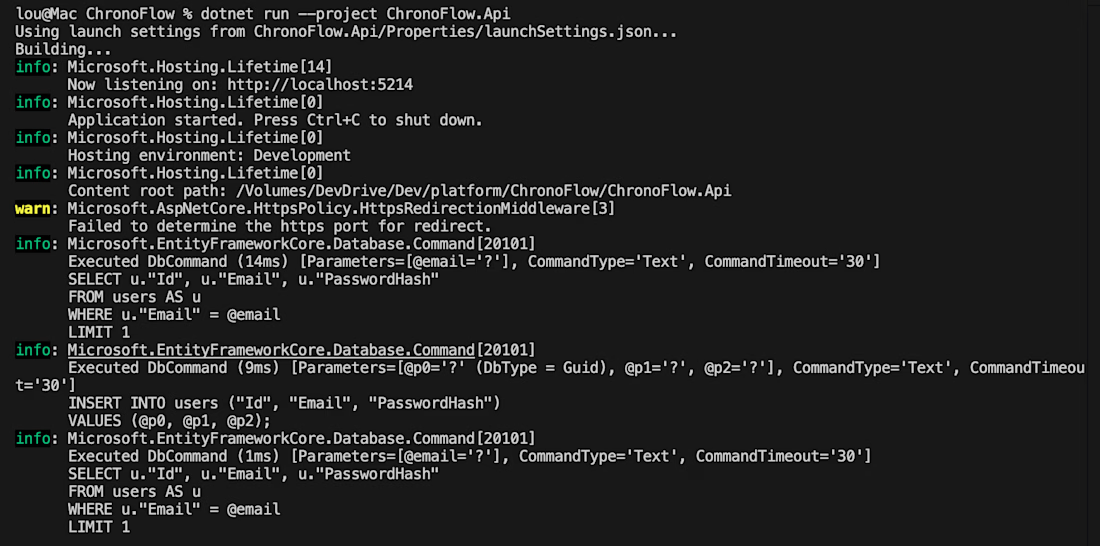
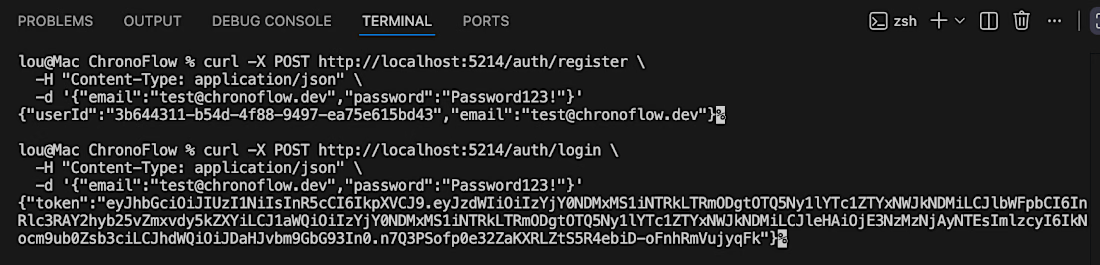
The project implements secure authentication using JWT tokens, event ingestion endpoints, and ordered event stream retrieval. All modules are designed to evolve without allowing domain logic to leak into the core platform.
The API is documented using the OpenAPI specification, and the system is backed by PostgreSQL for persistent storage.
Technologies used include .NET, ASP.NET Core, PostgreSQL, REST APIs, JWT authentication, and automated testing.
This project demonstrates backend architecture design, API development, and building scalable event-driven systems.:


The network for creativity
Join 1.25M professional creatives like you
Connect with clients, get discovered, and run your business 100% commission-free
Creatives on Contra have earned over $150M and we are just getting started

Challenges
View all


Related posts

A fresh take on file sharing & storage.
Designing a modern, simple, and user-friendly platform where users can upload, store, organize, and share files effortlessly. From secure storage to seamless file sharing, every interaction is designed to feel fast, intuitive, and reliable.
More details coming soon. Stay tuned!
#WebDesign #UXDesign #UIDesign #FileSharing #CloudStorage #Artificial Intelligence #InteractionDesign #ModernUI #ProductDesign #Figma #GeeksInDesign

The gradient blob doing double duty as both brand texture and a visual metaphor for data flow is a nice touch. Curious how Securitan differentiates on the security side once the full site lands.


I’ve been razzmatazzing and flibbertigibbeting with Claude Code and somehow ended up with a new yels.dev.
It finally feels like me: simple on the surface, slightly complicated underneath, and very much alive.
You can see who I am, what I do, the work behind Herodot, RaptorLabs, CyberLink Security and Solmint, plus a selection of projects I’ve built across AI, cybersecurity, Web3, product systems, education, archives, and experimental digital spaces.
Built to be explored


The simple-on-the-surface, layered-underneath idea comes through so clearly in the presentation. I especially like how the project archive turns the site into something to explore rather than just a résumé of links.

I’ve been building SabiFlow for a while, and honestly, the most interesting part of the project isn’t the code.
It's the problem.
Because it's personal.
I've experienced that thing where money comes in and somehow, without you really noticing, it starts disappearing.
Not because you don’t earn enough.
Not necessarily because you're irresponsible either.
Sometimes money simply has no job when it arrives.
And as an engineer, that got me thinking:
What if the problem isn't budgeting? What if the problem is that we’re asking people to make too many good decisions at the exact moment they have the most temptation to make bad ones?
That question became the foundation for SabiFlow.
Instead of telling someone, "You should save 20% of your income," I started thinking about what would happen if the system simply helped assign every inflow a purpose the moment it arrived.
That led me down a rabbit hole.
Funnels.
Automated distribution.
Wallet infrastructure.
Virtual accounts.
User behaviour.
Transaction flows.
KYC.
Compliance.
Even the psychology behind notifications.
And this is probably my favourite part of being both an engineer and a founder.
I don’t just ask:
"How do I build this feature?"
I ask:
"Why does this problem exist, and what kind of system could make dealing with it easier?"
Then the engineer in me comes along and asks:
"Okay… but how do we actually make this work reliably?" 😂
That tension between the founder thinking about the problem and the CTO thinking about the system is probably what I enjoy most about building SabiFlow.
I’m still figuring a lot of it out.
But I'm curious:
What’s a problem you’ve experienced personally that eventually made you want to build something around it?


The framing around “why does this problem exist?” is exactly the kind of product thinking that keeps a financial tool from becoming another dashboard. SabiFlow sounds strongest where the behavioral insight meets the practical system design—especially around notifications and reliable follow-through.