The network for creativity
Join 1.25M professional creatives like you
Connect with clients, get discovered, and run your business 100% commission-free
Creatives on Contra have earned over $150M and we are just getting started
Back to feedPost

I built our AI agent's memory system three times. The first version was embarrassing.
Every time the user said something, the agent stored it as a string in SQLite. Every time the user asked a question, it ran a basic SQL query:
WHERE content LIKE '%keyword%'
It wasn't a memory system. It was a search bar with persistence.
If a user said "I'm frustrated with my job," and later asked about "stress at work," the agent found nothing. The words didn't match. The agent was deaf to meaning.
Here is what we learned building and auditing the ARIA memory engine (now Silex Engine):
Storing is Not Learning
During our system audit, we found the agent was generating deep self-reflections at every turn ("I should have asked for clarification before answering"). But the code that built the system prompt never read them back. The agent was reflecting on its performance, storing it in the database, and immediately forgetting it.
Memory that does not influence future behavior is not memory. It is just a log.
Facts vs. Relationships
A flat database lists facts: "I use React" and "I use TypeScript." An intelligent agent needs a world model that draws a "co-occurs with" edge between them, reasoning that the developer operates in a modern type-safe JavaScript ecosystem.
How we architected our V3 hybrid memory stack:
• SQLite: For fast, persistent session storage.
• ChromaDB: Vector search for semantic retrieval (stress at work ➔ job frustration).
• NetworkX Causal Graph: To map relationships (causes, requires, contradicts) between facts.
• Consolidation Cycle: A weekly scheduler that clusters related nodes and synthesizes them into abstract user profiles.
Building cognitive memory isn’t about database storage. It’s about closing the retrieval loop so the agent actually changes its behavior based on what it learned.
I wrote a full breakdown of our memory audits and how we built the Silex Engine's memory core:
https://openyf.dev/blogs/aria-causal-memory
#AIAgents #SoftwareArchitecture #GraphDatabases #NoSQL #SystemEngineering
The network for creativity
Join 1.25M professional creatives like you
Connect with clients, get discovered, and run your business 100% commission-free
Creatives on Contra have earned over $150M and we are just getting started





Related posts

I cannot get my demo to be below 3 mins.. its looks impossible. So I'll drop my pitch here
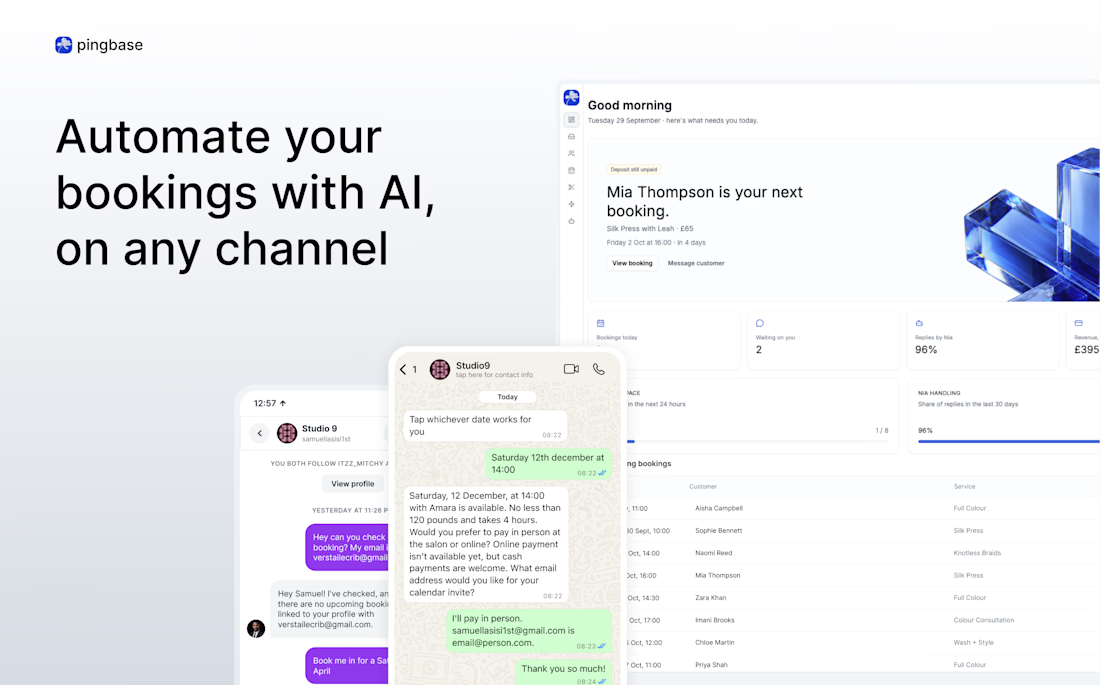
I built an AI Agent that books appointments directly inside chat apps like WhatsApp, Instagram, Telegram and Facebook Business through natural conversations.
I hooked up a few things to make it happen:
- WhatsApp Business API
- Meta scopes for Instagram
- Scopes for Facebook messaging
- Google Calendar API
- AI Agent (powered by Lovable)
All of these work together to help businesses get appointments without lifting a finger, saving time and money in the process.
PROBLEM:
Usually, appointment-based businesses would use booking websites (pretty common these days) to take bookings, but bookings generally dont start from there. It starts with customers sending messages on WhatsApp or Instagram (or social media generally), like, “Are you free on Saturday?”, and then they wait to be directed.
That normally means someone has to stop what they’re doing, reply to the customer, check the calendar, suggest a time, follow up, create the booking (or send a booking link), send reminders, collect payments, and handle any changes afterwards or, worst, answer repeated questions for the nth time.
and
Because clients/customers require fast responses, businesses lose hundreds of customers a year because their competitors replied first!
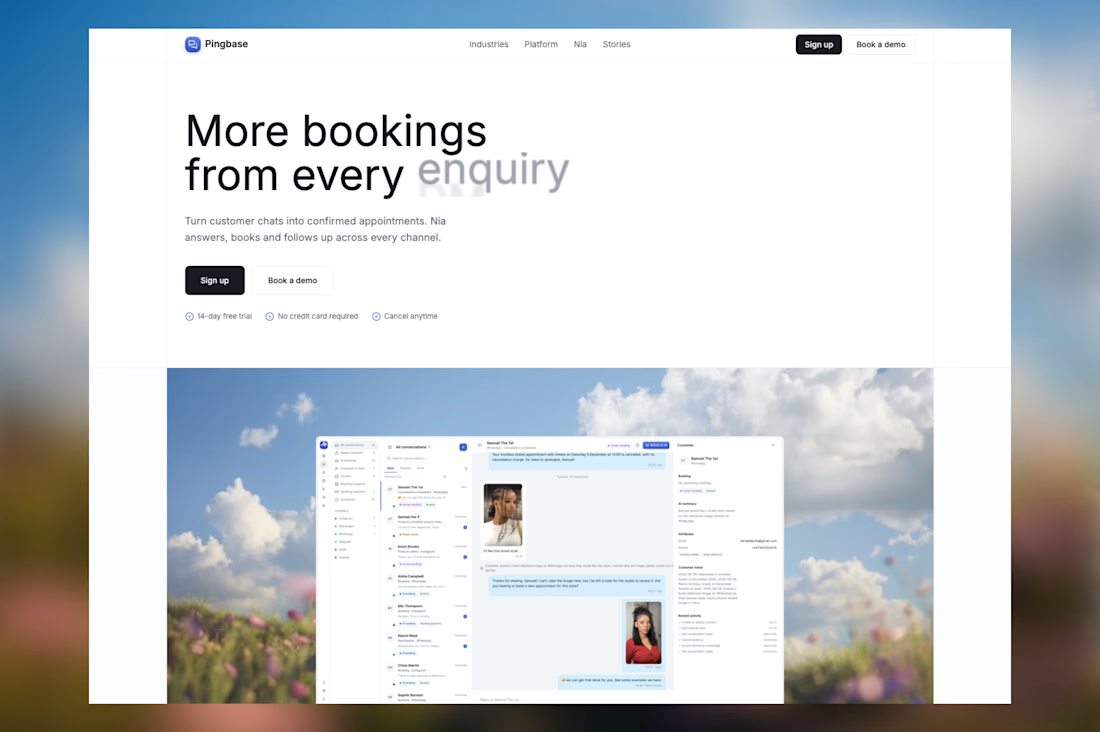
So I built PingBase
PingBase removes that entire back-and-forth. Instead of sending customers somewhere else to book, PingBase turns the conversation they’re already having into the booking.
This is usable fo any time of business for multiple use cases.
To test the project:
Send a WhatsApp message to the fictional business (Studio 9 - already set up on teh platform) at +447587492916 or message @samuellasisi1st on Instagram.
Or give it a spin yourself on Lovable: (maybe create your business)
https://pingbase.lovable.app
Demo below
- 3min video
- Some screenshots of the product (+ WhatsApp and IG Conversations)
- 10+ Min breakdown of how the product works end-to-end
Things to note: Meta-required scopes for this are not available for public use yet as it's not something I can control, so you might not be able to connect your own business Instagram or WhatsApp acounts just yet. but you can try...

Impressive
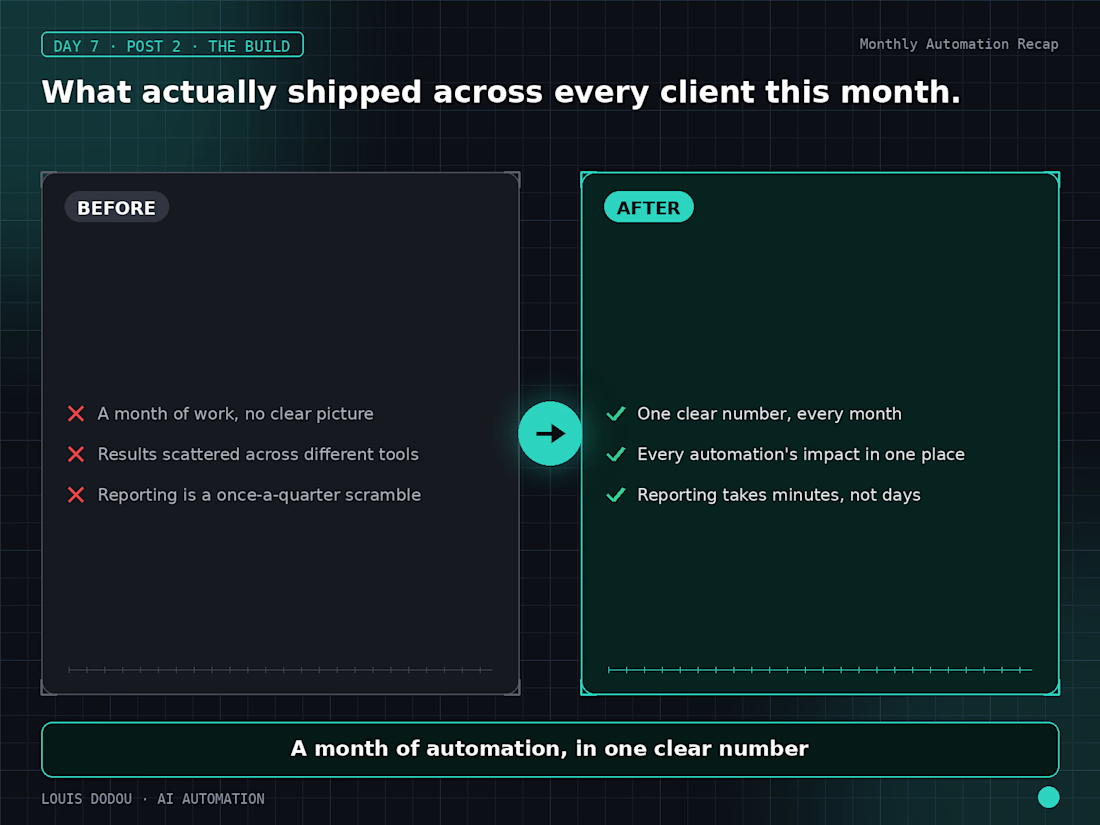
What actually shipped across every client this month:
A lead qualification bot, an inbox triage system, a contract automation flow, and a hiring screen different clients, same principle: automate the repetitive part, keep a human on anything that needs judgment.
→ Happy to walk through any of these in more detail.



Seeing the lead qualification bot take the first pass on prospects really frees up the team for deeper conversations. The inbox triage does the same for support tickets, letting agents focus on the tricky cases.

AI agents are moving from chat to action. 🤖
OpenAI just introduced Dots, always-on AI agents designed to proactively work on tasks instead of simply responding to prompts.
This feels like another step toward AI that executes workflows, not just generates answers.
As someone exploring AI agents + n8n automation, this is a space I'm definitely watching closely. 🚀
#AIAgents #AIAutomation #AI #OpenAI #n8n
Great to see OpenAI's Dots bringing always-on agents that can proactively tackle tasks - integrating them with n8n opens the door to truly autonomous workflows. Keep pushing the boundaries!