The network for creativity
Join 1.25M professional creatives like you
Connect with clients, get discovered, and run your business 100% commission-free
Creatives on Contra have earned over $150M and we are just getting started


The network for creativity
Join 1.25M professional creatives like you
Connect with clients, get discovered, and run your business 100% commission-free
Creatives on Contra have earned over $150M and we are just getting started

Challenges
View all


Related posts

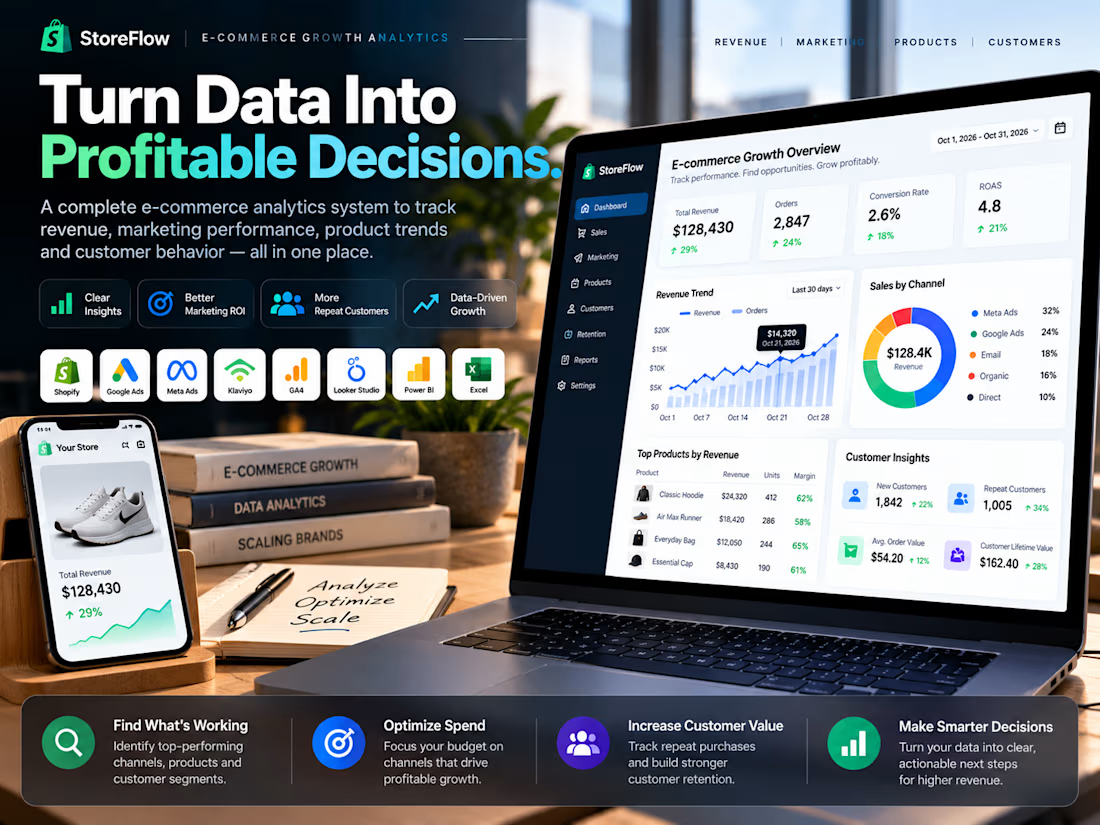
See exactly what’s driving revenue, where growth is leaking, and which products, channels, and customers deserve more investment.
I developed an e-commerce growth intelligence system around one question:
Where should the business invest next?
Most stores already have plenty of data. The harder problem is understanding what that data means for revenue, marketing spend, products, and customer growth.
So instead of building another dashboard full of charts, I’m structuring the system around decisions.
It brings together signals such as revenue, ROAS, CAC, conversion, product performance, repeat purchases, and retention to identify things like:
which channels deserve more budget, where acquisition is becoming inefficient, which products attract traffic but fail to convert, and where repeat customers are creating stronger value.
The goal isn’t just to answer:
“What happened?”
It’s to answer:
“What should we do next?”
Because the most useful analytics system isn’t the one with the most charts.
It’s the one that makes the next business decision clearer.
Tags: E-Commerce · Marketing Analytics · Data Analytics · Power BI · E-commerce Management
Marketing AnalyticsData AnalysisecommerceeCommerce ManagementMicrosoft ExcelMicrosoft Power BIShopify


Exactly. Analytics becomes much more valuable when it helps businesses make smarter decisions, not just track numbers.

Clean cash dashboard design
Buoy is a cash dashboard for finance teams. Every number is measured against one line: the least cash the company wants in the bank. Here, the weekly cash update: pick who gets it, add a line, send.
A concept I designed in Figma and built as a working prototype.
Case study: https://buoy-case-study.vercel.app


Crisp, clean, and effective.

Your shareholder account could be quietly costing you. 👀
Most founders I meet don’t know their shareholder current account balance.
Then year-end arrives, and the accountant asks:
“Why does the company owe you money?”
or worse,
“Why do you owe the company?”
Here’s the simple version 👇
Shareholder current account = the running tab between you and your company.
✅ Positive balance: the company owes YOU.
You paid a company bill from your own pocket or lent the business money. You can take it back as a repayment.
⚠️ Negative balance: YOU owe the company.
You took out more than you were entitled to. It’s treated like a loan, which can mean tax consequences, audit questions, and messy books when you want funding or a sale.
Quick example:
You put in 10,000 → company owes you 10,000 ✅
You withdraw 15,000 for personal use → you now owe 5,000 ⚠️
Most founders don’t have a money problem here. They have a record-keeping problem.
That’s where I come in.
At Counting Crux, we help startups and small businesses in the UAE and UK with:
📌 Monthly bookkeeping and clean reconciliations
📌 Shareholder/director account tracking
📌 VAT and Corporate Tax support
📌 Month-end and year-end reporting
📌 Work in QuickBooks, Zoho Books, Xero, and Excel
No jargon. No surprises at year-end. Just books you can trust. ✨
🎯 Want me to check your shareholder account for free?
Comment “CHECK” or DM me, and I’ll tell you where you stand.
♻️ Repost if you know a founder who mixes personal and business money.
#Accounting #Bookkeeping #Founders #Startups #SmallBusiness #UAE #UK #CorporateTax #VAT #Xero #QuickBooks

