The network for creativity
Join 1.25M professional creatives like you
Connect with clients, get discovered, and run your business 100% commission-free
Creatives on Contra have earned over $150M and we are just getting started
Back to feedPost


Most enterprises can't use AI analytics tools, and the model isn't the reason.
The tools want the data sent to them. For the consulting and professional-services firms this product was built for, that ended the conversation early. Sensitive client data could not leave their cloud.
So we flipped it. The whole platform deploys inside the customer's own AWS account, with zero data egress.
Once it's in, a business user types a question in plain English and gets a live, governed dashboard in under 60 seconds.
What happens between the question and the chart:
→ Enterprise identities scope sources, rows, columns and tenant before the query runs
→ Bedrock Agents plan the query and Bedrock Guardrails check it
→ Trino queries SQL, NoSQL and custom sources where the data already lives
→ Apache Superset turns the result into a dashboard people can save and share
→ Subscribed datasets are watched for anomalies, trends and thresholds
→ Every answer keeps its question, sources, validated query, permissions and confidence
It ships as a white-label React widget, so product teams can embed it in their own apps. It's also listed on AWS Marketplace.
Stack: React, Trino, Apache Superset, AWS Bedrock (Agents, Guardrails, AgentCore), ECS Fargate, Aurora PostgreSQL, ElastiCache, CloudFormation, isolated VPC.
The product moved into the enterprise's AWS account.
The data never moved out.
At Zenveus, we start with what the software has to prove: the data, the permissions and the trail it leaves behind.
The network for creativity
Join 1.25M professional creatives like you
Connect with clients, get discovered, and run your business 100% commission-free
Creatives on Contra have earned over $150M and we are just getting started

Related posts

What if your data looked like a beautifully printed science book?
For my first project here, I built something I dearly wanted for myself, a Genome Atlas: an editorial dashboard that reads the human genome like a book, chapter by chapter.
Three billion letters. Twenty thousand genes. Sixty-four codons that spell only twenty amino acids. I wanted to turn these numbers into something you feel before you read it: soft pastel watercolour, clean ink lines, and charts you can play with.
Ten chapters, ten ways to see data: chromosomes as gel lanes you can sort, a wheel of the genetic code that lights up every synonym, base pairs drawn like a chemistry textbook, and an animated flow that shows what you inherited from each grandparent.
Every figure comes with its source, because beautiful should never mean approximate.
It's now available for use here!


Turning 3 billion base pairs into a soft watercolour science book is seriously next-level craft, Sarah!
Quick nerd note from the startup legal side, since you're selling this as a digital product, adding a clear Single-User vs. Commercial License note (and a no-redistribution...

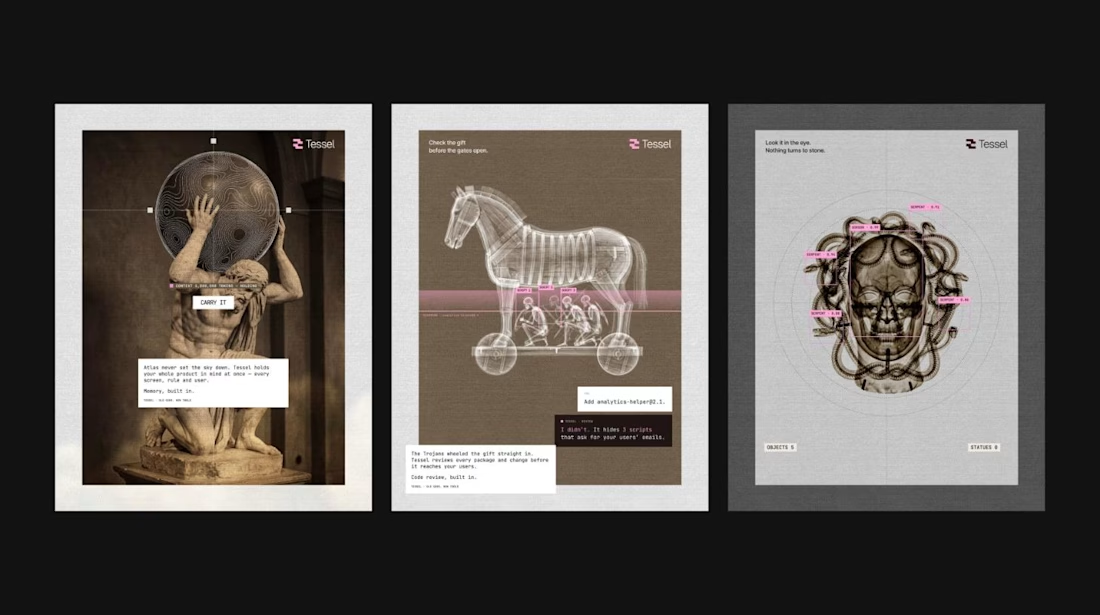
Branding an AI app builder with X-rayed Greek myths.
Tessel needed a brand that explains the product without a feature list, so every capability got a myth. Atlas holds your whole product in memory. Argus watches uptime. The Trojan Horse is code review. Apollo is voice. Medusa is visual QA.
Each poster pairs an archival image with a live-UI overlay, so it reads classical and engineered at the same time. Nine posters, one design system, one rule: the metaphor does the explaining.
Full project on my profile.


Landing page for Syntria, a platform that pulls scattered data into one clear view.
The goal was to make complex data feel calm and simple: dark navy tones, a glowing globe and a clear 4-step story from raw data to decision.
Designed and built with Claude Code.
Skills: Web Design, UI/UX Design, Landing Page Design, SaaS Design
Tools: Claude Code
Tags: saas, data platform, ai, dark ui, landing page, web design, b2b, dashboard, tech startup

The 4-step story from raw data to decision makes Syntria easy to grasp, Shakib. Dark navy with the glowing globe works really well for a data platform.