The network for creativity
Join 1.25M professional creatives like you
Connect with clients, get discovered, and run your business 100% commission-free
Creatives on Contra have earned over $150M and we are just getting started
Back to feedPost

A successful checkout doesn't necessarily mean a successful product.
What happens if:
• The payment succeeds, but the order isn't created?
• The user refreshes during payment?
• The same transaction is submitted twice?
• The confirmation email never arrives?
These are the scenarios that happy-path testing often misses.
Good QA isn't just about confirming that a feature works. It's about understanding how it behaves when things don't go as planned.
That's where real product reliability begins.
#QualityAssurance #SoftwareTesting #SaaS #ProductDevelopment
The network for creativity
Join 1.25M professional creatives like you
Connect with clients, get discovered, and run your business 100% commission-free
Creatives on Contra have earned over $150M and we are just getting started



Related posts

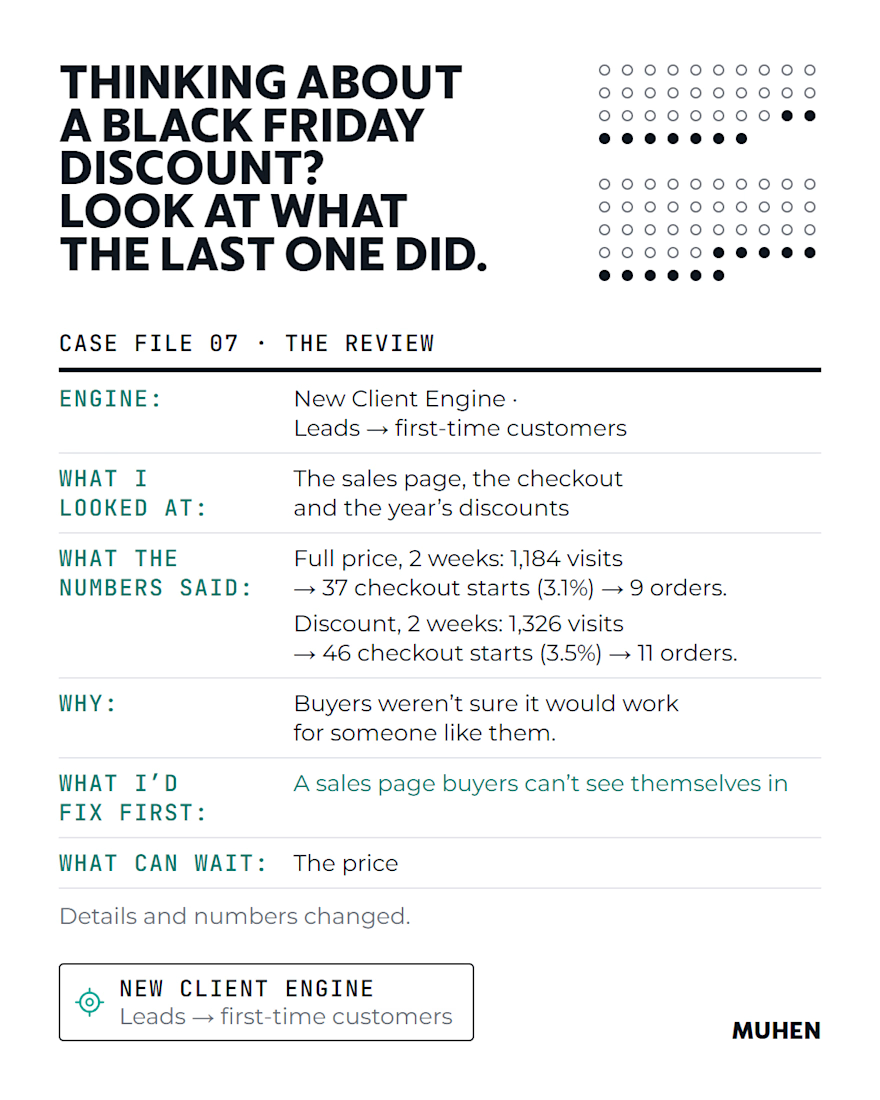
It's Black Friday, so here's one from my case files on discounts.
An online coach has a slow month, so a discount goes out. It's the third one that year. This sits in what I call the New Client Engine, the stretch where leads become first-time customers. I looked at the sales page, the checkout and the year's discounts.
Here's what the numbers said. Two weeks at full price brought 1,184 sales page visits, 37 checkout starts (3.1%) and 9 orders. Two weeks on the discount brought 1,326 visits, 46 checkout starts (3.5%) and 11 orders. Visits went up. Almost the same share of them led to a checkout start.
Why? Buyers weren't sure the program would work for someone like them. Nothing on the page spoke to their situation, and every story they'd seen came from a different kind of person at a different stage. A cheaper version of something you doubt is still something you doubt.
Based on these numbers, I wouldn't run another discount. I'd fix the sales page first, so buyers can see themselves in it. At full price, 1,147 of 1,184 visits ended without a checkout start, and the discount barely changed that.
The price can wait. It can stay right where it is.
Case File 07. Details and numbers changed.


Believable is the new viral.
I dropped that line in a comment on my partner Jamal's post yesterday.
And I meant every word of it.
Anyone can go viral.
A funny hook. A bold claim. A trending sound.
But viral doesn't book demos.
Believable does.
B2B SaaS founders don't lose deals because nobody saw them.
They lose deals because nobody believed them fast enough.
Your homepage has 5 seconds to answer 3 questions:
Is this for me?
Can I trust this?
What happens next?
If it fails any of those, they bounce — even if your product is 10/10.
That's why I built WordBuilt.
We don't chase viral.
We build believable.
Promise gets attention.
Mechanism gets conversion.
What does your homepage make people believe in the first 5 seconds?
#WordBuilt #B2BSaaS #Copywriting

This is an important point. Getting visitors to your website is only the first step. The real challenge is giving them a reason to trust your offer.
A strong homepage doesn't just grab attention; it removes doubts, communicates value clearly, and makes the next step obvious.
...


