The network for creativity
Join 1.25M professional creatives like you
Connect with clients, get discovered, and run your business 100% commission-free
Creatives on Contra have earned over $150M and we are just getting started
Back to feedPost

I used to think learning Kubernetes was mostly about learning Kubernetes. 😅
Then I realized something…
You can memorize kubectl commands, write YAML files, and deploy containers, but when something breaks, you eventually end up talking to Linux.
That’s where things get interesting. 🐧
A Kubernetes pod is running on a Linux system. Containers rely heavily on Linux concepts. Networking, processes, permissions, filesystems, logs, CPU, memory, and ports all connect back to the OS.
So before jumping into Kubernetes, I’d learn Linux fundamentals step by step:
→ Navigate the filesystem
→ Understand processes & signals
→ Learn permissions and users
→ Work with networking and ports
→ Read logs and troubleshoot services
→ Understand CPU & memory usage
→ Get comfortable with SSH and the terminal
Kubernetes becomes much easier when you understand what’s happening underneath it. 🚀
My biggest takeaway: Don’t just learn the orchestration layer. Learn the system it orchestrates.
I write more practical developer content here: blog.webdevlab.org
🐧 Have you learned Linux before Kubernetes, or did you jump straight into Kubernetes?
#Linux #Kubernetes #DevOps #CloudComputing #SoftwareDevelopment
blog.webdevlab.org
Blog - WebDevLab
Explore articles on Web3, AI, mobile development, backend scaling, and full stack development at WebDevLab.
The network for creativity
Join 1.25M professional creatives like you
Connect with clients, get discovered, and run your business 100% commission-free
Creatives on Contra have earned over $150M and we are just getting started
Trending
retrofuturism
Share your favorite designs from the past exploring the distant future. Or your own take on the aesthetic 🚀
halftone
Dots. Texture. Grain. Let's see your designs using the halftone technique.

Midjourney
Creatives are showing off what they're making with Midjourney.
colorgrade
Video editors sound off: How do you enhance the mood of your video in color grading?
Related posts

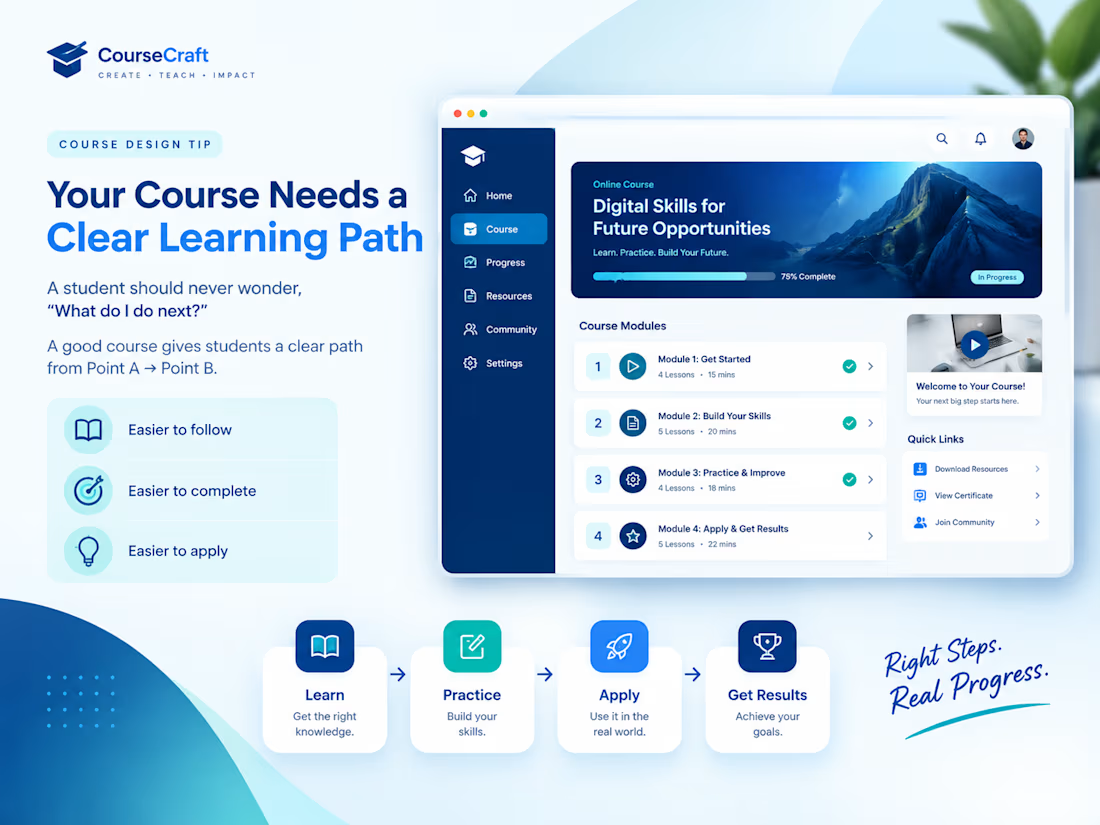
A student should never wonder:
“What do I do next?”
A good course gives students a clear path from Point A → Point B.
For example:
Learn → Practice → Apply → Get Results
Instead of giving students too much information, guide them through the right steps in the right order.
A clear learning path can make a course:
📚 Easier to follow
🎯 Easier to complete
💡 Easier to apply
The goal isn't to teach everything.
The goal is to teach what students need to reach the outcome.
How do you prefer courses to be structured?
#CourseCreation #CourseDeveloper #OnlineCourse #InstructionalDesign #Elearning #OnlineLearning #Kajabi


This is a good reminder that you don’t always have to have everything figured out before you start sharing your work.
Sometimes you just keep showing up, sharing what you’re working on, and having conversations along the way.
Then one day, you look up and realise you’ve built a community around your work.
Congrats on 1K, Divan! 🎉


Lovely

