The network for creativity
Join 1.25M professional creatives like you
Connect with clients, get discovered, and run your business 100% commission-free
Creatives on Contra have earned over $150M and we are just getting started
Back to feedPost
The 1450 MTU black hole: Why small HTTP requests succeed while large file transfers and TLS handshakes mysteriously hang and time out.
When migrating compute workloads to private or public clouds (OpenStack, GCP, or nested virtualization), network engineers frequently run into an elusive bug: ping works, SSH connects, but curl hangs indefinitely on TLS negotiation or git clone freezes at 98%.
This is the classic Path MTU Discovery (PMTUD) black hole caused by tunnel encapsulation.
Here is the exact network physics behind the failure:
1. The Standard 1500-Byte Frame: Linux VMs and physical hosts default to an Ethernet MTU of 1500 bytes. Applications negotiate a Maximum Segment Size (MSS) of 1460 bytes (1500 minus 40 bytes for IPv4/TCP headers).
2. The Overlay Encapsulation Penalty: Cloud Software-Defined Networking (SDN) protocols like VXLAN and Geneve encapsulate tenant packets inside an outer UDP packet. VXLAN adds a 50-byte header (14-byte Ethernet + 20-byte IP + 8-byte UDP + 8-byte VXLAN).
3. The Silent Drop: When an overlay network with 1500-byte physical interfaces transmits a full 1500-byte tenant packet, the resulting 1550-byte frame exceeds physical MTU. If the DF (Don't Fragment) bit is set, the switch drops the packet and sends an ICMP Type 3, Code 4 ("Fragmentation Needed") back to the sender.
4. The ICMP Firewall Filter: Over-zealous corporate firewalls or cloud security groups often block all incoming ICMP packets. The sender never receives the fragmentation notification and keeps retransmitting the unfragmented 1500-byte packet until timing out.
Resolving the MTU black hole requires deterministic network engineering:
• Physical Jumbo Frames (The Gold Standard): Configure the underlying physical network and hypervisor physical interfaces with MTU 9000 (or at least 1550). This allows tenant VMs to maintain a clean 1500-byte MTU with zero fragmentation overhead.
• Tenant MTU Clamping: When physical jumbo frames are not supported (such as nested cloud virtualization or unmanaged hosting), explicitly configure tenant networks with MTU 1450 (or 1442 for Geneve).
• TCP MSS Clamping in iptables/nftables: Enforce router-level MSS clamping on your border gateways: iptables -t mangle -A POSTROUTING -p tcp --tcp-flags SYN,RST SYN -j TCPMSS --clamp-mss-to-pmtu.
Never let silent packet fragmentation degrade your cloud application performance.
Audit and optimize your cloud network architecture with our 1-week Infrastructure & Cloud Architecture Audit on Contra:
#Networking #Cloud #CloudArchitecture #Infrastructure #Linux #DevOps #SRE #Architecture


The network for creativity
Join 1.25M professional creatives like you
Connect with clients, get discovered, and run your business 100% commission-free
Creatives on Contra have earned over $150M and we are just getting started



Related posts

The danger of SaaS Git dependency: When a vendor outage, account suspension, or price hike halts your entire engineering lifecycle.
Most modern technology companies anchor their entire software supply chain—source code, CI/CD pipelines, secret management, package registries, and issue tracking—to a single external SaaS provider (GitHub or GitLab).
While convenient, this model creates massive single-point-of-failure vulnerabilities and compliance liabilities:
1. Cascading Outage Disruption: When the SaaS provider suffers an incident, your developers cannot push code, CI pipelines cannot run security scans, and production emergency hotfixes are completely paralyzed.
2. IP Sovereignty & Data Exfiltration: Hosting sensitive proprietary algorithms, enterprise encryption keys, or regulated financial/healthcare intellectual property on multi-tenant commercial clouds carries inherent data exposure and regulatory audit friction.
3. Unpredictable Tier Pricing: Public SaaS platforms continually monetize developer seats, build minutes, and artifact storage, driving unexpected 40%+ operational cost increases.
The modern solution for resilient engineering organizations is deploying a self-hosted, sovereign Git forge (such as Forgejo or Gitea) integrated with dedicated, air-gapped CI/CD runners:
• Mathematical Resource Efficiency: Forgejo is a lightweight Go binary with a PostgreSQL backend. It delivers full Git hosting, PR reviews, issue management, and container registries consuming under 250MB of RAM—compared to 16GB+ for heavy alternatives.
• Native Actions Compatibility: Run standard, modern CI/CD workflows utilizing your existing YAML configurations with dedicated, bare-metal ephemeral execution runners.
• True Data Sovereignty: Store all git repositories, artifacts, and build logs on your own encrypted storage volumes (NVMe/Ceph) behind your zero-trust network perimeter.
• Hybrid Synchronization: Mirror external open-source dependencies locally for air-gapped security, while maintaining automated bidirectional replication to public repos when desired.
Take back control of your source code, your intellectual property, and your developer workflow.
Deploy a production-hardened sovereign Git forge with our 1–2 week Sprint on Contra:
#DevOps #Infrastructure #Security #CyberSecurity #Automation #Linux #SRE #Architecture
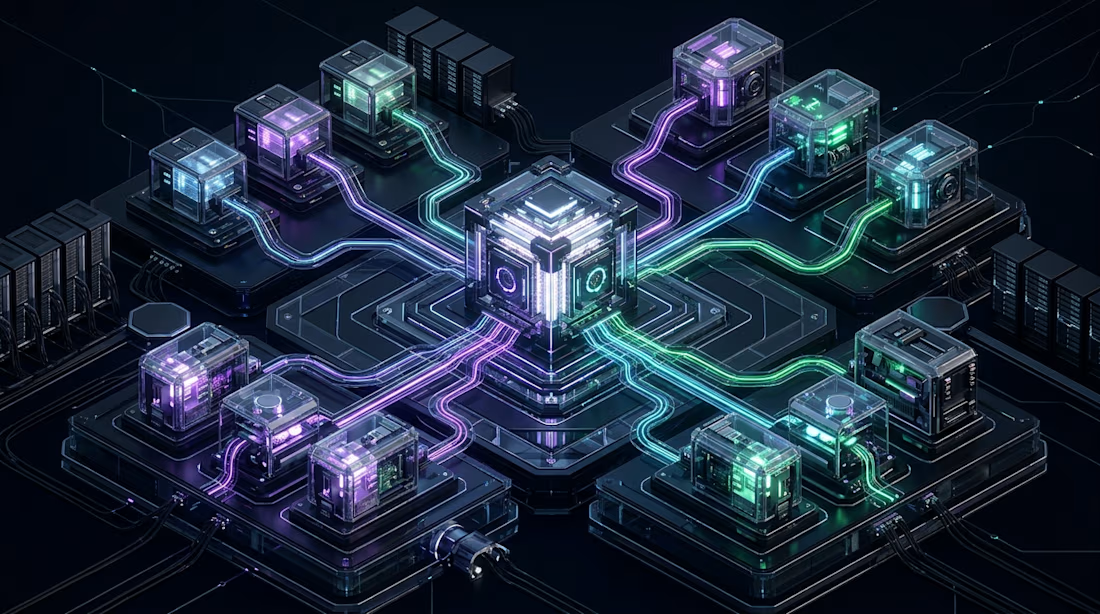

Enterprise Data Center Infrastructure with Server Racks, Structured Network Cabling and High-Density Computing Environments
A premium technology visualization exploring enterprise data center infrastructure, server rack systems, and high-density computing environments. The composition features symmetrical rows of server cabinets, structured overhead cable management, interconnected network infrastructure, and a centralized server corridor representing a modern enterprise computing facility. Designed for technology companies, startups, SaaS businesses, and digital product teams, these visuals can be used for website hero sections, digital marketing campaigns, pitch decks, corporate presentations, product launch materials, brand identity systems, editorial and publication design, commercial advertising and technology projects.
Available for freelance projects in 3D visual design for AI, cybersecurity, cloud infrastructure, SaaS, business and enterprise technology.
#DataCenter #ServerInfrastructure #EnterpriseTechnology #NetworkInfrastructure #ServerRacks #DataCenterDesign #HighDensityComputing #ITInfrastructure #TechnologyVisualization #3DDesign


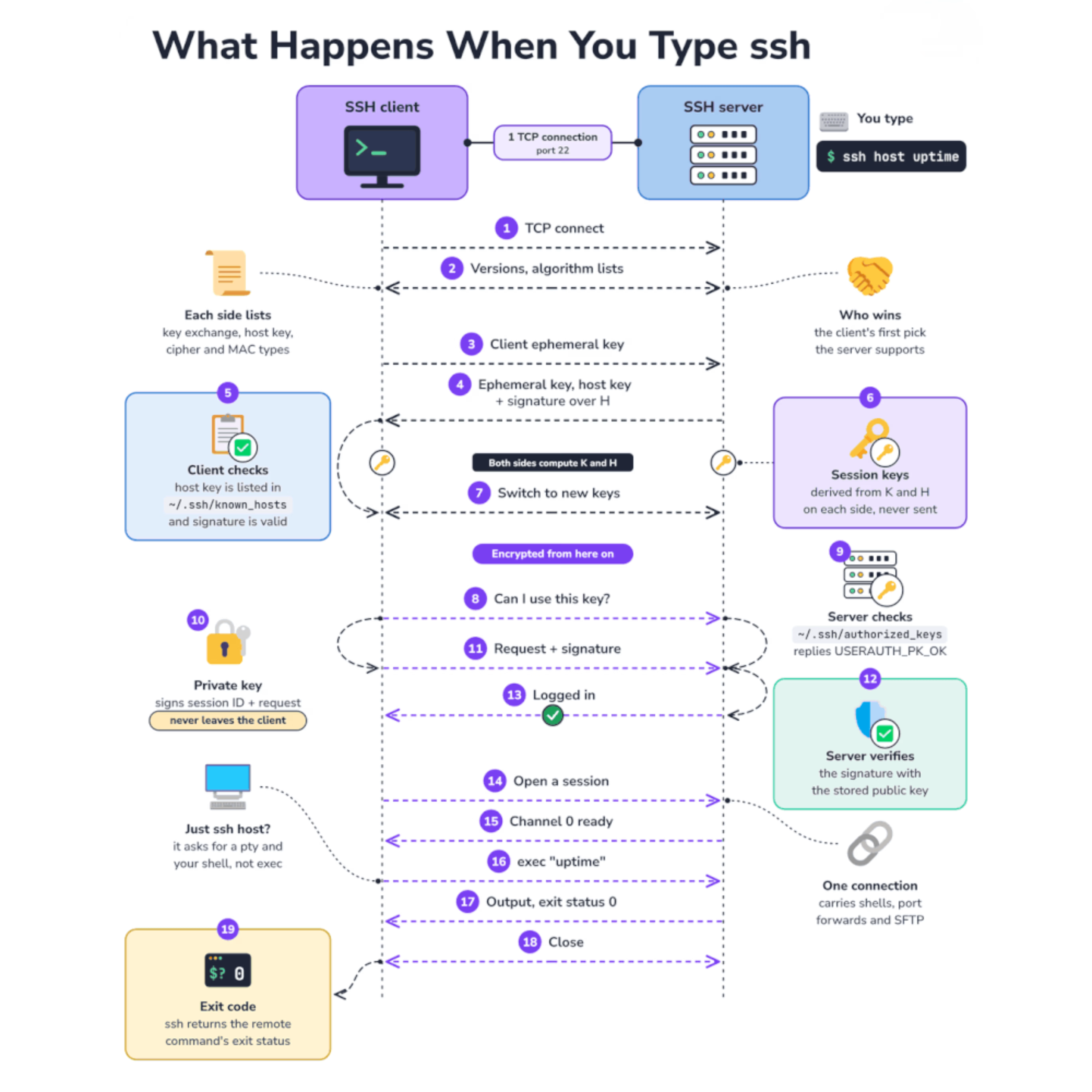
What Actually Happens When You Type ssh host uptime? 🖥️

What Actually Happens When You Type ssh host uptime? 🖥️
Typing a simple command like $ ssh host uptime feels instant, but there is a massive amount of cryptographic heavy lifting happening under the hood.
This sequence diagram perfectly breaks down the 19 steps that happen in the...