The network for creativity
Join 1.25M professional creatives like you
Connect with clients, get discovered, and run your business 100% commission-free
Creatives on Contra have earned over $150M and we are just getting started
Back to feedPost

What Actually Happens When You Type ssh host uptime? 🖥️
Typing a simple command like $ ssh host uptime feels instant, but there is a massive amount of cryptographic heavy lifting happening under the hood.
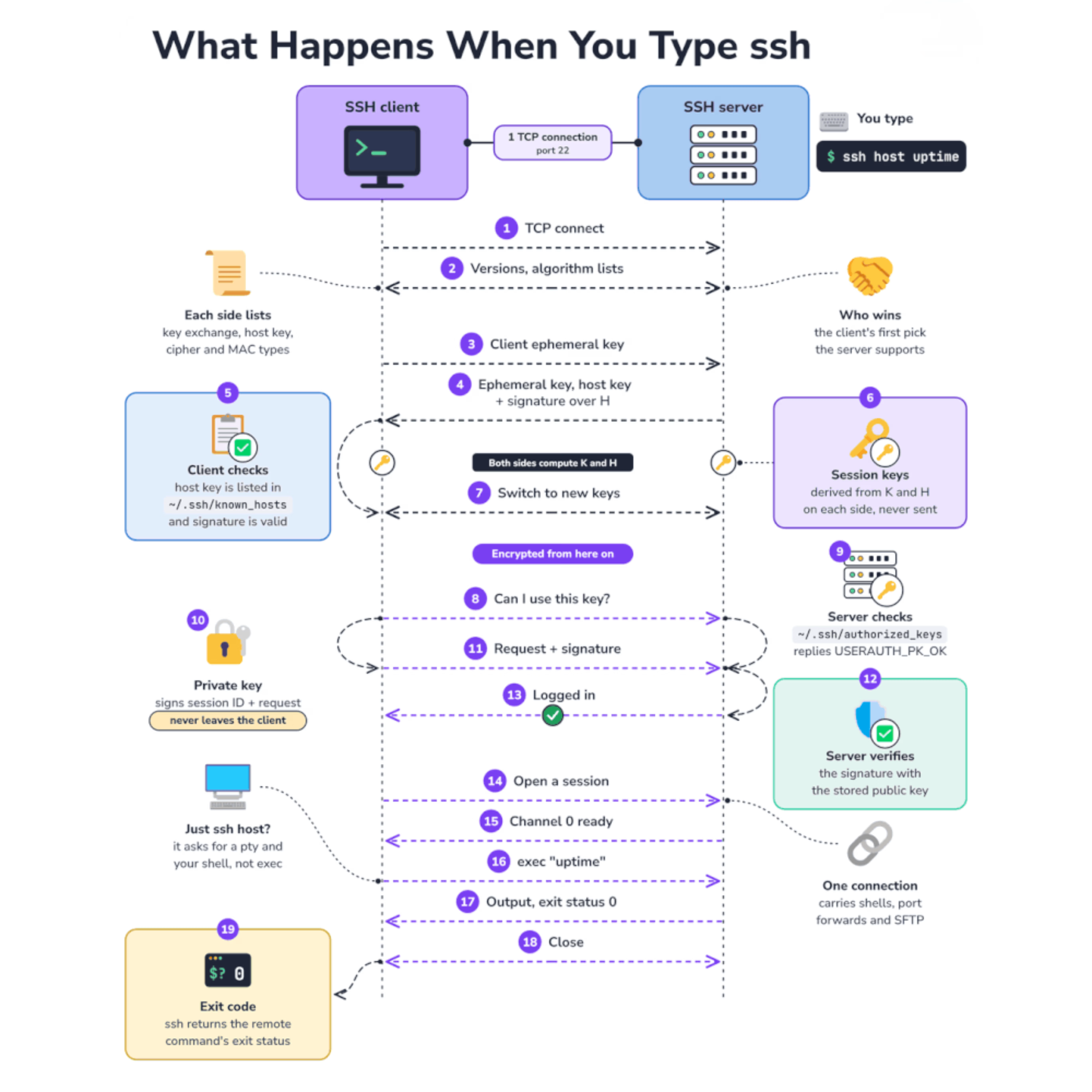
This sequence diagram perfectly breaks down the 19 steps that happen in the milliseconds after you hit enter. Whether you are deploying an Airflow pipeline, configuring remote Docker containers, or spinning up an MCP server, SSH is the backbone of backend infrastructure.
Here is what is actually happening:
1️⃣ The Handshake & Key Exchange (Steps 1-7): It starts with a TCP connection on port 22. Both sides negotiate algorithms and exchange ephemeral keys to compute session keys. From step 7 onward, the connection goes dark and everything is fully encrypted.
2️⃣ Authentication (Steps 8-13): The client checks the host key against ~/.ssh/known_hosts. Then, it asks to use a key, the server checks ~/.ssh/authorized_keys, and the client's private key signs the request without ever leaving the client machine.
3️⃣ Execution & Teardown (Steps 14-19): Once logged in, a session is opened, the command (exec "uptime") runs, and the server returns the output and an exit status code before safely closing the connection.
Understanding this lifecycle is crucial for debugging deployment issues, securing automated pipelines, or setting up secure remote environments.
What is your favorite terminal command that hides this level of complexity? 👇
The network for creativity
Join 1.25M professional creatives like you
Connect with clients, get discovered, and run your business 100% commission-free
Creatives on Contra have earned over $150M and we are just getting started
Related posts

Blog Listening Web Application With Admin Dashboard.
webdesignappdesignadmindesignBackend DevelopmentFrontend DevelopmentFull Stack DevelopmentExpressJSNext.jsTailwind CSS


Every client has said this at least once:
"It’s just one small change."
Then auth breaks, database need a migration, one integration stops working, and somehow it’s 2 AM 😅
Writing the change is usually easy. Finding everything it can break is the real work.
What was your biggest “small change”?


This is so relatable — that line about finding everything it can break being the real work is spot on. The 2 AM part made me laugh.

Building software is easier than ever. Knowing it’s ready for real users still takes engineering.
What happens when a payment fails, traffic spikes, or an update breaks something?
At EntaLogics, we build for those moments too.
Anyone can build software now. We make sure yours survives.
#EntaLogics #SoftwareEngineering #SoftwareDevelopment


Amazing work