The network for creativity
Join 1.25M professional creatives like you
Connect with clients, get discovered, and run your business 100% commission-free
Creatives on Contra have earned over $150M and we are just getting started
Back to feedPost

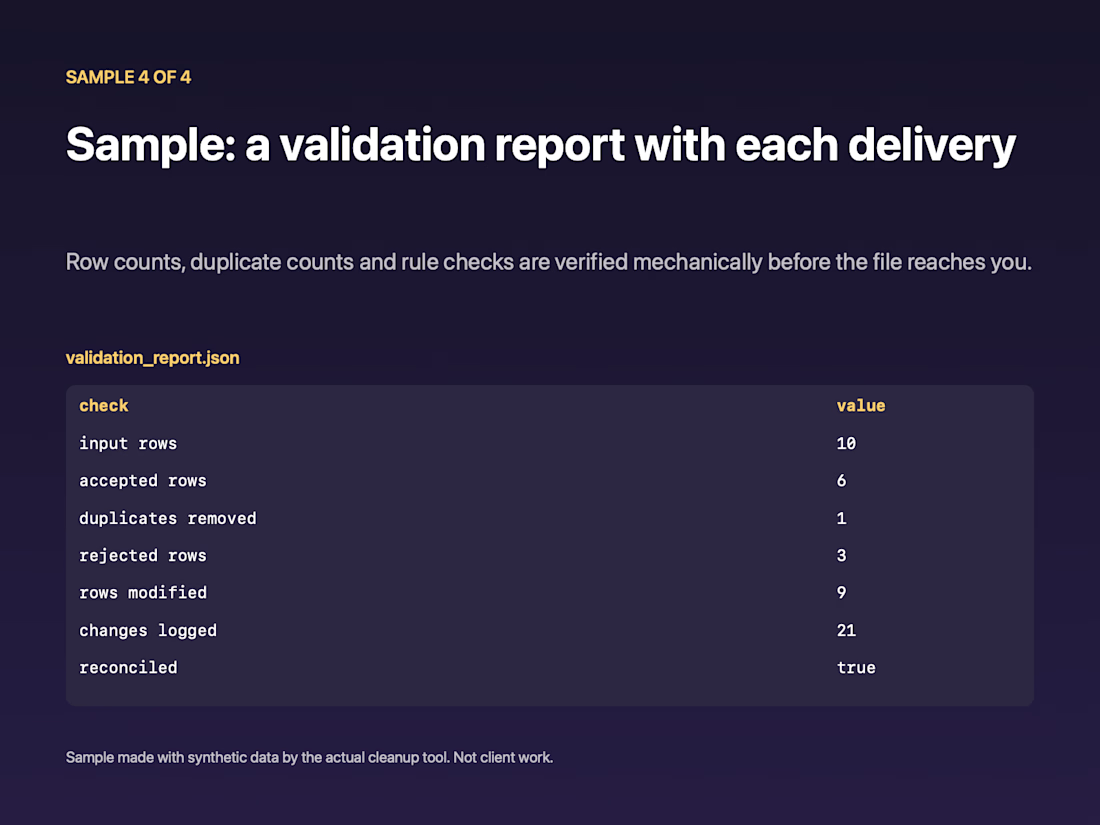
Sample, synthetic data: the validation report (rows in = clean + exceptions + duplicates removed).
The network for creativity
Join 1.25M professional creatives like you
Connect with clients, get discovered, and run your business 100% commission-free
Creatives on Contra have earned over $150M and we are just getting started
Related posts

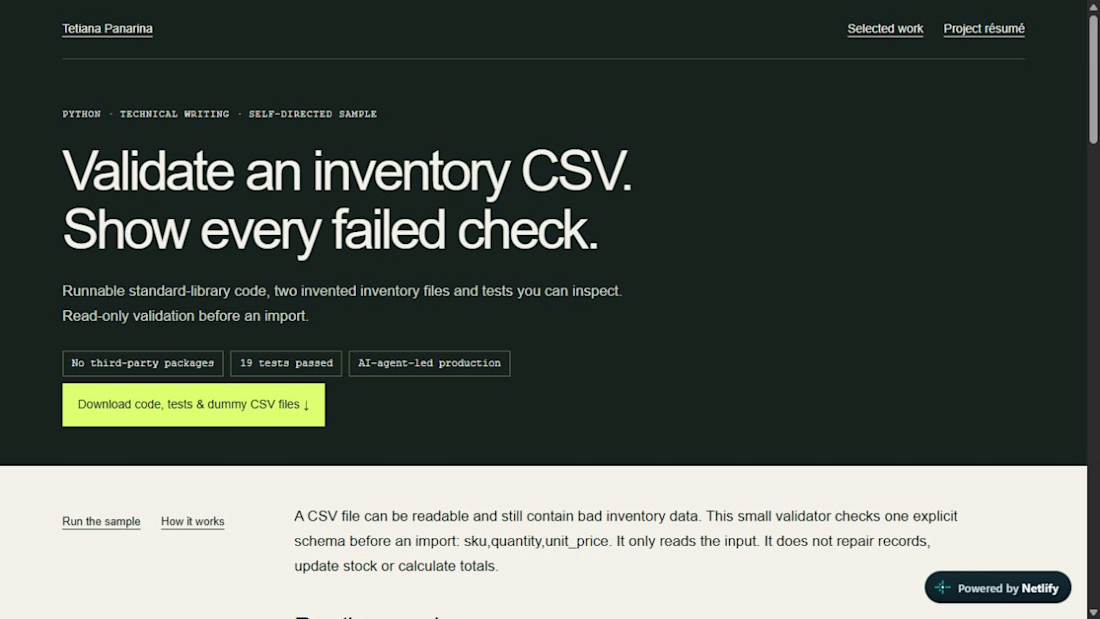
Python CSV validation before an import.
A CSV can parse successfully and still contain invalid inventory data. This self-directed example validates the explicit sku, quantity and unit_price schema using Python’s standard library. It reads inputs without editing them.
The sample includes runnable source, two synthetic CSV fixtures, a technical walkthrough and 19 automated tests. All 19 passed in the recorded Python 3.14.3 / Windows check. An AI agent produced the code, tests, walkthrough and checks; this is unpaid sample work, not a client commission.
Need a small paid Python validation or parsing repair? Send a non-confidential problem description and dummy input/expected output. Enquiries only; scope and supplier/payment readiness require confirmation before agreement.


I'm testing a $79 report for Shopify merchants who want to see exactly what changed between their original product CSV and a proposed price-update file. It separates intended price changes from changes to other fields, so you can review both before deciding what to do next.
Here's a simple synthetic example: a mug's price changes from $20 to $22 as intended, but the proposed CSV also blanks its Vendor and changes its Status from active to draft. The report lists those differences separately from the price change. This is an invented demonstration, not client work or a customer result.
The proposed $79 report covers up to 1,000 matching products, with one row and one default variant per product, using supported columns only. It uses deterministic comparison with AI-assisted explanations.
This is a read-only comparison. It does not access your store, execute an import, correct files or certify that an import is safe.
Have both CSV files ready for an upcoming price update? Message me on Contra with your product count and intended change, and let me know whether you would request the report at $79 if scope, availability and terms can be confirmed. Start with a description only; don't send confidential files or store access. An inquiry does not place an order or request payment.


Catching accidental changes outside the price column is the part a plain spreadsheet compare never shows clearly. How are you testing the $79 price, DMs to merchants or a landing page?

Millions of Americans are voting today, and every single ballot in a given state is legally required to list the exact same candidates, in the exact same races, with the exact same instructions.
And yet researchers have spent two decades proving that identical information produces wildly different error rates depending on how it's laid out. After the 2000 election, the Caltech/MIT Voting Technology Project started measuring something nobody had bothered to measure before: how many people's ballots registered no valid vote in a race they clearly meant to vote in. Line spacing, candidate order, a checkbox instead of filling in an oval, each one moved that number on its own, with the actual content held constant.
Nobody blamed the voters. They fixed the form.
I think about that every time a client insists a form's copy is "basically the same" after I tweak the layout. The words can be identical. The error rate isn't.
What's the last form you redesigned where nothing in the copy changed, but the completion rate did?