The network for creativity
Join 1.25M professional creatives like you
Connect with clients, get discovered, and run your business 100% commission-free
Creatives on Contra have earned over $150M and we are just getting started
Back to feedPost

THE BODY THAT COULDN’T ESCAPE
MUSEUM PIECE DESCRIPTION
Egon Schiele’s Self-Portrait (1911) is a watercolor, graphite, and gouache work on paper depicting the artist in a tense, angular pose suggestive of the crucified Christ. His bony, distorted figure, wild eyes, open mouth, raised hair, and agitated pencil lines create a powerful sense of inner tension. The Met describes Schiele’s self-portraits from this period as psychologically complex images.
Original artwork — The Metropolitan Museum of Art:
https://www.metmuseum.org/art/collection/search/483438
MY REIMAGINING
The painting is not simply being drawn. It is struggling to exist.
I reimagined Schiele’s Self-Portrait as a 20-second experimental 2D animation about anxiety, internal pressure, and the feeling of being trapped inside your own body and image.
The animation begins with an empty beige sheet. A nervous pencil stroke appears, followed by frantic graphite and charcoal marks. A fragment of the figure emerges, disappears, and is redrawn. An arm appears, vanishes, returns differently. A shoulder forms and is erased. A torso emerges and collapses back into scribbles. A face flashes into existence. An eye appears, disappears, and returns.
The figure repeatedly becomes more recognizable and then less recognizable.
Appear → disappear → erase → redraw → distort → repeat.
The man is already alive before he is fully formed. Even during the construction phase, he twitches, shifts, reaches, recoils, and struggles against the drawing around him.
Color slowly infiltrates the graphite: faint orange and red watercolor becomes warmer flesh tones, burnt orange, reddish brown, and darker accents. The original visual language gradually takes over without ever becoming clean or stable.
At around ten seconds, the figure finally becomes whole.
But that is not the resolution.
Once complete, the man begins moving. His head, shoulders, torso, arms, and hands shift nervously. He reaches toward the viewer and recoils, creating a subtle 2.5D sensation while remaining entirely hand-drawn. His movement generates new graphite, charcoal, chalk, and watercolor marks, and the same cycle of appearance, disappearance, and redraw returns inside the completed image.
The movement becomes increasingly frantic.
The figure looks desperate to scream, to escape his own outline, to break through the surface of the painting.
At the climax, his body stretches outward, the marks become chaotic, and the image feels like it is about to explode under unbearable internal pressure.
But it never actually explodes.
The pressure is held back.
The figure freezes at maximum tension.
Then, in a hard cut, everything disappears.
Blank beige paper.
And the first nervous mark begins again.
The anxiety never resolves. The painting is condemned to recreate itself over and over.
PROCESS
I built the piece in FLORA through an iterative process of rapid drawing, erasure, redrawing, movement, watercolor layering, and visual distortion.
The central creative decision was to change how the artwork exists in time rather than simply animating the finished painting. The act of forming and destroying the image becomes part of the emotional narrative.

The network for creativity
Join 1.25M professional creatives like you
Connect with clients, get discovered, and run your business 100% commission-free
Creatives on Contra have earned over $150M and we are just getting started
Trending
retrofuturism
Share your favorite designs from the past exploring the distant future. Or your own take on the aesthetic 🚀
halftone
Dots. Texture. Grain. Let's see your designs using the halftone technique.

Midjourney
Creatives are showing off what they're making with Midjourney.
colorgrade
Video editors sound off: How do you enhance the mood of your video in color grading?
Related posts

This is my 2nd Submission
Check my 1st submission at this link:
https://on.contra.com/CbjhLm
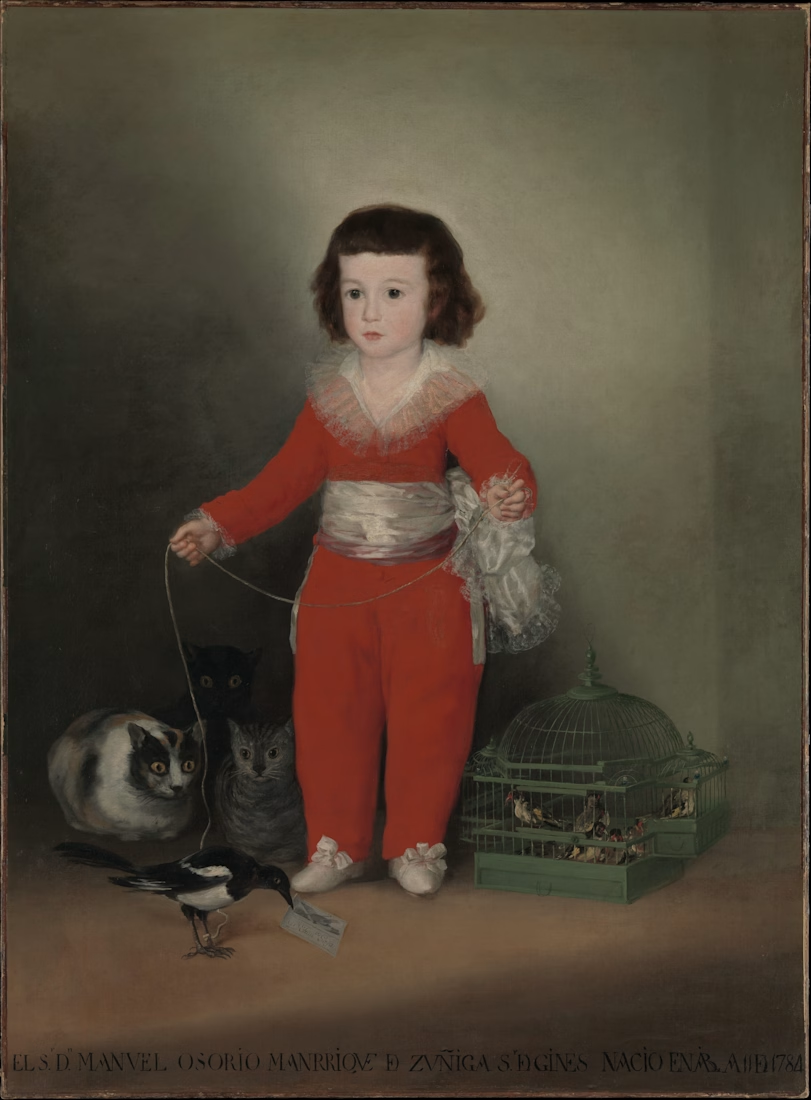
Inspired by: Manuel Osorio Manrique de Zúñiga, Francisco Goya, 1787–88, from The Met's open archive.
Link to Original Art: https://www.metmuseum.org/art/collection/search/436545
I liked this painting because of the boy at its center, Manuel, dressed in a striking red suit, holding a magpie on a string while three cats watch him from the shadows. Even as a child's portrait, it felt tense, like something was about to happen. It looked like a moment frozen right before a story unfolds.
What I made: I turned Manuel into a toy doll, kept his red suit, his pose, his face, everything the same, just changed what he is. In my video, a father buys the doll from a toy shop and gives it to his little daughter, and they walk out together. I chose a girl instead of a boy on purpose, it felt like giving Manuel a second life completely outside the world he was painted into, away from the cats, the cage, the tension, just a toy being loved.
How I made it: I downloaded the painting image from The Met's open archive, then imported it into FLORA, connected the picture to a text prompt node, then connected both the picture and text prompt node to the video node I also made an element Doll, and selected the Seedance 2.5 model with a 30 second clip. I kept the workflow as simple as possible.
Why I made this: I wanted to take Manuel out of the painting and out of the museum, and give him an actual childhood, even 230+ years later. I think his portrait still holds so much presence that it deserves to live on, just now as something a child can actually hold and love, not just look at.
Instagram post link:
https://www.instagram.com/p/Dc8SwEJMwP3/
Twitter(X) post link: https://x.com/AhmadSauleh/status/2096539462402466095?s=20

Awwwww so sweeet, ideaaa!!!
This is my 3rd and last submission, I have many Ideas so I combined them into one,
Inspired by:
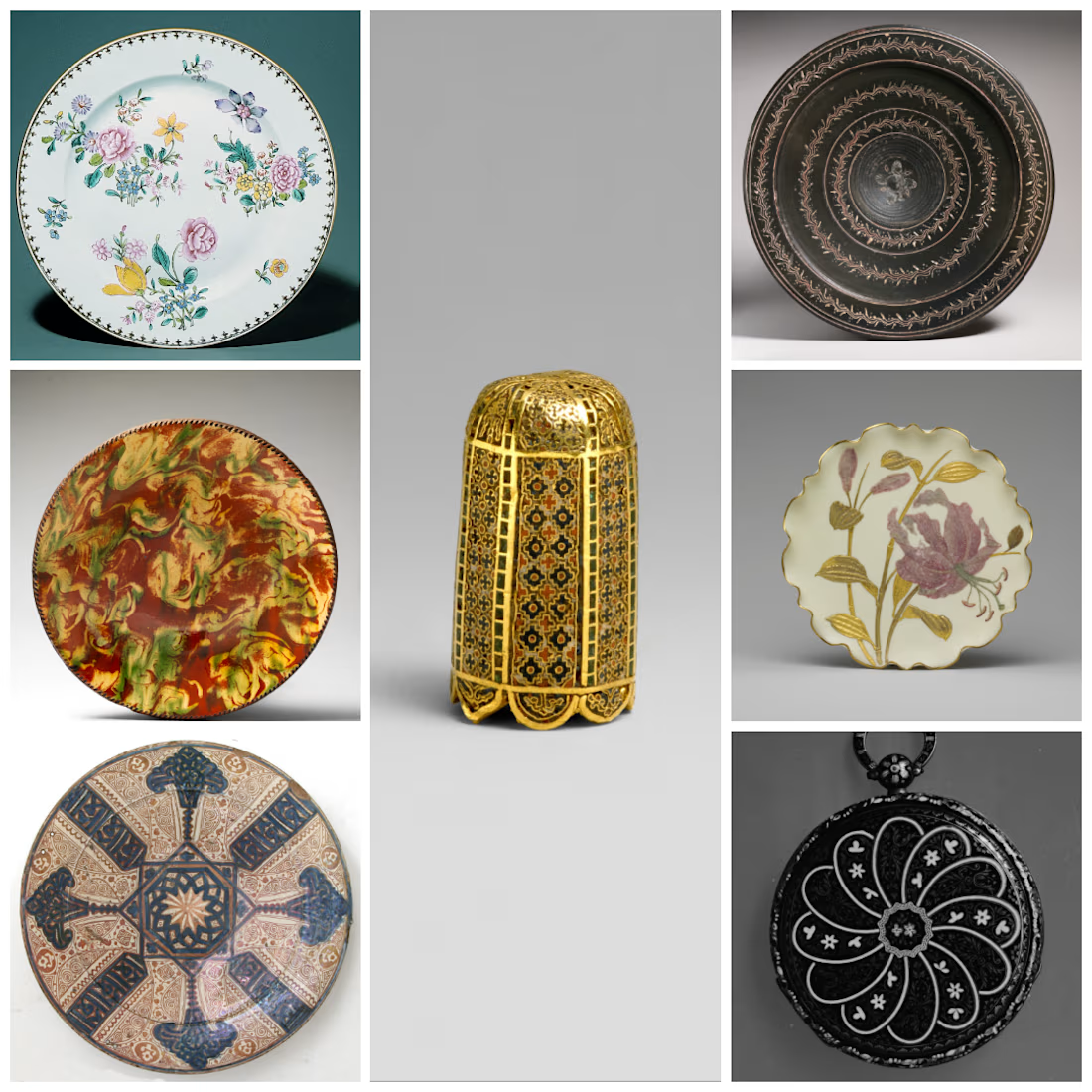
1. Tip of a Pointer, Bayzantine 1080–1150 As cylindrical bullet seats
Link to Art: https://www.metmuseum.org/art/collection/search/466296
2. Watch pobably swiss, ca. 1815-20 As key charm
Link to Art: https://www.metmuseum.org/art/collection/search/193359
3. i- Terracotta plate, Greek, South Italian, Campanian, Teano, ca 330-300 BCE
Link to Art: https://www.metmuseum.org/art/collection/search/248185
ii- Plate, ott and Brewer American, Retailer Bailey, Banks & Biddle American, ca 1884-90
Link to Art:
iii- Plate America, ca. 1800-20
Link to Art: https://www.metmuseum.org/art/collection/search/5996
iv- Plate, Spanish, late 14th-early 15th century
Link to Art: https://www.metmuseum.org/art/collection/search/468520
v- Plate, 1736-95
Link to Art: https://www.metmuseum.org/art/collection/search/6448
As Ear Rings
What I built:
I made a video which shows the use of old Art as being used in modern daily life as different objects
Why I built:
I built this because I think the old Art can be used in modern day if we look it from new and different perspective, I wanted to give a different point of view to everyone for seeing the old Art differently
In short I used multiple old art works and I tried to show how they can be used in today's life
In all my three submission I focused on the Judging points specially, building the world around the art, and changing one thing about it, and making it feel realistic
Instagram Post Link:
https://www.instagram.com/p/Dc84QrYNYrE/
Twitter(X) Post Link:
https://x.com/AhmadSauleh/status/2096623920396796398?s=20

How did you came up with this idea, It is really nice for using the old Art as new things such as Ear rings, seats, keychain

She was created to watch humanity.
To witness laughter, love, fear, death —
but never to experience any of it.
So one day, she asked a forbidden question:
Why can they live... while I can only watch?
She was given an answer.
It wasn't enough.
She fell.
And when she finally touched the Earth, she discovered something Heaven had never taught her:
some things are easier to survive than to control.
Her wings changed.
Her eyes changed.
And everything she looked at began to change with her.
The gods eventually found her.
But by then, she was no longer the angel who had fallen.
She had become something else.
And when they asked her to return, she gave them an answer of her own.
The story ends there.
Or perhaps that's where it finally begins.
This project was created in FLORA as part of the FLORA Museum Challenge, using works from The Metropolitan Museum of Art's Open Access collection as the foundation for the world and visual language of the story.
Artworks from The Met that inspired this work:
Marble statue of a lion
Greek
ca. 400–390 BCE
https://www.metmuseum.org/art/collection/search/248140
Marble statue of a wounded Amazon
Roman
1st–2nd century CE
https://www.metmuseum.org/art/collection/search/253373
Angel
Italian, Naples
late 18th–early 19th century
https://www.metmuseum.org/art/collection/search/206717
A Forest at Dawn with a Deer Hunt
Peter Paul Rubens, Flemish
ca. 1635
https://www.metmuseum.org/art/collection/search/437526
Bronze statuette of Apollo
Greek
ca. 500 BCE
https://www.metmuseum.org/art/collection/search/247971
Madonna and Child with the Young Saint John the Baptist
Fra Bartolomeo (Bartolomeo di Paolo del Fattorino), Italian
ca. 1497
https://www.metmuseum.org/art/collection/search/435614
Marble statue of an old woman
Roman
14–68 CE
https://www.metmuseum.org/art/collection/search/248132
Ruins of a Temple by a Lake
Etienne Allegrain, French
https://www.metmuseum.org/art/collection/search/334748
The original artworks belong to The Metropolitan Museum of Art's Open Access collection.
Built with @FLORA AI
#FLORAMuseum

I really like ur workflow