The network for creativity
Join 1.25M professional creatives like you
Connect with clients, get discovered, and run your business 100% commission-free
Creatives on Contra have earned over $150M and we are just getting started
Back to feedPost

The single-threaded freeze: Why issuing O(N) commands like KEYS * on a production Redis instance halts your web fleet and causes cascade timeouts.
Redis is famed for sub-millisecond responses and blistering throughput, often handling 100,000+ operations per second on a single core. But Redis achieves this speed using an **in-memory, single-threaded event loop**. It processes commands sequentially: one command must complete before the next command can begin.
When an engineer or automated script executes an unbounded O(N) command against a production Redis database containing millions of keys: 1. Total Event Loop Paralysis: Running ``KEYS user:*`` forces the single Redis execution thread to iterate through every single bucket in the entire keyspace dictionary. If you have 10 million keys, this blocking operation can freeze the event loop for 3 to 15 seconds. 2. Cascade Application Timeouts: While Redis is blocked executing ``KEYS *``, it cannot process any other command. Every application worker requesting a session token, rate limit counter, or cache entry stalls. Connection pools exhaust, HTTP request queues fill up, web servers return 504 Gateway Timeouts, and your entire platform experiences an outage. 3. The Replication Disconnect: Because the Redis master thread is frozen, it fails to send ping heartbeats to its replicas or Sentinel monitors. Sentinels declare the master dead, trigger an unnecessary failover, or replicas disconnect and trigger costly full resynchronizations.
Hardening production in-memory data stores requires strict command sanitation and non-blocking architectural hygiene: • Deprecate KEYS in Favor of SCAN: Never use ``KEYS *`` in production code. Replace it with the non-blocking ``SCAN`` cursor family (``SCAN``, ``SSCAN``, ``HSCAN``, ``ZSCAN``), which inspects the keyspace in small, bounded batches (e.g., 100 keys per iteration) without freezing the event loop. • Use UNLINK Instead of DEL for Large Keys: Deleting a hash, set, or list with 500,000 elements using standard ``DEL`` blocks the main thread while freeing memory. Use ``UNLINK``, which unbinds the key from the keyspace in O(1) time and reclaims memory asynchronously on a background worker thread. • Perform Asynchronous Flushes: If clearing an instance is necessary, always invoke ``FLUSHDB ASYNC`` or ``FLUSHALL ASYNC`` to prevent blocking the event loop during memory deallocation. • Rename and Disable Dangerous Commands: In ``redis.conf``, permanently disable or rename destructive commands using ``rename-command KEYS ""``, ``rename-command FLUSHALL ""``, and ``rename-command CONFIG ""`` to prevent accidental human or script outages.
Protect your low-latency caching tiers and eliminate self-inflicted service freezes.
Deploy hardened, high-availability database and caching infrastructure with our 2-week Database Clustering & Hardening Sprint on Contra: https://contra.com/s/QbN6svWo-high-availability-database-cluster-deployment-and-hardening
#Database #Backend #Performance #Architecture #SRE #DevOps #Infrastructure

The network for creativity
Join 1.25M professional creatives like you
Connect with clients, get discovered, and run your business 100% commission-free
Creatives on Contra have earned over $150M and we are just getting started





Related posts

CREARA is a Spain-based architectural firm with a unique selling point: creating spaces that align with the lifestyles desired by young families.
With a premium, minimalist aesthetic, the firm stands out by avoiding cookie-cutter designs, instead creating bespoke solutions tailored to each client's specific needs.
Focusing primarily on young families, the visual identity is soft, modern, and sustainable.




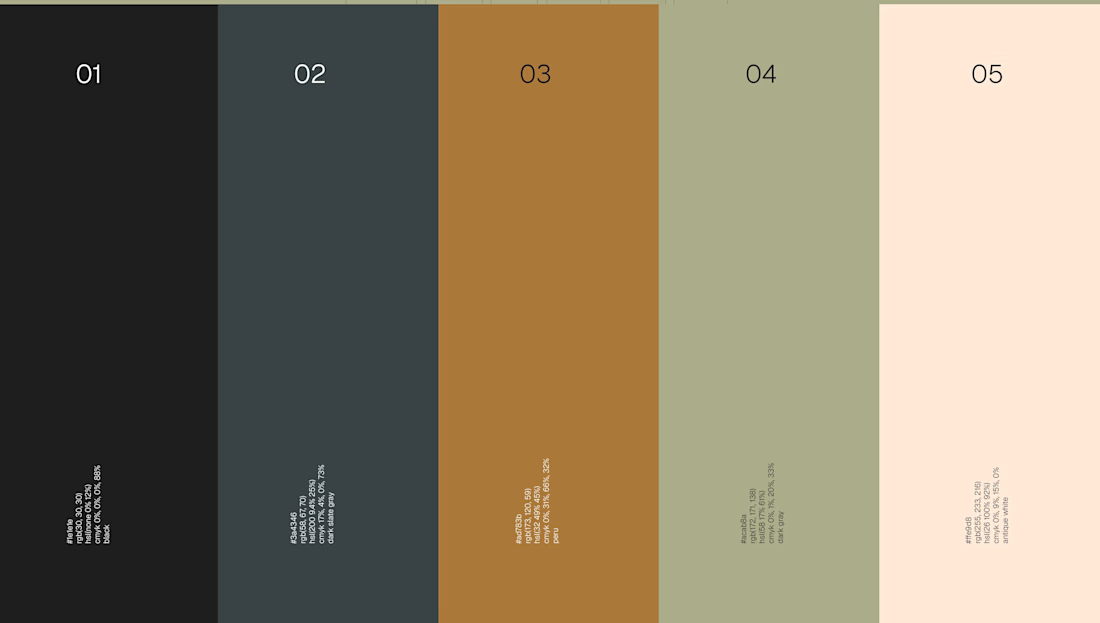


The young-families angle is the tricky constraint here, since premium minimal usually gets read as slightly untouchable and families are the audience least inclined to want that. The softened wordmark and the warmer half of the palette look like where that gets absorbed. Was the...

AetherOS is a web desktop for AI agents. The entire project sits inside a single HTML file. It starts with a boot screen. Then it opens into a dark workspace. The background has black animated particles. Everything runs on plain CSS and vanilla JavaScript. The site loads zero external dependencies and zero sound files.
The bottom dock holds seven apps. These tools manage four AI agents: Atlas, Sage, Bolt, and Vega. The Agents app shows them chatting and passing tasks. Files lets you browse a drive. Memory shows a live graph of what the system knows. Users can also modify a history timeline. Studio lets you test prompts. Flows builds node pipelines, and Cost tracks token usage.
Every window can be moved, resized, minimized, or maximized. The top menu bar has a model switcher. It routes tasks to Claude Opus 4.7, GPT-5.2, Gemini 3 Pro, DeepSeek V4, or Llama 4. The OS also has Spotlight search, sound toggles, and local API key inputs. The interface uses dark glass panels with blue highlights.
Building the node graphs in one single HTML5 file was tough. At first, the physics nodes pushed apart too hard. They floated right off the screen. Dragging extra lines while getting zoomed in also threw off the precise positions. I fixed the center gravity math. Then I divided mouse positions by the zoom factor. That stopped the unnecessary movement and kept the OS stable.😊


📦 One thing that makes React Native apps easier to scale: build features as modules, not as one giant app.
For example, instead of spreading payment logic across 8 screens, keep it grouped:
• UI
• state
• API calls
• validation
• analytics
• errors
• tests
The same goes for:
• auth
• onboarding
• profile
• chat
• subscriptions
• notifications
This makes it much easier to:
✅ change one feature without breaking another
✅ onboard new developers
✅ test functionality in isolation
✅ replace APIs later
✅ remove features cleanly
✅ scale the codebase without chaos
You don’t need enterprise architecture for a small app.
But you do need boundaries.
Good structure gives you speed later, not just cleanliness today. 🚀