The network for creativity
Join 1.25M professional creatives like you
Connect with clients, get discovered, and run your business 100% commission-free
Creatives on Contra have earned over $150M and we are just getting started
Back to feedPost

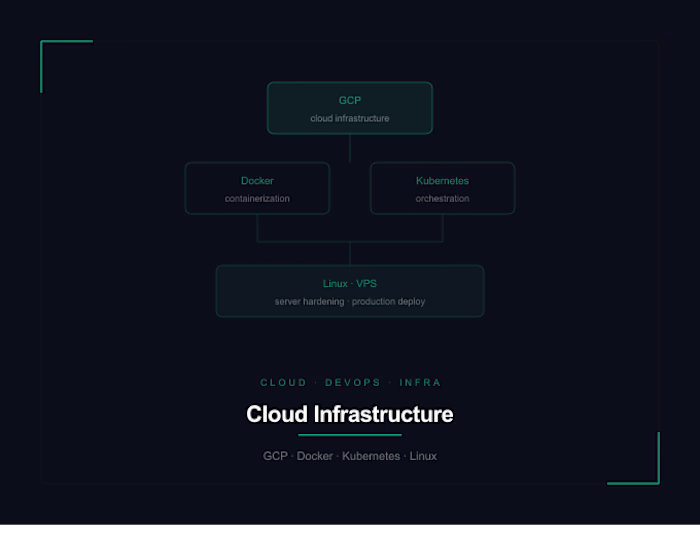
Cloud Infrastructure & DevOps Engineering
Designed and deployed cloud infrastructure for
early-stage startups — from bare VPS to containerized
production environments.
Delivered across 2 client engagements:
— GCP infrastructure setup and configuration
— Docker containerization and orchestration
with Kubernetes
— Linux server hardening and production deployment
— CI/CD pipeline implementation
— Monitoring and incident response setup
Each engagement ran 2–4 weeks, fully remote,
delivered autonomously from architecture to
production handoff.
Stack: GCP · Docker · Kubernetes · Linux · VPS


The network for creativity
Join 1.25M professional creatives like you
Connect with clients, get discovered, and run your business 100% commission-free
Creatives on Contra have earned over $150M and we are just getting started



Related posts

A cleanup on my Mac turned into a CI optimization across several projects.
It started with 30 GB of npm cache and another 20 GB in old node_modules folders. After recovering roughly 50 GB, I moved several projects to pnpm.
Updating CI for the migration led me to review the pipelines themselves. I found duplicate stages and Docker images carrying build-time dependencies and unnecessary files into production.
I removed the duplicate work and switched to multi-stage Docker builds, keeping only what each app needed at runtime.
On some projects, average CI runs dropped from 6–7 minutes to about 2. A few longer pipelines went from 15–16 minutes to around 6.
The pnpm migration also sped up dependency installs and gave me more control over dependency install scripts.
What’s had the biggest impact on build times in your projects?

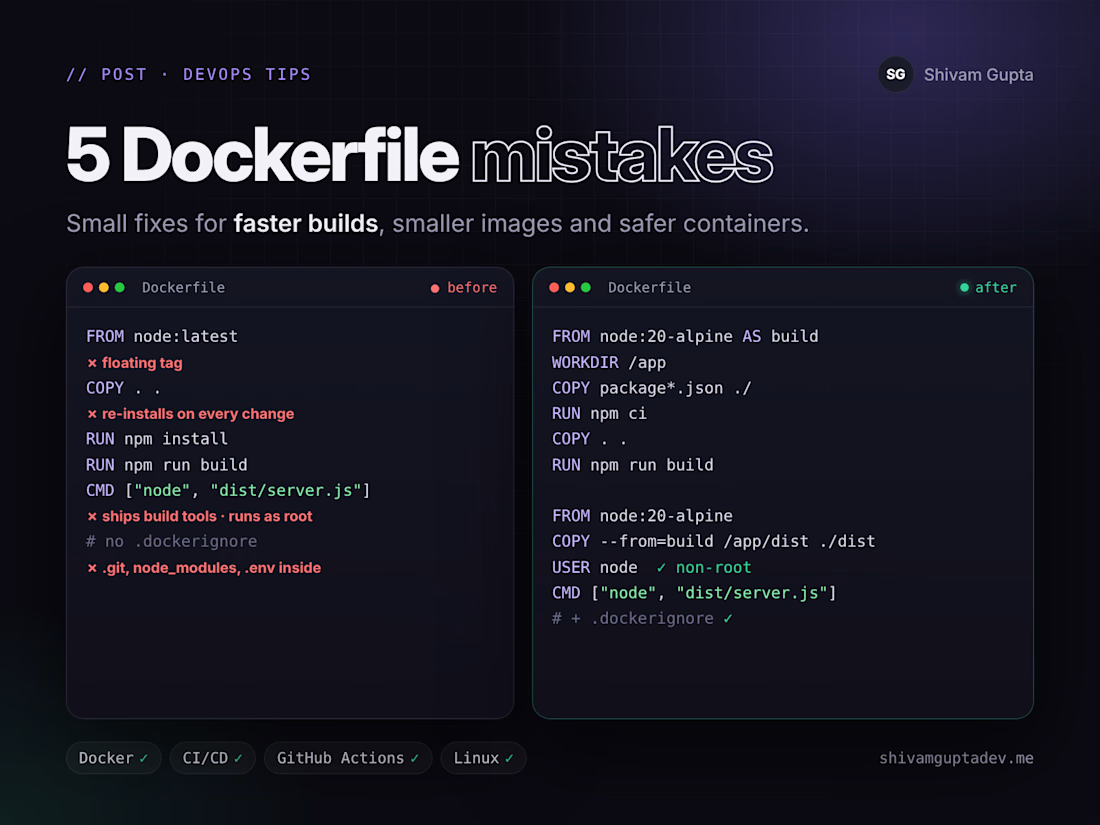
5 Dockerfile mistakes that make your app slower, bigger and less secure 🐳
Most Dockerfiles I see work fine. They're just slower, heavier and riskier than they need to be:
① Copying the whole project before installing dependencies. Every code change re-installs everything. Copy package files first, install, then copy the rest.
② Shipping build tools to production. Use a multi-stage build and copy only the output.
③ Running as root. Add a non-root USER. One line, big win.
④ No .dockerignore. node_modules, .git and local .env files end up inside your image.
⑤ Floating base images like node:latest. Pin a version so your build doesn't change under you.
Fix these and you get faster builds, smaller images and fewer surprises in production.
Need your app containerized with a proper CI/CD pipeline? That's exactly what I do.


Stravaulta - Cloud & Data Storage Logo. S Letter Mark Logo Concept.
In a digital landscape overflowing with complex information, modern businesses need a data solution that feels effortless, secure, and deeply connected. That vision inspired the visual identity for Stravaulta, a next-generation cloud infrastructure and multi-layered data storage platform.
The mark is built around a seamless interplay of form and meaning. By combining fluid, orbiting rings with clever negative space, the icon naturally reveals the letter 'S' at its core. These overlapping layers represent multi-tiered cloud architecture and impenetrable data vaults, while the continuous, swirling curves capture the speed and fluidity of real-time synchronization.
To break away from the cold, rigid look of traditional tech brands, the identity pairs a vibrant, energetic gradient with clean, geometric typography—reflecting innovation, agility, and forward momentum.
Available for freelance brand identity and logo design projects. Feel free to reach out!