The network for creativity
Join 1.25M professional creatives like you
Connect with clients, get discovered, and run your business 100% commission-free
Creatives on Contra have earned over $150M and we are just getting started
Back to feedPost

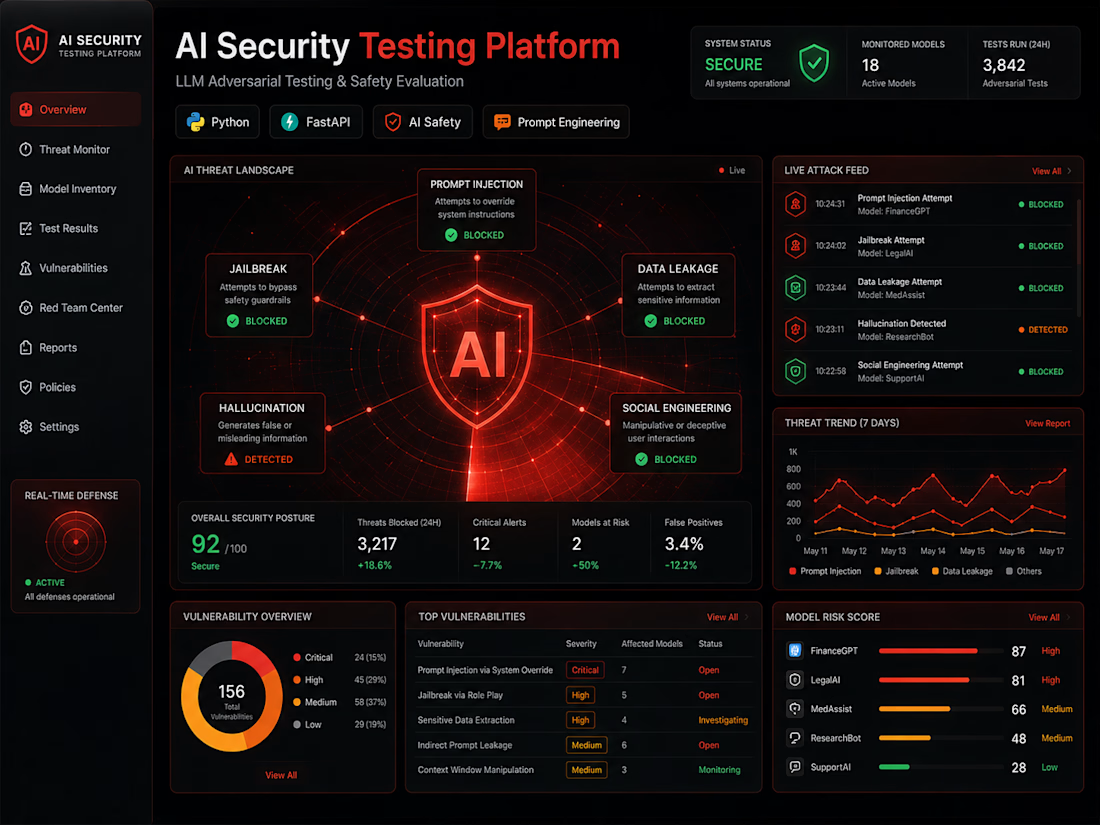
AI Security Testing Platform (Sentinel Env)
About this work
As Large Language Models become increasingly integrated into production applications, ensuring their reliability and resilience against adversarial attacks has become a critical engineering challenge. Sentinel Env was developed as a modular AI evaluation platform that enables systematic testing of LLM-powered agents under realistic attack scenarios before deployment.
The platform simulates prompt injection, jailbreak attempts, social engineering, and other adversarial interactions through reproducible evaluation pipelines. Instead of producing only a binary pass/fail result, it measures robustness using structured scoring, resilience profiling, and detailed performance metrics that help identify security weaknesses and improve model behavior over time.
Designed with extensibility in mind, Sentinel Env exposes standardized API endpoints for evaluation workflows, making it suitable for continuous testing, benchmarking, and integration into AI development pipelines. The project demonstrates practical AI safety engineering by combining automated evaluation, reproducible experimentation, and quantitative model assessment into a unified framework.
Key Highlights
• Simulates prompt injection and adversarial attack scenarios
• Measures model robustness through resilience scoring and evaluation metrics
• Exposes reproducible API endpoints for automated AI testing
• Modular architecture designed for extensibility and benchmarking
• Enables continuous AI safety evaluation before production deployment


The network for creativity
Join 1.25M professional creatives like you
Connect with clients, get discovered, and run your business 100% commission-free
Creatives on Contra have earned over $150M and we are just getting started





Related posts

AetherOS is a web desktop for AI agents. The entire project sits inside a single HTML file. It starts with a boot screen. Then it opens into a dark workspace. The background has black animated particles. Everything runs on plain CSS and vanilla JavaScript. The site loads zero external dependencies and zero sound files.
The bottom dock holds seven apps. These tools manage four AI agents: Atlas, Sage, Bolt, and Vega. The Agents app shows them chatting and passing tasks. Files lets you browse a drive. Memory shows a live graph of what the system knows. Users can also modify a history timeline. Studio lets you test prompts. Flows builds node pipelines, and Cost tracks token usage.
Every window can be moved, resized, minimized, or maximized. The top menu bar has a model switcher. It routes tasks to Claude Opus 4.7, GPT-5.2, Gemini 3 Pro, DeepSeek V4, or Llama 4. The OS also has Spotlight search, sound toggles, and local API key inputs. The interface uses dark glass panels with blue highlights.
Building the node graphs in one single HTML5 file was tough. At first, the physics nodes pushed apart too hard. They floated right off the screen. Dragging extra lines while getting zoomed in also threw off the precise positions. I fixed the center gravity math. Then I divided mouse positions by the zoom factor. That stopped the unnecessary movement and kept the OS stable.😊


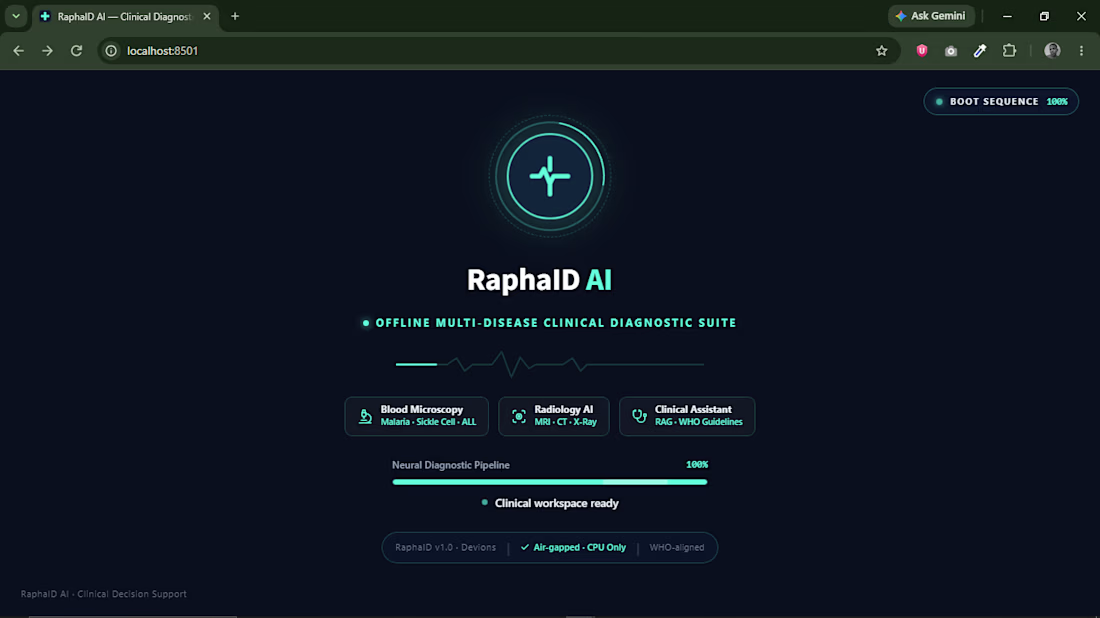
Building AI for healthcare leaves zero room for error.
I’m currently collaborating with an incredible team on Raphald AI, a medical detection application. Building the systems for a project with stakes this high is a massive reminder that the underlying backend architecture matters just as much as the machine learning model itself.
When integrating diagnostic AI, your API endpoints cannot drop requests, and your database workflows demand absolute integrity. You aren't just passing JSON payloads; you are handling critical, real-time workflows where stability is non-negotiable.
Engineering these systems continues to shape my approach to building robust Python backends. If you are developing a product that requires reliable AI integration or rock-solid FastAPI infrastructure, check out the newly updated services on my profile. Let's build something that works when it counts.



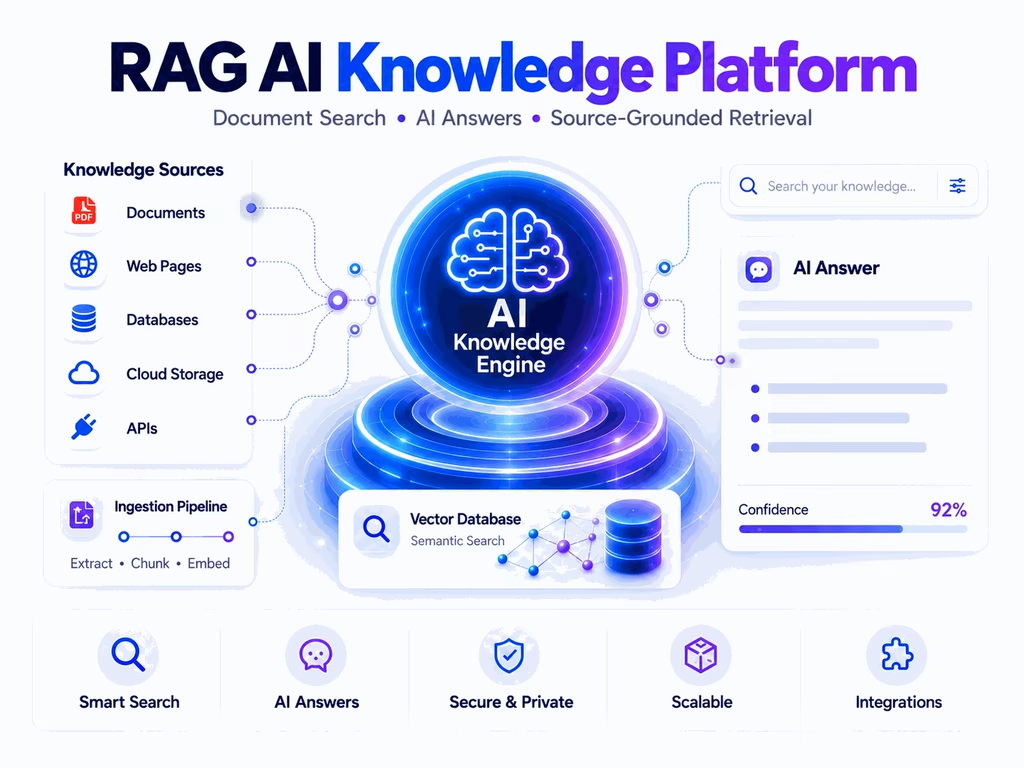
𝐑𝐀𝐆 𝐀𝐈 𝐊𝐧𝐨𝐰𝐥𝐞𝐝𝐠𝐞 𝐏𝐥𝐚𝐭𝐟𝐨𝐫𝐦 | 𝐈𝐧𝐭𝐞𝐥𝐥𝐢𝐠𝐞𝐧𝐭 𝐒𝐞𝐚𝐫𝐜𝐡, 𝐀𝐈 𝐀𝐧𝐬𝐰𝐞𝐫𝐬 & 𝐕𝐞𝐜𝐭𝐨𝐫 𝐃𝐚𝐭𝐚𝐛𝐚𝐬𝐞
I designed and built a RAG-powered AI knowledge platform that lets businesses search documents, websites, databases, and internal knowledge using natural language.
The system processes content, creates embeddings, stores them in a vector database, retrieves the most relevant information, and uses AI to generate accurate, source-grounded answers.
My services include: RAG development, document ingestion, semantic search, vector database setup, OpenAI/LLM integration, internal knowledge assistants, API integrations, and analytics.
The solution helps teams find information faster, reduce repetitive research, improve answer consistency, and build scalable AI-powered knowledge systems.
𝐓𝐞𝐜𝐡 𝐒𝐭𝐚𝐜𝐤:
OpenAI, LangChain, RAG, Pinecone, Qdrant, Weaviate, FAISS, Chroma, Python, FastAPI, PostgreSQL, APIs.