The network for creativity
Join 1.25M professional creatives like you
Connect with clients, get discovered, and run your business 100% commission-free
Creatives on Contra have earned over $150M and we are just getting started
Back to feedPost

Founders don’t want more dashboards.
They want fewer decisions.
Good paid acquisition reduces thinking.
Bad paid acquisition creates constant anxiety.
The difference is not tactics. It’s ownership.
The network for creativity
Join 1.25M professional creatives like you
Connect with clients, get discovered, and run your business 100% commission-free
Creatives on Contra have earned over $150M and we are just getting started





Related posts

Webdesly Circle — luxury loyalty MVP without points spam
I shipped Webdesly Circle — a maison loyalty desk built on access and care, not points balances.
No “you have 532 points.”
The loop: Define tiers → Assign a member → Grant an experience entitlement → Today → Mark fulfilled.
What’s live → https://webdesly-circle.vercel.app
Today · Members · Tiers · Entitlements · Settings. Next.js + Neon + Vercel. Distinct from Club (private club OS) — Circle is brand loyalty.
Phase 0 MVP in continuous development — grant→fulfill works; member portal, email, Stripe, suite bridges come next.
Want a calm loyalty/engagement SaaS MVP built with Cursor? DM me on Contra.


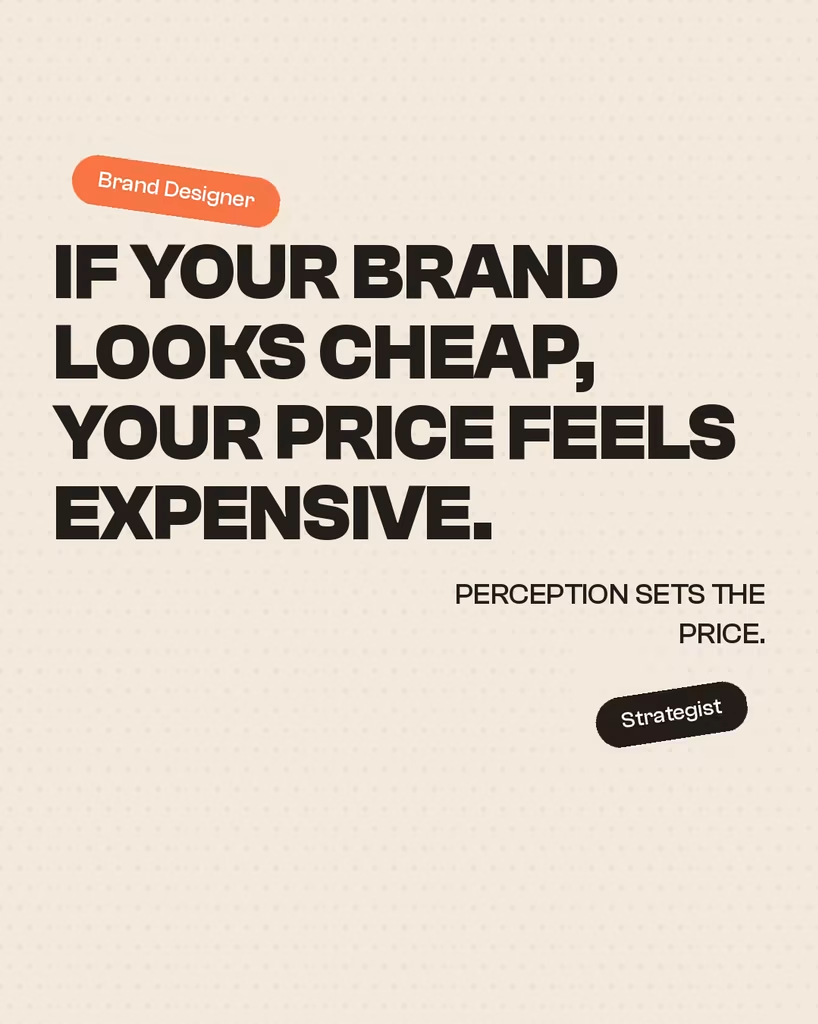
I've watched founders undercharge for years because their brand looked cheaper than their work.
Your price doesn't get questioned when the branding does the answering. Clean identity, confident packaging, a finished-looking site — that's what makes a client say "worth it" before they've even read the number.
Looking cheap is a tax you pay on every sale. Remove it.

Hey frens, for years I could do much of the work around a new product:
Define the opportunity.
Clarify the audience.
Shape the positioning.
Map the customer journey.
Write the MVP brief.
Plan the launch.
But turning that thinking into a working product usually required another dependency: a developer, technical co-founder, agency budget, or a long wait.
That has changed.
AI-native building tools have become a practical technical execution partner in my work—effectively, an always-available CTO for the early stage of an idea.
Alongside my work as a Hands-On CMO, entrepreneur, and investor, I have added two new hats:
Web developer.
Software builder.
Not because AI replaces experienced engineers, product designers, security, or serious technical architecture.
But because it lets a commercially minded operator move from a clear business problem to a real, testable first version much faster.
A recent example is Viewly by Realto: a focused PropTech workflow designed to turn property interest into a structured viewing request.
The problem is familiar. Someone sees a property, asks for a viewing, and the process becomes a chain of calls, messages, email follow-ups, availability checks, delays, and sometimes a lost lead.
Viewly gives the prospect a clearer path: explore the property, choose a suitable time, submit details, and move toward a confirmed viewing—while the business receives a structured enquiry rather than another unorganised message.
The lesson is bigger than real estate.
The first entrepreneurial bottleneck is no longer always technical execution.
It is clarity:
• Who is the first user?
• What recurring problem do they have?
• What is the smallest useful outcome?
• What can we test before building too much?
The winners will not be the people who generate the most AI apps.
They will be the people who turn real friction into focused, usable products.
I wrote more about the shift from writing briefs to building the first version here:
#Entrepreneurship #AIBuilders #VibeCoding #ProductStrategy #MVP #PropTech #RealEstateTech #NoCode #AI #StartupBuilding

thenewentrepreneurship.substack.com
The New Entrepreneur Builds the First Version
From Property Enquiry to Confirmed Viewing: Building Viewly with AI

Excellent work