The network for creativity
Join 1.25M professional creatives like you
Connect with clients, get discovered, and run your business 100% commission-free
Creatives on Contra have earned over $150M and we are just getting started
Back to feedPost
My core stack is less "generate pretty pictures" and more "build the pipeline that does the thinking":
n8n — the glue. Great for orchestrating multi-step agent workflows and connecting APIs without writing a service from scratch. Weakness: gets messy fast on complex branching logic, and debugging a broken node chain eats time.
RAG (usually with a vector DB + LangChain-style retrieval) — lets me ground LLM output in actual client data instead of hallucinated generalities. Strength: dramatically improves accuracy for domain-specific asks. Weakness: chunking/retrieval quality is finicky, and a bad embedding setup silently tanks results without throwing an error.
Claude/GPT for reasoning + code — my default for anything needing judgment: analysis writeups, SQL/Python generation, proposal drafting. Strength: fast iteration. Weakness: still needs a human check on numbers — confident-sounding ≠ correct.
Power BI / Tableau — where the AI output actually becomes something a client trusts. AI can shortcut the analysis, but the dashboard is what gets signed off on.
The honest lesson: the "AI" part is maybe 30% of the workflow. The rest is validation, data plumbing, and making the output legible to a non-technical stakeholder.


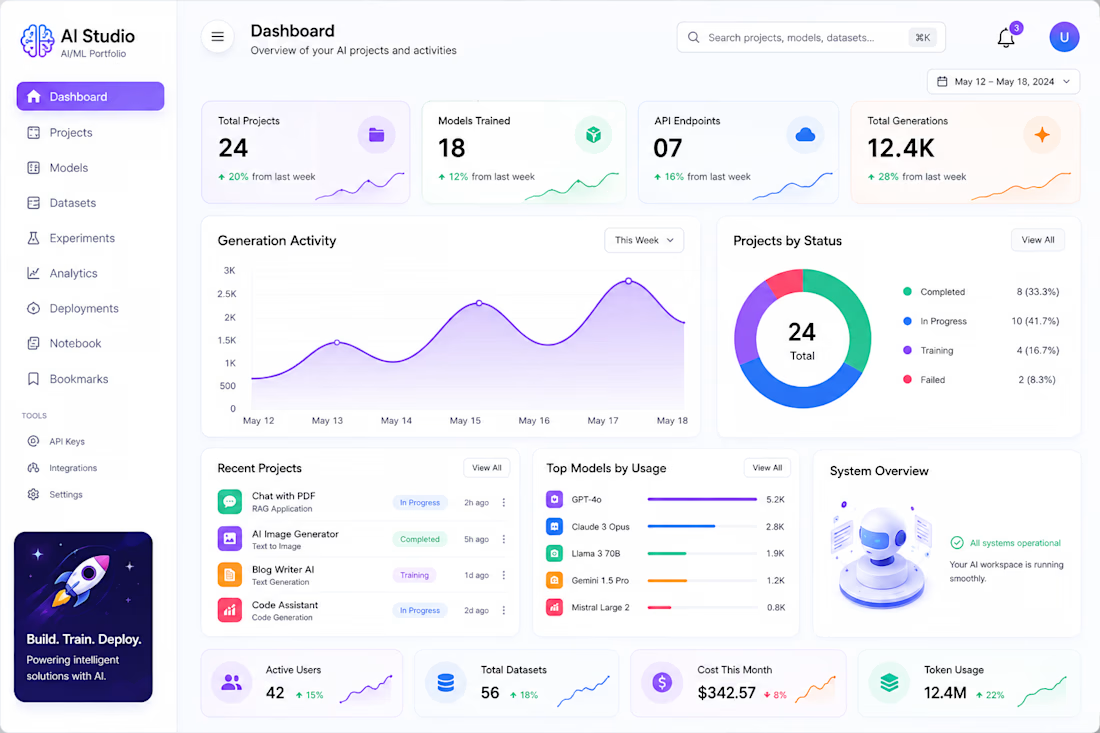

Silent failures are what I watch closest. I treat an answer as untrusted unless I can show exactly which source text the model read, because fluent output can hide a bad match.

I completely agree. I believe AI outputs should be traceable and verifiable, especially when accuracy matters. Being able to identify the exact source text behind an answer is important for catching silent failures, preventing incorrect matches, and building trust in AI systems.
The network for creativity
Join 1.25M professional creatives like you
Connect with clients, get discovered, and run your business 100% commission-free
Creatives on Contra have earned over $150M and we are just getting started









Related posts

AI Email Automation with n8n and Google Gemini
An AI workflow that reads every incoming email, sorts it into 6 categories, and takes the right action automatically.
The problem: businesses lose time and leads because customer emails are mixed with promotions, job alerts, and security emails.
What I built:
Gmail Trigger that picks up each new email
AI Text Classifier (Google Gemini) with 6 categories: Security Alert, Promotions, Jobs, Personal, Payments, and Client Inquiries
Automatic Gmail labels for every category
Google Sheets log for jobs, leads, and payments
AI information extraction for client emails (name, phone, service, budget)
AI-written reply drafts for client emails, saved as drafts so a person approves every reply
Instant Discord alerts for security, payment, and client emails
Tools: n8n, Google Gemini, Gmail, Google Sheets, Discord
This project is a working demo built on my own inbox. The same system can be adapted to any business email, such as travel agencies, event venues, stores, recruiters, and consultants.
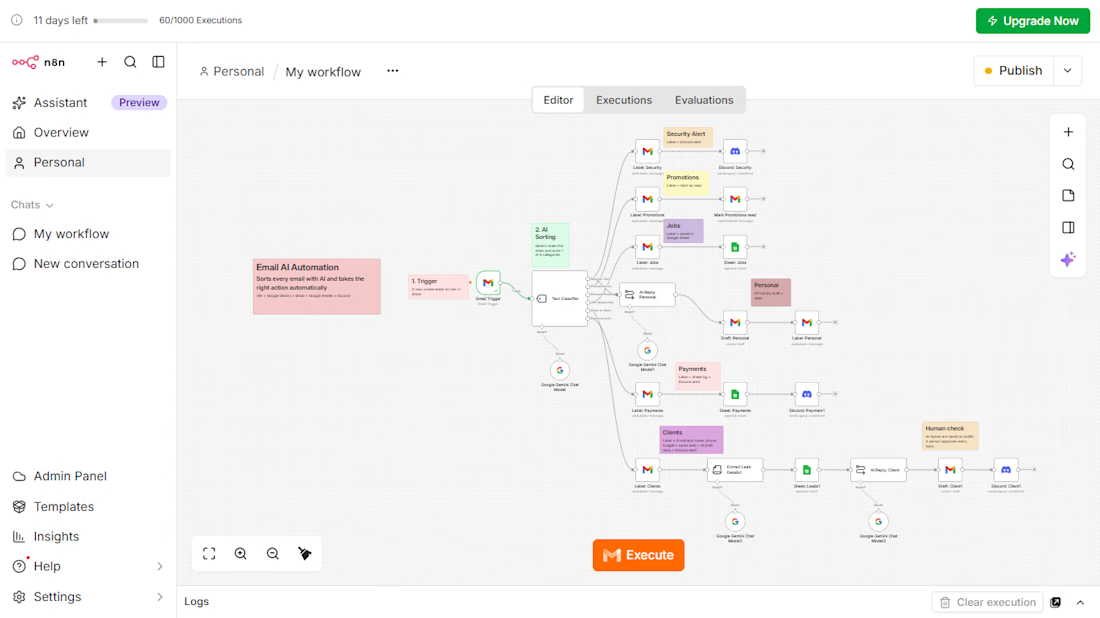

Impressive workflow! I especially like the human approval step for AI-written replies. Automation with the right oversight makes a real difference. 🙌

Hushdesk — AI Support SaaS Website | Next.js + GSAP


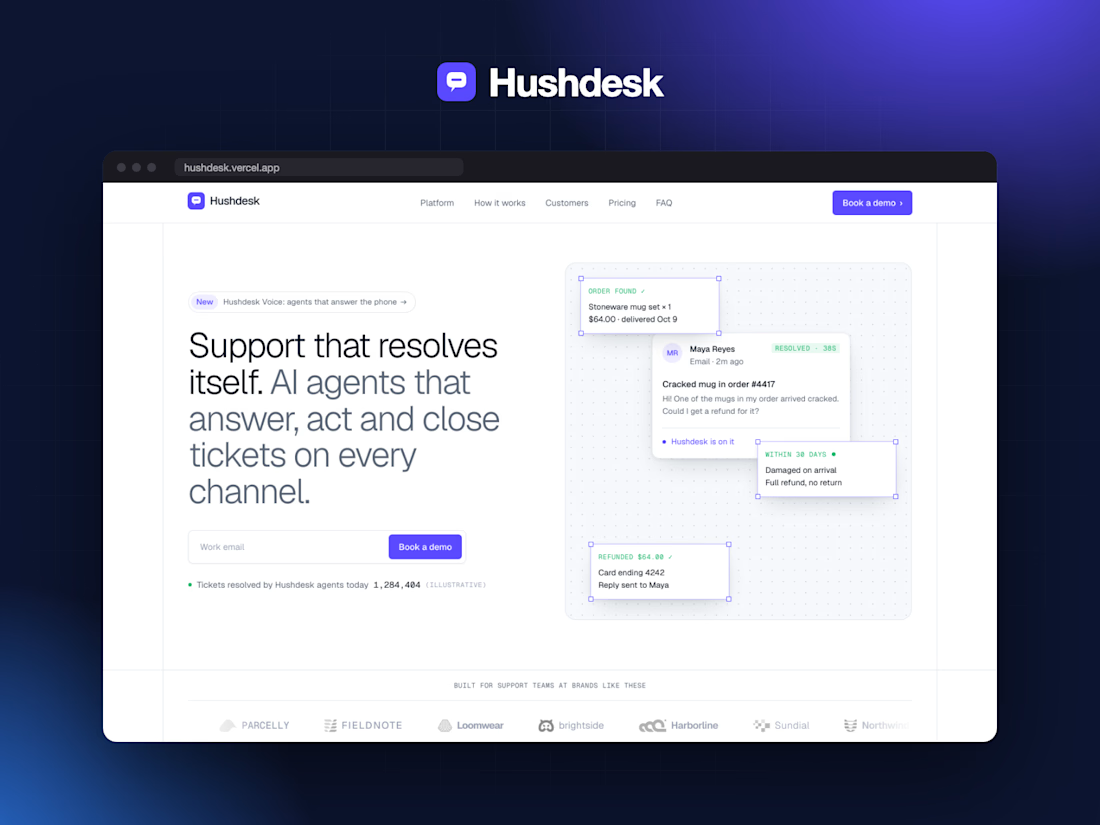

For an AI support flow, I’d make the handoff point part of the demo: show what happens when the answer is uncertain or the customer asks for a person. Is that transition covered in the interaction?

Sunny Rock — Cinematic Paris Travel Website | Creative Web Development
Experience Paris through Sunny Rock, a cinematic travel website concept designed to combine immersive visuals, elegant UI/UX, and interactive scrolling into a premium digital experience.
This self-directed project explores modern web design through cinematic imagery, scroll-driven animations, glassmorphism, smooth transitions, and responsive layouts.
🛠️ Technologies & Skills
HTML5 & CSS3 — Semantic structure, modern styling, and responsive layouts
JavaScript (ES6+) / TypeScript — Interactive behavior and animation logic
React.js — Reusable components, hooks, and state management
Tailwind CSS — Utility-first styling and responsive design
HTML5 Canvas API — 2D rendering for visual effects and image sequences
Scroll-Driven Animation — Frame-by-frame image sequences synchronized with scrolling
requestAnimationFrame & Linear Interpolation (Lerp) — Smooth animation updates
Lenis Smooth Scrolling — Fluid scrolling experiences
Intersection Observer API — Scroll-triggered reveals and entrance animations
UI/UX & Visual Design — Visual hierarchy, typography, glassmorphism, and interaction design
SVG Graphics — Scalable icons and vector elements
AI Visual Generation & Prompt Engineering — Cinematic visual assets
Cloudinary — Media hosting and image optimization
Performance Optimization — Efficient asset loading and animation rendering
Python & Browser Automation — Development utilities, asset processing, and testing
✨ Design Highlights
Cinematic, immersive visual storytelling
Premium travel-inspired aesthetic
Smooth, scroll-based animation sequences
Modern glassmorphism interface
Responsive layouts for different screen sizes
Interactive elements and refined micro-interactions
Project Type: Self-Directed Portfolio Project
Focus Areas: Creative Front-End Development · Web Design · UI/UX Design · Interactive Experiences · Animation
Designed and developed by Ubaid | Ubaid Web Studio.🔥


