
Security review for AI-built apps (Supabase)Jago Westerduin
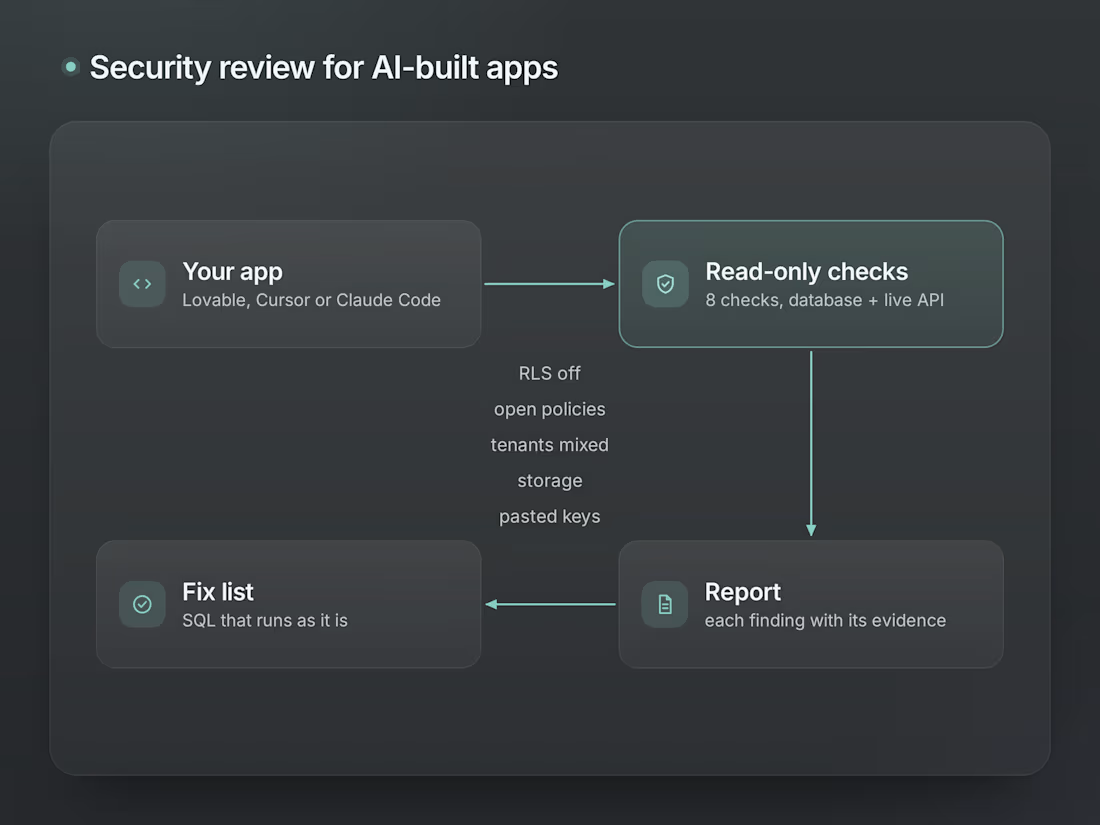
Built your app with Lovable, Cursor or Claude Code, and no developer has looked at the database yet? The most common problem is simple. Anyone with the public key in your front end can read or change data they should never see.
What I check. Tables with row level security off, and policies that let everyone through. Customers or teams that can see each other's data. SECURITY DEFINER functions and views that bypass your rules. Storage buckets and storage policies. Secret keys pasted into functions or triggers. And, with your public anon key, what the live API really hands to a stranger.
What you get. A report where every finding carries its severity, evidence you can check yourself, and the SQL that fixes it. Then the same checks run again on the fixed version.
Proof. On a deliberately vulnerable test app the checks find 30 problems (9 critical). On the fixed version they find 0. 43 automated tests, and every SQL fix is run in the tests.
No service-role key needed. All checks are read-only, and fixes go into a copy or run only after you approve them.
It is a first pass, not a full penetration test, and the report says so. 14 days of fixes after delivery.
Starting at$300
Duration1 week
Tags
Supabase

Service provided by
Jago Westerduin proThe Hague, Netherlands
Security review for AI-built apps (Supabase)Jago Westerduin
Starting at$300
Duration1 week
Tags
Supabase
Built your app with Lovable, Cursor or Claude Code, and no developer has looked at the database yet? The most common problem is simple. Anyone with the public key in your front end can read or change data they should never see.
What I check. Tables with row level security off, and policies that let everyone through. Customers or teams that can see each other's data. SECURITY DEFINER functions and views that bypass your rules. Storage buckets and storage policies. Secret keys pasted into functions or triggers. And, with your public anon key, what the live API really hands to a stranger.
What you get. A report where every finding carries its severity, evidence you can check yourself, and the SQL that fixes it. Then the same checks run again on the fixed version.
Proof. On a deliberately vulnerable test app the checks find 30 problems (9 critical). On the fixed version they find 0. 43 automated tests, and every SQL fix is run in the tests.
No service-role key needed. All checks are read-only, and fixes go into a copy or run only after you approve them.
It is a first pass, not a full penetration test, and the report says so. 14 days of fixes after delivery.
$300