
Designing and building data pipelinesDanylo Zdoryk
My work process:
Identify the data sources: The first step is to understand your needs and determine where the data for the pipeline will be coming from. This could include databases, APIs, flat files, or other sources.
Extract the data: Once the data sources have been identified, I will write code or use tools to extract the data from those sources. This could involve accessing APIs, running SQL queries, or importing data from flat files.
Clean and transform the data: The extracted data is often in raw form and needs to be cleaned and transformed before it can be useful. I will perform tasks such as removing duplicates, handling missing values, and converting the data into a uniform format to prepare it for the pipeline.
Store the data: The cleaned and transformed data needs to be stored somewhere for the pipeline to access it. I will choose a suitable location for the data, such as a database or a data lake, and store the data there.
Build the pipeline: With the data extracted, cleaned, and stored, I can then build the pipeline to move the data from the source to the destination. This could involve writing code, using a pipeline construction tool, or some combination of both.
Test and debug the pipeline: Once the pipeline is built, it is important to test it to ensure it is functioning correctly. I will run tests to verify that the pipeline is working as intended, and will troubleshoot and debug any issues that arise.
Deploy the pipeline: Once the pipeline has been thoroughly tested and is working as expected, I will deploy it for your use. This may involve integrating it into your existing systems or making it available to other users.
Optional
Maintain the pipeline: Data pipelines require ongoing maintenance to ensure they continue to function properly. I can monitor the pipeline for issues and make updates as needed to keep it running smoothly.
What's included
Data pipelines scripts
Sctipts for data pipelines
DAG files
If you need to use orchestrer in the project you also receive dag files.
Script for running and manual.
Script for installation and running pipelines.
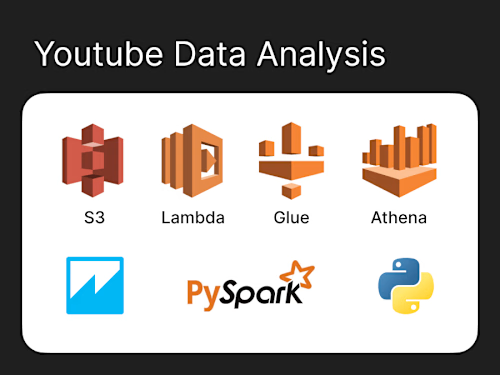
Example work
Danylo's other services

Starting at$10 /hr
Tags
AWS

Microsoft SQL Server

MySQL

PostgreSQL

Python

Database Engineer
Data Engineer
Service provided by
Danylo Zdoryk Poland
Designing and building data pipelinesDanylo Zdoryk
Starting at$10 /hr
Tags
AWS
Microsoft SQL Server
MySQL
PostgreSQL
Python
Database Engineer
Data Engineer
My work process:
Identify the data sources: The first step is to understand your needs and determine where the data for the pipeline will be coming from. This could include databases, APIs, flat files, or other sources.
Extract the data: Once the data sources have been identified, I will write code or use tools to extract the data from those sources. This could involve accessing APIs, running SQL queries, or importing data from flat files.
Clean and transform the data: The extracted data is often in raw form and needs to be cleaned and transformed before it can be useful. I will perform tasks such as removing duplicates, handling missing values, and converting the data into a uniform format to prepare it for the pipeline.
Store the data: The cleaned and transformed data needs to be stored somewhere for the pipeline to access it. I will choose a suitable location for the data, such as a database or a data lake, and store the data there.
Build the pipeline: With the data extracted, cleaned, and stored, I can then build the pipeline to move the data from the source to the destination. This could involve writing code, using a pipeline construction tool, or some combination of both.
Test and debug the pipeline: Once the pipeline is built, it is important to test it to ensure it is functioning correctly. I will run tests to verify that the pipeline is working as intended, and will troubleshoot and debug any issues that arise.
Deploy the pipeline: Once the pipeline has been thoroughly tested and is working as expected, I will deploy it for your use. This may involve integrating it into your existing systems or making it available to other users.
Optional
Maintain the pipeline: Data pipelines require ongoing maintenance to ensure they continue to function properly. I can monitor the pipeline for issues and make updates as needed to keep it running smoothly.
What's included
Data pipelines scripts
Sctipts for data pipelines
DAG files
If you need to use orchestrer in the project you also receive dag files.
Script for running and manual.
Script for installation and running pipelines.
Example work
Danylo's other services
$10 /hr