
Deep-Dive Learning Product Audit & Scaling RoadmapViktoriia O.
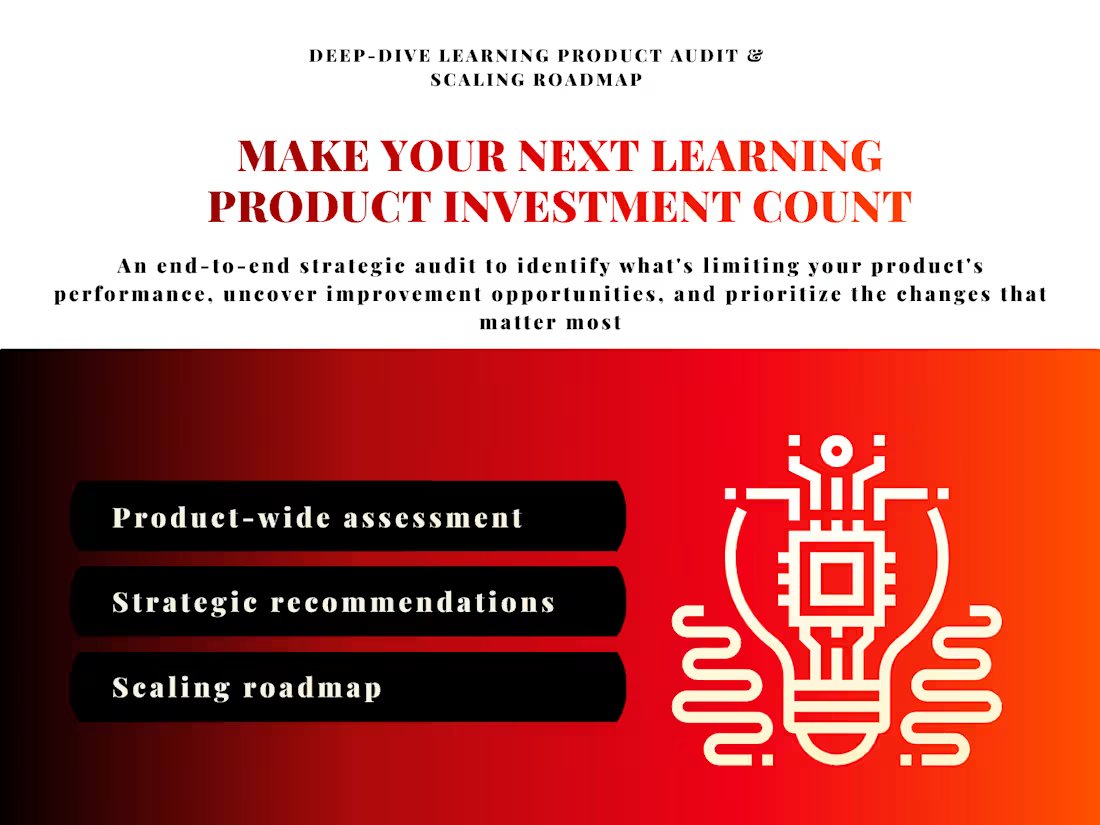
Before investing more in your learning product, make sure you're investing in the right improvements.
As a learning business grows, individual fixes and isolated improvements may no longer be enough. Issues with student retention, learning effectiveness, product delivery, and operational efficiency are often interconnected.
You might be investing in new content, marketing, technology, or additional resources without knowing whether these investments address the actual limitations of your product.
I conduct a comprehensive assessment of your learning product to understand how its components work together, identify what is limiting its performance, and uncover opportunities to make it stronger, more effective, and better prepared for growth.
This isn't just about identifying weaknesses. It's about understanding where your product already creates value, where that value is being lost, and which improvements deserve your attention and resources first.
What you'll get
1. Comprehensive Learning Product Assessment
An end-to-end evaluation of your learning product, covering the areas most relevant to its business objectives:
Product & Business Alignment: Value proposition, learner needs, product promise, business objectives, and alignment between what is marketed and what students actually experience.
Curriculum & Learning Experience: Program structure, learning objectives, content progression, workload, learning activities, and consistency across the curriculum.
Student Journey & UX: Onboarding, navigation, communication, support, key touchpoints, and potential friction throughout the learning experience.
Engagement & Retention: Student engagement mechanisms, potential dropout factors, completion barriers, and opportunities to improve participation and persistence.
Learning Effectiveness: Assessment methods, feedback mechanisms, practical application, and how effectively the product supports intended learning outcomes.
Product Delivery & Operations: LMS experience, delivery processes, support workflows, and opportunities to improve efficiency and consistency as the business grows.
The assessment is tailored to your product rather than limited to a fixed checklist.
2. Strategic Findings & Improvement Opportunities
You'll receive a structured analysis highlighting:
Product strengths and elements worth preserving.
Structural weaknesses and performance bottlenecks.
Gaps between business objectives, product delivery, and learner experience.
Opportunities to improve student satisfaction, engagement, retention, and learning outcomes.
Inefficiencies that may increase operational workload or limit scalability.
Areas where additional investment is justified — and where it may not be necessary.
I'll distinguish evidence-backed findings from hypotheses that require further validation.
3. Prioritized Recommendations & Scaling Roadmap
This is where the findings become practical business decisions.
You'll receive specific recommendations explaining:
What should be improved, reconsidered, or preserved.
Why each improvement matters and what problem it addresses.
Which changes have the greatest potential business or learning impact.
What should be prioritized based on urgency, expected value, and implementation effort.
Which improvements depend on other changes or additional resources.
What to address immediately and what to plan for the next stages of product development.
The result is a decision-ready improvement roadmap that helps you allocate resources more effectively and move forward with a clearer product strategy.
How it works
You provide access to your learning product and relevant materials, which may include:
Curriculum and learning materials.
LMS access or product walkthroughs.
Customer research and learner profiles.
Student feedback, surveys, and testimonials.
Sales materials and product positioning.
Available learning, engagement, retention, and business performance data.
Internal documentation and delivery processes.
I'll review the available evidence, assess how the different parts of your product interact, identify improvement opportunities, and prepare a structured report with prioritized recommendations.
The scope is agreed upon before the engagement begins, based on your product's complexity and business objectives.
Pricing & Scope
Starting at $1,500
The final price is individually calculated based on the scope and complexity of the assessment.
Key pricing factors include:
Product size: Program duration, number of modules, courses, learning paths, and target learner segments.
Delivery complexity: Number of delivery formats, platforms, student support mechanisms, assessment systems, and operational workflows.
Audit depth: Number of product areas requiring assessment and the level of qualitative and quantitative analysis involved.
Available evidence: Volume and complexity of curriculum materials, student feedback, performance data, and internal documentation.
Additional research requirements: Stakeholder interviews, workshops, or other discovery activities, if needed and agreed upon.
A larger or more complex learning product requires a broader assessment and more extensive analysis. I'll review the scope and confirm the deliverables and final price before starting.
Best for
EdTech founders and established online education businesses.
Course creators managing established, multi-module programs.
Learning businesses preparing for expansion or scaling.
Teams experiencing stagnating student engagement, retention, or completion.
Businesses planning a major product update or improvement initiative.
Founders who want an independent assessment before investing further in product development.
Scope
One comprehensive learning product assessment within an individually agreed scope.
The engagement includes product evaluation, documented findings, strategic improvement recommendations, and a prioritized scaling roadmap.
Implementation, course redevelopment, content production, LMS configuration, and independent market research are not included unless agreed upon separately.
FAQs
Example work
Viktoriia's other services
Contact for pricing
Duration3 weeks
Tags
Curriculum Development
Customer Experience
Learning Experience Design
Product Strategist
Business Diagnostics
EdTech
Product Audit
Product Optimization
Retention Strategy
Service provided by
Viktoriia O. Ukraine
- 5.00
- Rating
- 1
- Followers
Deep-Dive Learning Product Audit & Scaling RoadmapViktoriia O.
Contact for pricing
Duration3 weeks
Tags
Curriculum Development
Customer Experience
Learning Experience Design
Product Strategist
Business Diagnostics
EdTech
Product Audit
Product Optimization
Retention Strategy
Before investing more in your learning product, make sure you're investing in the right improvements.
As a learning business grows, individual fixes and isolated improvements may no longer be enough. Issues with student retention, learning effectiveness, product delivery, and operational efficiency are often interconnected.
You might be investing in new content, marketing, technology, or additional resources without knowing whether these investments address the actual limitations of your product.
I conduct a comprehensive assessment of your learning product to understand how its components work together, identify what is limiting its performance, and uncover opportunities to make it stronger, more effective, and better prepared for growth.
This isn't just about identifying weaknesses. It's about understanding where your product already creates value, where that value is being lost, and which improvements deserve your attention and resources first.
What you'll get
1. Comprehensive Learning Product Assessment
An end-to-end evaluation of your learning product, covering the areas most relevant to its business objectives:
Product & Business Alignment: Value proposition, learner needs, product promise, business objectives, and alignment between what is marketed and what students actually experience.
Curriculum & Learning Experience: Program structure, learning objectives, content progression, workload, learning activities, and consistency across the curriculum.
Student Journey & UX: Onboarding, navigation, communication, support, key touchpoints, and potential friction throughout the learning experience.
Engagement & Retention: Student engagement mechanisms, potential dropout factors, completion barriers, and opportunities to improve participation and persistence.
Learning Effectiveness: Assessment methods, feedback mechanisms, practical application, and how effectively the product supports intended learning outcomes.
Product Delivery & Operations: LMS experience, delivery processes, support workflows, and opportunities to improve efficiency and consistency as the business grows.
The assessment is tailored to your product rather than limited to a fixed checklist.
2. Strategic Findings & Improvement Opportunities
You'll receive a structured analysis highlighting:
Product strengths and elements worth preserving.
Structural weaknesses and performance bottlenecks.
Gaps between business objectives, product delivery, and learner experience.
Opportunities to improve student satisfaction, engagement, retention, and learning outcomes.
Inefficiencies that may increase operational workload or limit scalability.
Areas where additional investment is justified — and where it may not be necessary.
I'll distinguish evidence-backed findings from hypotheses that require further validation.
3. Prioritized Recommendations & Scaling Roadmap
This is where the findings become practical business decisions.
You'll receive specific recommendations explaining:
What should be improved, reconsidered, or preserved.
Why each improvement matters and what problem it addresses.
Which changes have the greatest potential business or learning impact.
What should be prioritized based on urgency, expected value, and implementation effort.
Which improvements depend on other changes or additional resources.
What to address immediately and what to plan for the next stages of product development.
The result is a decision-ready improvement roadmap that helps you allocate resources more effectively and move forward with a clearer product strategy.
How it works
You provide access to your learning product and relevant materials, which may include:
Curriculum and learning materials.
LMS access or product walkthroughs.
Customer research and learner profiles.
Student feedback, surveys, and testimonials.
Sales materials and product positioning.
Available learning, engagement, retention, and business performance data.
Internal documentation and delivery processes.
I'll review the available evidence, assess how the different parts of your product interact, identify improvement opportunities, and prepare a structured report with prioritized recommendations.
The scope is agreed upon before the engagement begins, based on your product's complexity and business objectives.
Pricing & Scope
Starting at $1,500
The final price is individually calculated based on the scope and complexity of the assessment.
Key pricing factors include:
Product size: Program duration, number of modules, courses, learning paths, and target learner segments.
Delivery complexity: Number of delivery formats, platforms, student support mechanisms, assessment systems, and operational workflows.
Audit depth: Number of product areas requiring assessment and the level of qualitative and quantitative analysis involved.
Available evidence: Volume and complexity of curriculum materials, student feedback, performance data, and internal documentation.
Additional research requirements: Stakeholder interviews, workshops, or other discovery activities, if needed and agreed upon.
A larger or more complex learning product requires a broader assessment and more extensive analysis. I'll review the scope and confirm the deliverables and final price before starting.
Best for
EdTech founders and established online education businesses.
Course creators managing established, multi-module programs.
Learning businesses preparing for expansion or scaling.
Teams experiencing stagnating student engagement, retention, or completion.
Businesses planning a major product update or improvement initiative.
Founders who want an independent assessment before investing further in product development.
Scope
One comprehensive learning product assessment within an individually agreed scope.
The engagement includes product evaluation, documented findings, strategic improvement recommendations, and a prioritized scaling roadmap.
Implementation, course redevelopment, content production, LMS configuration, and independent market research are not included unless agreed upon separately.
FAQs
Example work
Viktoriia's other services
Contact for pricing