Advanced RAG- Multi-Source AI That Never HallucinatesPATHAKHRK INC
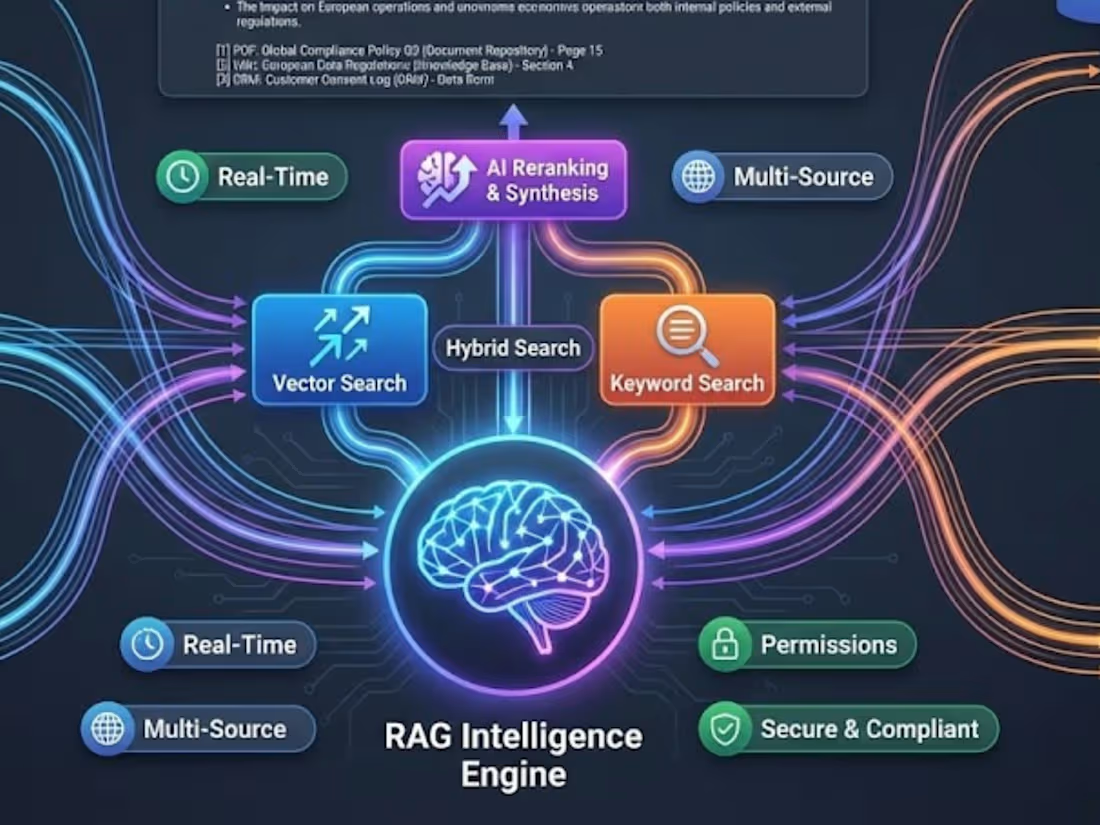
I'll build you an advanced RAG system that pulls accurate, cited information from all your data sources simultaneously—documents, databases, APIs, CRMs, everything—using hybrid search that combines semantic understanding with keyword precision to deliver exactly what users need. This isn't basic document Q&A; it's enterprise-grade knowledge intelligence that synthesizes information across sources, respects permissions, operates in real-time, and tells you exactly where every answer came from with confidence scores. This is for businesses with complex knowledge spread across multiple systems who need AI that actually knows their stuff comprehensively and never makes things up
What's included
Enterprise-Grade Multi-Source RAG Architecture
RAG system that doesn't just read your documents—it intelligently synthesizes information from multiple data sources simultaneously. I'll build an architecture that connects to your internal databases, document repositories, APIs, knowledge bases, CRM data, support tickets, wikis, and any other information sources you have. The system understands which sources are most authoritative for different query types and retrieves information from the optimal combination of sources for each question. You get an AI that has complete knowledge across your entire organization, not just one folder of PDFs.
Hybrid Search Implementation (Vector + Keyword)
Best-of-both-worlds search combining semantic understanding with precision keyword matching. The system uses vector embeddings to understand meaning and intent (so "refund policy" and "getting my money back" both work), while also implementing traditional keyword search with Elasticsearch for exact term matching when needed. This hybrid approach means you get intelligent semantic search for natural language queries and precise results for technical terms, product codes, or specific phrases. Way more powerful than vector search alone.
Intelligent Source Orchestration & Ranking
Smart logic that knows which sources to check for different query types and how to rank results when multiple sources have relevant information. Product questions pull from product databases first, then documentation. Policy questions prioritize official policy docs over casual mentions in emails. The system learns which sources users trust most and adjusts rankings accordingly. You're not getting a random mix of results—you're getting intelligently curated answers from the most reliable sources for each specific question.
Real-Time Data Source Integration
Live connections to dynamic data sources that update constantly. The system can query your inventory database for current stock levels, check your CRM for customer history, pull recent support tickets, access live pricing from your systems, and integrate with internal APIs for real-time information. Answers reflect current reality, not stale snapshots from when documents were last uploaded. If your pricing changes at 2 PM, the AI knows by 2:01 PM.
Advanced Document Processing Pipeline
Sophisticated ingestion that handles every document type and format your business uses. PDFs with complex layouts, scanned documents with OCR, Excel spreadsheets with data extraction, PowerPoint presentations, HTML pages, code documentation, Markdown files, emails with attachments—the pipeline intelligently processes each format. It preserves document structure, extracts metadata, identifies key sections, and chunks content semantically (based on topics, not arbitrary character counts) for optimal retrieval.
Multi-Document Synthesis & Cross-Reference
The AI doesn't just find one relevant document—it synthesizes information across multiple sources to give comprehensive answers. If product specs are in one doc, pricing in another, and warranty info in a third, the system pulls all relevant pieces and combines them into one coherent response. It identifies connections and relationships between documents that humans might miss. This is true knowledge synthesis, not just document retrieval.
Contextual Filtering & Permissions
Respects your organizational structure and data access rules. Different users see different information based on their roles and permissions. Sales reps get sales-relevant docs, support gets support docs, executives get everything. The system can filter by department, region, product line, or any criteria you define. Sensitive information stays protected while still being searchable by authorized users. Security isn't an afterthought—it's built into the retrieval logic.
Confidence Scoring & Source Attribution
Every answer comes with transparency about reliability. The system provides confidence scores showing how certain it is about responses, cites specific sources with document names and page numbers, indicates when information conflicts across sources, and explicitly states when it can't find sufficient information. You can verify every claim by tracing back to source material. No black box—full transparency and accountability.
Semantic Reranking & Relevance Optimization
2-stage retrieval process where initial search casts a wide net, then AI-powered reranking identifies the most relevant results for the specific query context. This dramatically improves answer quality compared to simple similarity search. The reranking model understands nuanced relevance—not just "these documents mention similar keywords" but "these specific sections actually answer the question." Users get the best possible results, not just the closest matches.
Custom Query Understanding & Intent Detection
Preprocessing layer that understands what users really mean before searching. The system handles typos and misspellings, recognizes synonyms and related terms specific to your business, understands acronyms and internal terminology, detects question type (factual, comparison, procedural, opinion), and reformulates ambiguous queries for better retrieval. Someone searching "the new thing" when you launched a new product yesterday? The system understands the context.
Conversation Memory & Context Awareness
Maintains conversation history so follow-up questions work naturally. If someone asks "What's our return policy?" then follows with "Does that apply to sale items?" the system understands "that" refers to the return policy discussed moments ago. Context flows through multi-turn conversations. You don't need to repeat yourself—the AI remembers what you talked about and builds on previous exchanges naturally.
Automated Knowledge Gap Identification
Analytics showing where your knowledge base has holes. The system tracks queries that don't get good answers, identifies topics with insufficient documentation, highlights areas where users repeatedly ask similar unanswered questions, and suggests what content to create or update. Your knowledge base evolves based on actual user needs, not guesses about what might be helpful.
Multi-Language Support with Translation
Query in 1 language, retrieve from documents in another. The system can search English documentation to answer Spanish queries, translate results appropriately, or maintain separate embeddings per language for native search. Perfect for global companies with documentation in multiple languages. Your knowledge base becomes accessible to everyone regardless of preferred language.
API Access & Integration Flexibility
Clean RESTful API making the RAG system available to any application. Embed it in your website, add it to internal tools, build Slack bots, integrate with customer support platforms, power mobile apps—whatever you need. Comprehensive API documentation, code examples, and SDK support. The intelligent knowledge retrieval becomes infrastructure powering multiple touchpoints across your organization.
Version Control & Document Change Tracking
When documents update, the system tracks changes and maintains version history. You can see what information has changed over time, revert to previous versions if needed, and understand how answers evolved as documentation improved. Audit trails show exactly what information the AI was using on any given date. Critical for compliance and quality control.
Performance Optimization & Caching
Lightning-fast responses through intelligent caching and optimization. Frequently asked questions get sub-second responses from cache. The system precomputes embeddings for common query patterns, optimizes index structures for your specific data, and implements smart caching strategies that balance freshness with speed. Users get instant answers without sacrificing accuracy.
60-Day Enterprise Optimization Program
2 months of intensive optimization after deployment. I'll monitor query patterns and improve retrieval relevance, tune ranking algorithms based on user feedback, add new data sources as needs emerge, train your team on advanced usage, optimize for performance and cost, and establish best practices for maintaining quality. We'll work together to make this system exceptional for your specific use case and organizational knowledge.
FAQs
Example work

Starting at$9,500
Duration5 weeks
Tags
ChatGPT

Elasticsearch

FastAPI

LangChain

MongoDB

AI Automation
AI Engineer
Backend Engineer
Service provided by
PATHAKHRK INC Kangra, India
- 2
- Followers
Advanced RAG- Multi-Source AI That Never HallucinatesPATHAKHRK INC
Starting at$9,500
Duration5 weeks
Tags
ChatGPT
Elasticsearch
FastAPI
LangChain
MongoDB
AI Automation
AI Engineer
Backend Engineer
I'll build you an advanced RAG system that pulls accurate, cited information from all your data sources simultaneously—documents, databases, APIs, CRMs, everything—using hybrid search that combines semantic understanding with keyword precision to deliver exactly what users need. This isn't basic document Q&A; it's enterprise-grade knowledge intelligence that synthesizes information across sources, respects permissions, operates in real-time, and tells you exactly where every answer came from with confidence scores. This is for businesses with complex knowledge spread across multiple systems who need AI that actually knows their stuff comprehensively and never makes things up
What's included
Enterprise-Grade Multi-Source RAG Architecture
RAG system that doesn't just read your documents—it intelligently synthesizes information from multiple data sources simultaneously. I'll build an architecture that connects to your internal databases, document repositories, APIs, knowledge bases, CRM data, support tickets, wikis, and any other information sources you have. The system understands which sources are most authoritative for different query types and retrieves information from the optimal combination of sources for each question. You get an AI that has complete knowledge across your entire organization, not just one folder of PDFs.
Hybrid Search Implementation (Vector + Keyword)
Best-of-both-worlds search combining semantic understanding with precision keyword matching. The system uses vector embeddings to understand meaning and intent (so "refund policy" and "getting my money back" both work), while also implementing traditional keyword search with Elasticsearch for exact term matching when needed. This hybrid approach means you get intelligent semantic search for natural language queries and precise results for technical terms, product codes, or specific phrases. Way more powerful than vector search alone.
Intelligent Source Orchestration & Ranking
Smart logic that knows which sources to check for different query types and how to rank results when multiple sources have relevant information. Product questions pull from product databases first, then documentation. Policy questions prioritize official policy docs over casual mentions in emails. The system learns which sources users trust most and adjusts rankings accordingly. You're not getting a random mix of results—you're getting intelligently curated answers from the most reliable sources for each specific question.
Real-Time Data Source Integration
Live connections to dynamic data sources that update constantly. The system can query your inventory database for current stock levels, check your CRM for customer history, pull recent support tickets, access live pricing from your systems, and integrate with internal APIs for real-time information. Answers reflect current reality, not stale snapshots from when documents were last uploaded. If your pricing changes at 2 PM, the AI knows by 2:01 PM.
Advanced Document Processing Pipeline
Sophisticated ingestion that handles every document type and format your business uses. PDFs with complex layouts, scanned documents with OCR, Excel spreadsheets with data extraction, PowerPoint presentations, HTML pages, code documentation, Markdown files, emails with attachments—the pipeline intelligently processes each format. It preserves document structure, extracts metadata, identifies key sections, and chunks content semantically (based on topics, not arbitrary character counts) for optimal retrieval.
Multi-Document Synthesis & Cross-Reference
The AI doesn't just find one relevant document—it synthesizes information across multiple sources to give comprehensive answers. If product specs are in one doc, pricing in another, and warranty info in a third, the system pulls all relevant pieces and combines them into one coherent response. It identifies connections and relationships between documents that humans might miss. This is true knowledge synthesis, not just document retrieval.
Contextual Filtering & Permissions
Respects your organizational structure and data access rules. Different users see different information based on their roles and permissions. Sales reps get sales-relevant docs, support gets support docs, executives get everything. The system can filter by department, region, product line, or any criteria you define. Sensitive information stays protected while still being searchable by authorized users. Security isn't an afterthought—it's built into the retrieval logic.
Confidence Scoring & Source Attribution
Every answer comes with transparency about reliability. The system provides confidence scores showing how certain it is about responses, cites specific sources with document names and page numbers, indicates when information conflicts across sources, and explicitly states when it can't find sufficient information. You can verify every claim by tracing back to source material. No black box—full transparency and accountability.
Semantic Reranking & Relevance Optimization
2-stage retrieval process where initial search casts a wide net, then AI-powered reranking identifies the most relevant results for the specific query context. This dramatically improves answer quality compared to simple similarity search. The reranking model understands nuanced relevance—not just "these documents mention similar keywords" but "these specific sections actually answer the question." Users get the best possible results, not just the closest matches.
Custom Query Understanding & Intent Detection
Preprocessing layer that understands what users really mean before searching. The system handles typos and misspellings, recognizes synonyms and related terms specific to your business, understands acronyms and internal terminology, detects question type (factual, comparison, procedural, opinion), and reformulates ambiguous queries for better retrieval. Someone searching "the new thing" when you launched a new product yesterday? The system understands the context.
Conversation Memory & Context Awareness
Maintains conversation history so follow-up questions work naturally. If someone asks "What's our return policy?" then follows with "Does that apply to sale items?" the system understands "that" refers to the return policy discussed moments ago. Context flows through multi-turn conversations. You don't need to repeat yourself—the AI remembers what you talked about and builds on previous exchanges naturally.
Automated Knowledge Gap Identification
Analytics showing where your knowledge base has holes. The system tracks queries that don't get good answers, identifies topics with insufficient documentation, highlights areas where users repeatedly ask similar unanswered questions, and suggests what content to create or update. Your knowledge base evolves based on actual user needs, not guesses about what might be helpful.
Multi-Language Support with Translation
Query in 1 language, retrieve from documents in another. The system can search English documentation to answer Spanish queries, translate results appropriately, or maintain separate embeddings per language for native search. Perfect for global companies with documentation in multiple languages. Your knowledge base becomes accessible to everyone regardless of preferred language.
API Access & Integration Flexibility
Clean RESTful API making the RAG system available to any application. Embed it in your website, add it to internal tools, build Slack bots, integrate with customer support platforms, power mobile apps—whatever you need. Comprehensive API documentation, code examples, and SDK support. The intelligent knowledge retrieval becomes infrastructure powering multiple touchpoints across your organization.
Version Control & Document Change Tracking
When documents update, the system tracks changes and maintains version history. You can see what information has changed over time, revert to previous versions if needed, and understand how answers evolved as documentation improved. Audit trails show exactly what information the AI was using on any given date. Critical for compliance and quality control.
Performance Optimization & Caching
Lightning-fast responses through intelligent caching and optimization. Frequently asked questions get sub-second responses from cache. The system precomputes embeddings for common query patterns, optimizes index structures for your specific data, and implements smart caching strategies that balance freshness with speed. Users get instant answers without sacrificing accuracy.
60-Day Enterprise Optimization Program
2 months of intensive optimization after deployment. I'll monitor query patterns and improve retrieval relevance, tune ranking algorithms based on user feedback, add new data sources as needs emerge, train your team on advanced usage, optimize for performance and cost, and establish best practices for maintaining quality. We'll work together to make this system exceptional for your specific use case and organizational knowledge.
FAQs
Example work
$9,500