
Astro Migration — Move Your Website to AstroEaxi Agu
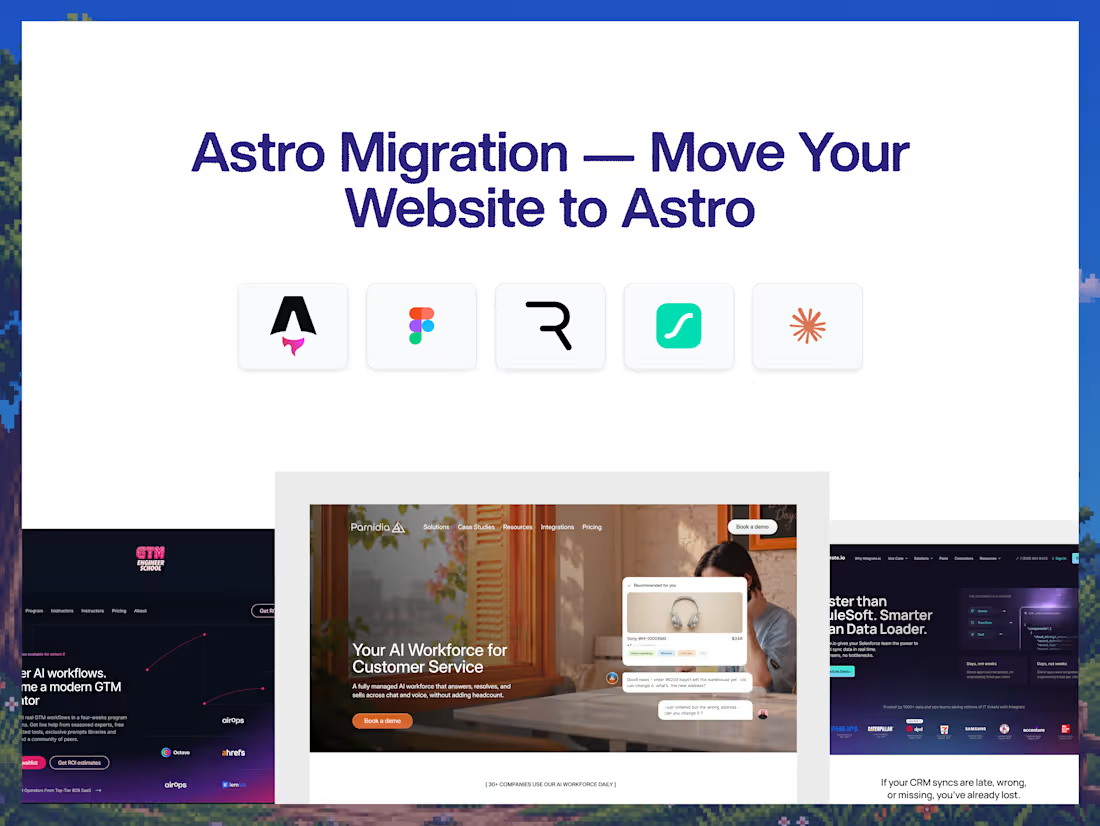
Your website shouldn’t be slow, heavy, or locked into a platform you can’t leave.
But moving to Astro is more than exporting pages. Layouts need to be rebuilt as clean components, content needs to move into a proper structure, URLs and redirects need to be protected, and your team still needs an easy way to edit the site after launch.
This engagement moves your existing website from Framer, Webflow, WordPress, Wix, Squarespace, or any other platform to Astro, while keeping the parts of your site that already work.
I handle the audit, the component rebuild, content migration into the headless CMS of your choice, SEO protection, GitHub and hosting setup, and launch.
Your site lives on your GitHub. Your team edits it with Claude or your CMS, without touching code.
Same website. Faster foundation. Fully yours.
Why this engagement model exists
Astro is built for content-driven websites like marketing sites, blogs, docs, and portfolios. It ships plain HTML by default and only loads JavaScript where a page actually needs it.
But a migration can go wrong when it’s treated as a copy-and-paste job. Rankings drop, links break, and the team loses the editing experience they had before.
I approach migration as a rebuild with continuity in mind. Your structure, visual language, content, URLs, and key functions are reviewed before anything moves. Then the site is rebuilt in Astro with reusable components and fast pages. It’s stored in your own GitHub repository and set up so your team can keep making changes without a developer.
Who this is for
Teams paying monthly platform fees for a site that rarely changes.
WordPress sites that are slow, plugin-heavy, or hard to secure.
Startups and SaaS companies that want a fast marketing site they fully own.
Businesses with blogs, docs, or large content libraries.
Founders who want to own their code, host it anywhere, and update it with AI.
Not for: teams that want to drag and drop page layouts themselves every week, complex e-commerce stores, or web apps with heavy logged-in functionality.
What you walk away with
A complete Astro rebuild of your existing website, based on the agreed migration scope.
Reusable components for sections, navigation, buttons, cards, and other recurring elements.
Responsive layouts for desktop, tablet, and mobile.
Content migration for blog posts, case studies, projects, team members, testimonials, and other collections.
A headless CMS setup with the CMS of your choice, such as Sanity, Storyblok, Contentful, Strapi, Payload, Hygraph, or Prismic. Markdown-based content is also an option if you’d rather keep it simple.
Your website live on your own GitHub repository, connected to your hosting so every approved change goes live automatically.
A Claude-ready project setup, so your team can describe a change in plain words (“add a new team member,” “update the pricing section”) and Claude makes it. No code knowledge needed.
Animations and interactions recreated where appropriate.
SEO foundation: page titles, meta descriptions, heading structure, Open Graph, sitemap, robots.txt, and structured data.
A full URL map and 301 redirects to protect existing rankings.
Image optimization and performance tuning.
Forms and integrations connected.
Hosting setup on Vercel, Netlify, or Cloudflare, plus domain connection.
A handoff guide showing your team how to edit with Claude and with your CMS.
How it ships
Day 1: Audit & planning. I review your current site, pages, CMS, content, integrations, URLs, and performance baseline.
Days 2–3: Astro rebuild. Pages, components, layouts, navigation, and imagery are rebuilt in Astro.
Day 4: Content & CMS. Content is migrated into your chosen headless CMS and connected to the Astro site.
Day 5: SEO & redirects. URL mapping, redirects, metadata, sitemap, and structured data.
Day 6: QA & performance. Responsive testing, browser checks, and Lighthouse and Core Web Vitals checks.
Day 7: Launch & handoff. GitHub repository, hosting, domain, final QA, publishing, Claude and CMS editing setup, and handoff.
Typical turnaround: 1 week for sites up to 10 pages. Larger sites or big content libraries are scoped and quoted separately.
The Astro advantage
You don’t have to choose between keeping your website and moving to a faster foundation.
Existing Website → Audit → Astro Rebuild → Headless CMS → SEO & Redirects → GitHub & Hosting → Launch
Your website keeps its identity and content while becoming faster, lighter, and fully owned by you. Updates happen through Claude or your CMS, with no code and no waiting on a developer.
FAQs
Eaxi's other services
Starting at$999
Duration7 days
Tags
Astro

Web Developer
Service provided by
Eaxi Agu proNigeria
- $25k+
- Earned
- 9
- Paid projects
- 5.00
- Rating
- 34
- Followers
Astro Migration — Move Your Website to AstroEaxi Agu
Your website shouldn’t be slow, heavy, or locked into a platform you can’t leave.
But moving to Astro is more than exporting pages. Layouts need to be rebuilt as clean components, content needs to move into a proper structure, URLs and redirects need to be protected, and your team still needs an easy way to edit the site after launch.
This engagement moves your existing website from Framer, Webflow, WordPress, Wix, Squarespace, or any other platform to Astro, while keeping the parts of your site that already work.
I handle the audit, the component rebuild, content migration into the headless CMS of your choice, SEO protection, GitHub and hosting setup, and launch.
Your site lives on your GitHub. Your team edits it with Claude or your CMS, without touching code.
Same website. Faster foundation. Fully yours.
Why this engagement model exists
Astro is built for content-driven websites like marketing sites, blogs, docs, and portfolios. It ships plain HTML by default and only loads JavaScript where a page actually needs it.
But a migration can go wrong when it’s treated as a copy-and-paste job. Rankings drop, links break, and the team loses the editing experience they had before.
I approach migration as a rebuild with continuity in mind. Your structure, visual language, content, URLs, and key functions are reviewed before anything moves. Then the site is rebuilt in Astro with reusable components and fast pages. It’s stored in your own GitHub repository and set up so your team can keep making changes without a developer.
Who this is for
Teams paying monthly platform fees for a site that rarely changes.
WordPress sites that are slow, plugin-heavy, or hard to secure.
Startups and SaaS companies that want a fast marketing site they fully own.
Businesses with blogs, docs, or large content libraries.
Founders who want to own their code, host it anywhere, and update it with AI.
Not for: teams that want to drag and drop page layouts themselves every week, complex e-commerce stores, or web apps with heavy logged-in functionality.
What you walk away with
A complete Astro rebuild of your existing website, based on the agreed migration scope.
Reusable components for sections, navigation, buttons, cards, and other recurring elements.
Responsive layouts for desktop, tablet, and mobile.
Content migration for blog posts, case studies, projects, team members, testimonials, and other collections.
A headless CMS setup with the CMS of your choice, such as Sanity, Storyblok, Contentful, Strapi, Payload, Hygraph, or Prismic. Markdown-based content is also an option if you’d rather keep it simple.
Your website live on your own GitHub repository, connected to your hosting so every approved change goes live automatically.
A Claude-ready project setup, so your team can describe a change in plain words (“add a new team member,” “update the pricing section”) and Claude makes it. No code knowledge needed.
Animations and interactions recreated where appropriate.
SEO foundation: page titles, meta descriptions, heading structure, Open Graph, sitemap, robots.txt, and structured data.
A full URL map and 301 redirects to protect existing rankings.
Image optimization and performance tuning.
Forms and integrations connected.
Hosting setup on Vercel, Netlify, or Cloudflare, plus domain connection.
A handoff guide showing your team how to edit with Claude and with your CMS.
How it ships
Day 1: Audit & planning. I review your current site, pages, CMS, content, integrations, URLs, and performance baseline.
Days 2–3: Astro rebuild. Pages, components, layouts, navigation, and imagery are rebuilt in Astro.
Day 4: Content & CMS. Content is migrated into your chosen headless CMS and connected to the Astro site.
Day 5: SEO & redirects. URL mapping, redirects, metadata, sitemap, and structured data.
Day 6: QA & performance. Responsive testing, browser checks, and Lighthouse and Core Web Vitals checks.
Day 7: Launch & handoff. GitHub repository, hosting, domain, final QA, publishing, Claude and CMS editing setup, and handoff.
Typical turnaround: 1 week for sites up to 10 pages. Larger sites or big content libraries are scoped and quoted separately.
The Astro advantage
You don’t have to choose between keeping your website and moving to a faster foundation.
Existing Website → Audit → Astro Rebuild → Headless CMS → SEO & Redirects → GitHub & Hosting → Launch
Your website keeps its identity and content while becoming faster, lighter, and fully owned by you. Updates happen through Claude or your CMS, with no code and no waiting on a developer.
FAQs
Eaxi's other services
$999