
Custom Backtest Build — Strategy Mechanics & ValidationPhillip Wells
What this is
You bring the strategy rules; I build and run the backtest on the GitHub-based quantitative backtesting harness I developed for my own macro research — Macro Backtest Runner v1.2 — and document exactly what the test does and does not prove.
The engine behind it
This isn't a spreadsheet or a one-off script. The harness separates three questions that most backtests sloppily collapse into one:
COMMON_WINDOW_ARCHITECTURE — allocation and mechanics comparisons where every scenario runs over one identical sample (a ~23-24 month common window), so differences come from the architecture, not from cherry-picked periods
ANCHOR_FORWARD_THESIS — a portfolio/thesis frozen at a documented historical anchor date (first verified anchor: 2026-03-27) and measured forward, with no later information allowed to leak into the baseline
EVENT_DATED_SYSTEM — replays a documented decision ledger, where adds, cuts, and replacements enter only on the dates they actually happened
Eleven test harnesses cover allocation weighting, defense-mix sensitivity, dependency caps, satellite weight grids, orchestration splits, diversifier tests, replacement comparisons (FN allocation, RSP replacement), and correlation/brutality stress tests — 100+ documented allocation scenarios, including a 64-combination satellite weight grid (3 positions swept across 4 weight levels, backed by 27,514 simulated trades), plus 100-iteration stress loops, with tens of thousands of simulated trades persisted as structured result artifacts.
Integrity controls
Completed-month rule (v1.2): the incomplete current month is excluded from every metric — no partial month dressed up as a finished one
Every compared scenario uses identical assumptions; only the variable under test changes
Costs, contributions, and drift thresholds are modeled explicitly
Requested vs. actual start dates are always reported, with the constraining series named
Every test carries a bias classification — common-window tests use a present-day universe retrospectively, so survivorship/selection bias is labeled, not hidden
A result counts only after the GitHub Actions run succeeds and the structured result artifact is persisted
How it works
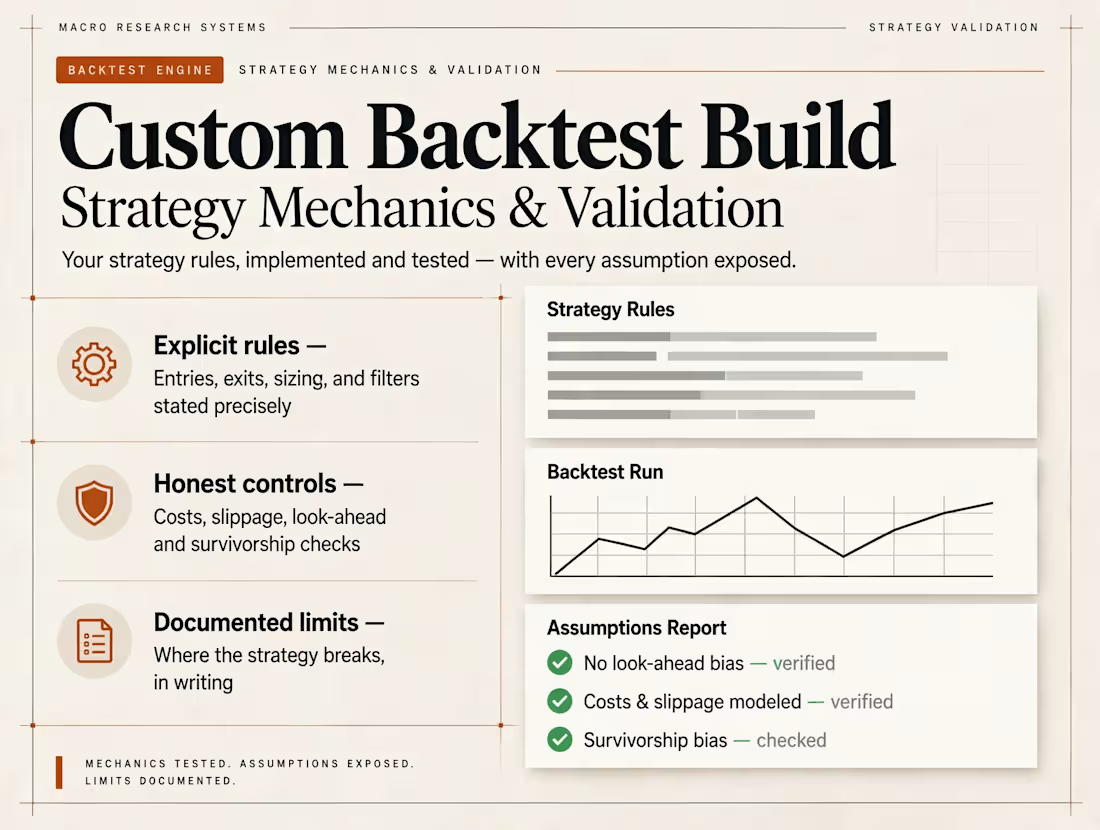
We define your strategy in explicit, testable rules (entries, exits, sizing, filters) — if a rule can't be stated precisely, that's the first finding
I implement it in the harness and run it against historical data
You get the results with every assumption exposed: data source, costs/slippage treatment, look-ahead and survivorship controls, and parameter sensitivity
Honest framing
A backtest tests mechanics and behavior — it is not proof of future returns, and this service is research tooling, not investment advice. What it does give you is a disciplined way to find out whether a strategy idea survives contact with its own rules before real money is involved, and a record of exactly where it breaks.
Who it's for
Independent traders and small teams with a rule-based strategy idea who want it tested rigorously instead of vibes-tested.
Phillip's other services


Starting at$1,500
Duration2 weeks
Tags
Backtesting
GitHub

Data Analyst
Quantitative Research
Trading Systems
Service provided by
Phillip Wells Savannah, USA
- 3
- Followers
Custom Backtest Build — Strategy Mechanics & ValidationPhillip Wells
Starting at$1,500
Duration2 weeks
Tags
Backtesting
GitHub
Data Analyst
Quantitative Research
Trading Systems
What this is
You bring the strategy rules; I build and run the backtest on the GitHub-based quantitative backtesting harness I developed for my own macro research — Macro Backtest Runner v1.2 — and document exactly what the test does and does not prove.
The engine behind it
This isn't a spreadsheet or a one-off script. The harness separates three questions that most backtests sloppily collapse into one:
COMMON_WINDOW_ARCHITECTURE — allocation and mechanics comparisons where every scenario runs over one identical sample (a ~23-24 month common window), so differences come from the architecture, not from cherry-picked periods
ANCHOR_FORWARD_THESIS — a portfolio/thesis frozen at a documented historical anchor date (first verified anchor: 2026-03-27) and measured forward, with no later information allowed to leak into the baseline
EVENT_DATED_SYSTEM — replays a documented decision ledger, where adds, cuts, and replacements enter only on the dates they actually happened
Eleven test harnesses cover allocation weighting, defense-mix sensitivity, dependency caps, satellite weight grids, orchestration splits, diversifier tests, replacement comparisons (FN allocation, RSP replacement), and correlation/brutality stress tests — 100+ documented allocation scenarios, including a 64-combination satellite weight grid (3 positions swept across 4 weight levels, backed by 27,514 simulated trades), plus 100-iteration stress loops, with tens of thousands of simulated trades persisted as structured result artifacts.
Integrity controls
Completed-month rule (v1.2): the incomplete current month is excluded from every metric — no partial month dressed up as a finished one
Every compared scenario uses identical assumptions; only the variable under test changes
Costs, contributions, and drift thresholds are modeled explicitly
Requested vs. actual start dates are always reported, with the constraining series named
Every test carries a bias classification — common-window tests use a present-day universe retrospectively, so survivorship/selection bias is labeled, not hidden
A result counts only after the GitHub Actions run succeeds and the structured result artifact is persisted
How it works
We define your strategy in explicit, testable rules (entries, exits, sizing, filters) — if a rule can't be stated precisely, that's the first finding
I implement it in the harness and run it against historical data
You get the results with every assumption exposed: data source, costs/slippage treatment, look-ahead and survivorship controls, and parameter sensitivity
Honest framing
A backtest tests mechanics and behavior — it is not proof of future returns, and this service is research tooling, not investment advice. What it does give you is a disciplined way to find out whether a strategy idea survives contact with its own rules before real money is involved, and a record of exactly where it breaks.
Who it's for
Independent traders and small teams with a rule-based strategy idea who want it tested rigorously instead of vibes-tested.
Phillip's other services
$1,500