
Multi-Agent AI- 3 Specialists Solving Complex ProblemsPATHAKHRK INC
I'll architect and build a custom multi-agent AI system where three specialized agents collaborate like a team of experts to solve your complex problem—each with distinct expertise working in coordinated sequence to analyze, research, and synthesize solutions that a single AI couldn't deliver alone. The system handles everything from data processing to final output generation with full visibility into what each agent is doing and why, all wrapped in a clean web interface your users will actually enjoy using. This is for sophisticated problems that benefit from multiple expert perspectives working together—think research synthesis, strategic planning, content creation, data analysis, or any challenge that's too complex for one-size-fits-all AI.
What's included
Custom Multi-Agent Architecture Design
Complete system architecture designed specifically for your problem. I'll break down your complex challenge into specialized roles and design three AI agents, each with distinct expertise that complements the others. This isn't generic—it's custom-built around your specific use case, whether that's research analysis, content creation, data processing, planning, or whatever multi-faceted problem you're trying to solve. You'll get detailed architecture documentation showing how agents collaborate and why this approach beats a single AI trying to do everything
3 AI Agents with Unique Capabilities
3 fully functional AI agents, each engineered with specific expertise and personality. Agent 1 might be your analyst who processes data and identifies patterns. Agent 2 could be your researcher who gathers detailed information. Agent 3 might be your synthesizer who combines insights into actionable outputs. Each agent has custom system prompts, specialized tools, distinct reasoning approaches, and clear responsibilities. They work like a team of experts collaborating on your problem, not one generalist doing everything mediocrely
Intelligent Agent Orchestration System
Sophisticated orchestration layer built with Kaiban.js that manages how agents work together. This handles the critical coordination—which agent runs first, how data passes between agents, when agents need to collaborate versus work independently, error handling if an agent fails, and ensuring outputs from one agent properly inform the next. The orchestration is what turns three separate AIs into one coherent problem-solving system.
Agent Communication & Context Management
Smart context management ensuring agents maintain relevant information throughout the workflow. When Agent 2 receives results from Agent 1, it has all the context needed to build on that work. When Agent 3 synthesizes everything, it has the complete picture. The system manages memory, passes relevant data between agents, prevents information loss, and ensures consistency. Agents understand what their teammates discovered without redundant processing.
Sequential Workflow with Dependencies
Carefully designed workflow where agents execute in the optimal sequence with proper dependencies. Agent 1's analysis must complete before Agent 2 can research, and both must finish before Agent 3 synthesizes. The system enforces these dependencies, handles timing, manages async operations, and ensures stability. If Agent 1 takes longer than expected, the system waits appropriately rather than moving forward with incomplete data.
Real-Time Data Integration & Tool Access
Connections to real-time data sources and tools your agents need to be effective. If agents need to search the web, query databases, access APIs, pull from documents, or interact with external systems, those integrations are built in. Each agent gets access to the specific tools relevant to its role. The analyst might access your analytics platform, the researcher might use search APIs, the synthesizer might connect to your content management system.
Custom Output Generation & Formatting
Structured output that's immediately usable for your needs. The final agent doesn't just dump text—it generates properly formatted reports, structured data, organized recommendations, or whatever output format makes sense for your use case. If you need a business report, you get sections with headers and bullet points. If you need structured data, you get properly formatted JSON. Output matches your actual requirements, not generic AI responses.
Quality Validation & Confidence Scoring
Built-in quality checks at each stage ensuring agents produce reliable outputs. Each agent includes confidence scoring showing how certain it is about its conclusions. If confidence is low, the system can trigger agent re-runs with different approaches or flag outputs for human review. Validation mechanisms prevent garbage from one agent polluting the work of downstream agents. You get visibility into reliability, not blind trust.
Interactive Web Application Interface
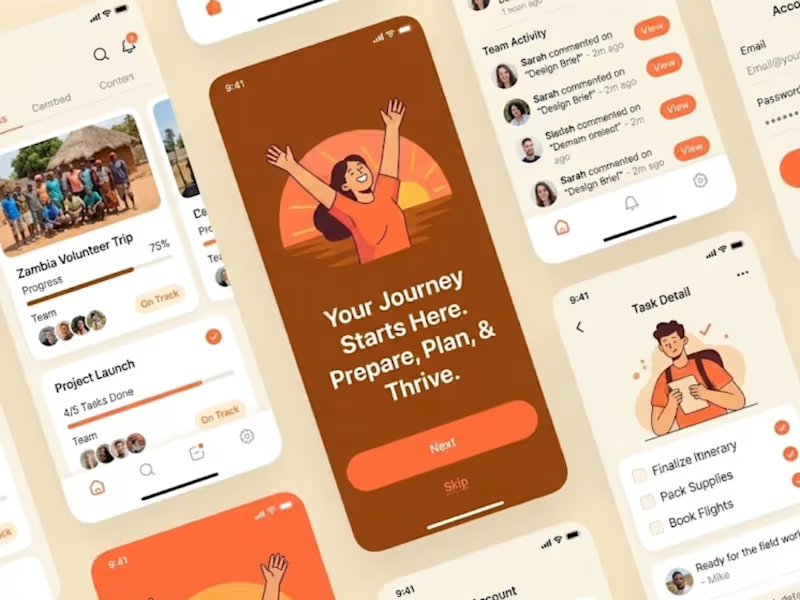
Clean, responsive web app built with Next.js where users interact with the multi-agent system. The interface guides input collection, shows real-time progress as agents work ("Agent 1: Analyzing data...", "Agent 2: Researching options...", "Agent 3: Generating recommendations..."), displays intermediate results if helpful, and presents the final output beautifully. Users understand what's happening under the hood without seeing technical complexity
Progress Tracking & Agent Activity Monitoring
Real-time visibility into what each agent is doing. Users see which agent is currently working, what stage of the process they're in, how long each step is taking, and when results are ready. This transparency builds trust and sets appropriate expectations—people know the system is working and roughly how long to wait, rather than staring at a loading spinner wondering if anything is happening.
Error Handling & Graceful Degradation
Error handling ensuring the system fails gracefully rather than crashing. If Agent 1 encounters an error, the system can retry with adjusted parameters, use fallback approaches, or escalate appropriately. If external APIs are down, agents work with cached data or acknowledge limitations. Users get useful partial results rather than complete failures. The system logs errors for debugging while maintaining a smooth user experience.
Performance Optimization & Speed Tuning
Optimized system that delivers results as fast as possible without sacrificing quality. This includes parallel processing where agents can work simultaneously, efficient API usage to minimize wait times, smart caching to avoid redundant work, and streamlined workflows. While some complex problems naturally take time, the system is engineered to eliminate unnecessary delays and give users results quickly.
Scalability & Concurrent Request Handling
Infrastructure that handles multiple users running the multi-agent system simultaneously without performance degradation. Whether it's 1 person or 100 people using the system at once, everyone gets consistent performance. The architecture scales horizontally, manages resources efficiently, and ensures fairness. Your system can grow from internal tool to customer-facing product without rebuilding.
Admin Dashboard for System Management
Backend dashboard for monitoring and managing the multi-agent system. View usage statistics, track success rates, see average processing times, monitor API costs, review error logs, and analyze output quality. You can adjust agent prompts, tune parameters, update data sources, and control system behavior without touching code. This gives you ongoing control and optimization capability.
Documentation & Usage Guide
Complete documentation covering the system architecture, how agents work individually and together, example use cases, API documentation if relevant, troubleshooting guide, and best practices. Plus training for your team on how to use the system effectively, interpret outputs, handle edge cases, and get maximum value. You're not left figuring things out—you have clear guidance.
90-Day Evolution & Optimization Period
3 months of active collaboration after launch to refine and enhance the system based on real usage. We'll monitor how agents perform in production, identify patterns in successes and failures, tune prompts for better outputs, adjust orchestration for efficiency, add capabilities based on user feedback, and evolve the system as we learn what works best. This is a partnership to make sure the multi-agent system delivers maximum value.
FAQs

Starting at$12,000
Duration6 weeks
Tags
ChatGPT

JavaScript

LangChain

Next.js

TypeScript

AI Agent Developer
AI Developer
Fullstack Engineer
Service provided by
PATHAKHRK INC Kangra, India
- 2
- Followers
Multi-Agent AI- 3 Specialists Solving Complex ProblemsPATHAKHRK INC
Starting at$12,000
Duration6 weeks
Tags
ChatGPT
JavaScript
LangChain
Next.js
TypeScript
AI Agent Developer
AI Developer
Fullstack Engineer
I'll architect and build a custom multi-agent AI system where three specialized agents collaborate like a team of experts to solve your complex problem—each with distinct expertise working in coordinated sequence to analyze, research, and synthesize solutions that a single AI couldn't deliver alone. The system handles everything from data processing to final output generation with full visibility into what each agent is doing and why, all wrapped in a clean web interface your users will actually enjoy using. This is for sophisticated problems that benefit from multiple expert perspectives working together—think research synthesis, strategic planning, content creation, data analysis, or any challenge that's too complex for one-size-fits-all AI.
What's included
Custom Multi-Agent Architecture Design
Complete system architecture designed specifically for your problem. I'll break down your complex challenge into specialized roles and design three AI agents, each with distinct expertise that complements the others. This isn't generic—it's custom-built around your specific use case, whether that's research analysis, content creation, data processing, planning, or whatever multi-faceted problem you're trying to solve. You'll get detailed architecture documentation showing how agents collaborate and why this approach beats a single AI trying to do everything
3 AI Agents with Unique Capabilities
3 fully functional AI agents, each engineered with specific expertise and personality. Agent 1 might be your analyst who processes data and identifies patterns. Agent 2 could be your researcher who gathers detailed information. Agent 3 might be your synthesizer who combines insights into actionable outputs. Each agent has custom system prompts, specialized tools, distinct reasoning approaches, and clear responsibilities. They work like a team of experts collaborating on your problem, not one generalist doing everything mediocrely
Intelligent Agent Orchestration System
Sophisticated orchestration layer built with Kaiban.js that manages how agents work together. This handles the critical coordination—which agent runs first, how data passes between agents, when agents need to collaborate versus work independently, error handling if an agent fails, and ensuring outputs from one agent properly inform the next. The orchestration is what turns three separate AIs into one coherent problem-solving system.
Agent Communication & Context Management
Smart context management ensuring agents maintain relevant information throughout the workflow. When Agent 2 receives results from Agent 1, it has all the context needed to build on that work. When Agent 3 synthesizes everything, it has the complete picture. The system manages memory, passes relevant data between agents, prevents information loss, and ensures consistency. Agents understand what their teammates discovered without redundant processing.
Sequential Workflow with Dependencies
Carefully designed workflow where agents execute in the optimal sequence with proper dependencies. Agent 1's analysis must complete before Agent 2 can research, and both must finish before Agent 3 synthesizes. The system enforces these dependencies, handles timing, manages async operations, and ensures stability. If Agent 1 takes longer than expected, the system waits appropriately rather than moving forward with incomplete data.
Real-Time Data Integration & Tool Access
Connections to real-time data sources and tools your agents need to be effective. If agents need to search the web, query databases, access APIs, pull from documents, or interact with external systems, those integrations are built in. Each agent gets access to the specific tools relevant to its role. The analyst might access your analytics platform, the researcher might use search APIs, the synthesizer might connect to your content management system.
Custom Output Generation & Formatting
Structured output that's immediately usable for your needs. The final agent doesn't just dump text—it generates properly formatted reports, structured data, organized recommendations, or whatever output format makes sense for your use case. If you need a business report, you get sections with headers and bullet points. If you need structured data, you get properly formatted JSON. Output matches your actual requirements, not generic AI responses.
Quality Validation & Confidence Scoring
Built-in quality checks at each stage ensuring agents produce reliable outputs. Each agent includes confidence scoring showing how certain it is about its conclusions. If confidence is low, the system can trigger agent re-runs with different approaches or flag outputs for human review. Validation mechanisms prevent garbage from one agent polluting the work of downstream agents. You get visibility into reliability, not blind trust.
Interactive Web Application Interface
Clean, responsive web app built with Next.js where users interact with the multi-agent system. The interface guides input collection, shows real-time progress as agents work ("Agent 1: Analyzing data...", "Agent 2: Researching options...", "Agent 3: Generating recommendations..."), displays intermediate results if helpful, and presents the final output beautifully. Users understand what's happening under the hood without seeing technical complexity
Progress Tracking & Agent Activity Monitoring
Real-time visibility into what each agent is doing. Users see which agent is currently working, what stage of the process they're in, how long each step is taking, and when results are ready. This transparency builds trust and sets appropriate expectations—people know the system is working and roughly how long to wait, rather than staring at a loading spinner wondering if anything is happening.
Error Handling & Graceful Degradation
Error handling ensuring the system fails gracefully rather than crashing. If Agent 1 encounters an error, the system can retry with adjusted parameters, use fallback approaches, or escalate appropriately. If external APIs are down, agents work with cached data or acknowledge limitations. Users get useful partial results rather than complete failures. The system logs errors for debugging while maintaining a smooth user experience.
Performance Optimization & Speed Tuning
Optimized system that delivers results as fast as possible without sacrificing quality. This includes parallel processing where agents can work simultaneously, efficient API usage to minimize wait times, smart caching to avoid redundant work, and streamlined workflows. While some complex problems naturally take time, the system is engineered to eliminate unnecessary delays and give users results quickly.
Scalability & Concurrent Request Handling
Infrastructure that handles multiple users running the multi-agent system simultaneously without performance degradation. Whether it's 1 person or 100 people using the system at once, everyone gets consistent performance. The architecture scales horizontally, manages resources efficiently, and ensures fairness. Your system can grow from internal tool to customer-facing product without rebuilding.
Admin Dashboard for System Management
Backend dashboard for monitoring and managing the multi-agent system. View usage statistics, track success rates, see average processing times, monitor API costs, review error logs, and analyze output quality. You can adjust agent prompts, tune parameters, update data sources, and control system behavior without touching code. This gives you ongoing control and optimization capability.
Documentation & Usage Guide
Complete documentation covering the system architecture, how agents work individually and together, example use cases, API documentation if relevant, troubleshooting guide, and best practices. Plus training for your team on how to use the system effectively, interpret outputs, handle edge cases, and get maximum value. You're not left figuring things out—you have clear guidance.
90-Day Evolution & Optimization Period
3 months of active collaboration after launch to refine and enhance the system based on real usage. We'll monitor how agents perform in production, identify patterns in successes and failures, tune prompts for better outputs, adjust orchestration for efficiency, add capabilities based on user feedback, and evolve the system as we learn what works best. This is a partnership to make sure the multi-agent system delivers maximum value.
FAQs
$12,000