
A daily publishing system for your Shopify blog that holds itself to an editor's standard. Built on Make.com, OpenAI and your Shopify Admin API, in accounts you own.
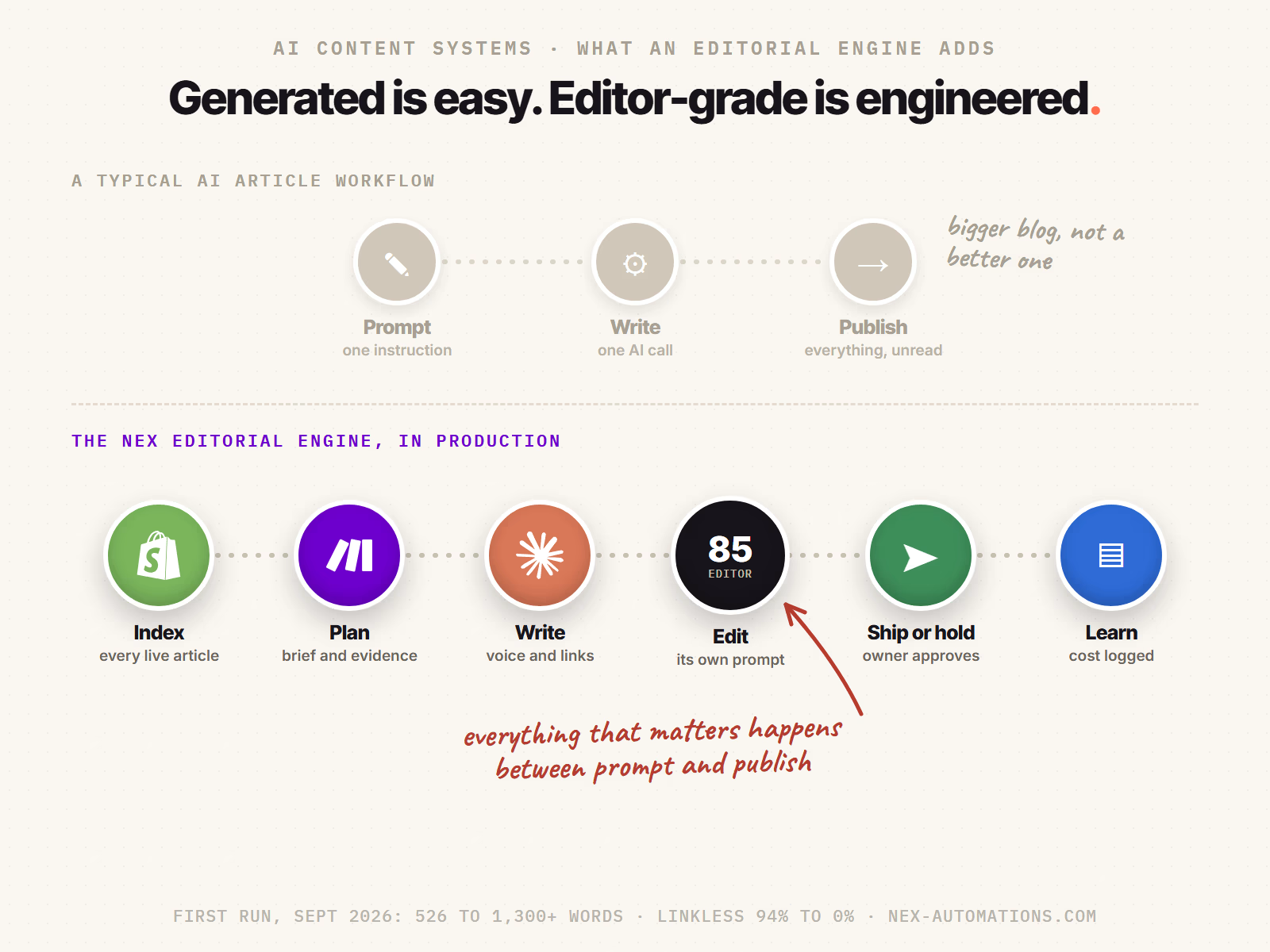
Most AI article tools are three steps: prompt, write, publish. They work on day one and cost you on day ninety, when the blog is hundreds of thin lookalike articles competing with each other in search. The Editorial Engine is built like an editorial desk instead, and every stage exists because the three-step version breaks without it.
How this differs from a normal AI article workflow
It knows your blog before it writes. An index of every live article, labelled by search intent, so no new piece ever competes with one you already have. A typical workflow has no memory at all.
It plans before it writes. Each topic becomes a brief and evidence plan first: the reader's real question, question-shaped sections, which facts are safe to assert and which to avoid. The writer never invents its own outline.
It writes to sell, not just to fill. Your voice, your exact closing line, and three tracked links per article into durable collection pages, so blog readers have somewhere to go and you can trace clicks to orders.
A second AI edits with its own prompt. Every draft is graded on 8 quality dimensions with a pass mark of 85, independently of the step that wrote it. The writer never marks its own homework.
Weak drafts never reach your blog. A draft that misses the bar gets one revision against the editor's findings and a second review. Miss twice and it waits for you with the findings written out, instead of publishing.
It runs like production software. Every module carries retry-then-alert error handling, the on-off switch is a spreadsheet cell you already open, and every run logs its QA scores and AI cost, so you always know what an article cost you.
Measured, not promised
First production run on a live US used-book Shopify store, September 2026, against the store's 125 existing articles:
Typical article length: 526 words before, 1,300+ after
Articles with no links into the store: 94% before, 0% after
Carrying the owner's signature closing line: 28% before, 100% after
Of the first five drafts, the editor published one, held two at scores of 91 and 94 for the owner and blocked two
See the architecture, the real Make.com scenario map and the before and after table in the full case study: Daily SEO publishing for Shopify.
Who builds it
Prem Patel, Nex Automations. Make.com Level 5 certified, the top of Make's five-level ladder, earned on a build challenge set by Make's engineering team under operation limits, and a listed partner in the Make directory. Zapier Certified Expert. 1,200+ automations for 210+ clients across 12+ countries over 6+ years (nex-automations.com, 2026).
Everything is built inside your own Shopify, Make.com and OpenAI accounts with documentation and a walkthrough, so nothing depends on anyone else's subscriptions staying alive.
Get it for$1,200.00
Single-blog Editorial Engine
$1,200.00
The full pipeline on one Shopify blog: article index, intent-level duplicate checking, brief-first writing in your voice, independent AI editor with a pass mark, tracked collection links, draft-first rollout, run log and failure alerts. Built in your accounts in about 2 weeks.
Tags
Product created by
Prem Patel proIndia
- 11
- Followers
Prem's other products
TradingView to Telegram alert bot on Make.com
$99.00
Get it for$1,200.00
Single-blog Editorial Engine
$1,200.00
The full pipeline on one Shopify blog: article index, intent-level duplicate checking, brief-first writing in your voice, independent AI editor with a pass mark, tracked collection links, draft-first rollout, run log and failure alerts. Built in your accounts in about 2 weeks.
Tags
A daily publishing system for your Shopify blog that holds itself to an editor's standard. Built on Make.com, OpenAI and your Shopify Admin API, in accounts you own.
Most AI article tools are three steps: prompt, write, publish. They work on day one and cost you on day ninety, when the blog is hundreds of thin lookalike articles competing with each other in search. The Editorial Engine is built like an editorial desk instead, and every stage exists because the three-step version breaks without it.
How this differs from a normal AI article workflow
It knows your blog before it writes. An index of every live article, labelled by search intent, so no new piece ever competes with one you already have. A typical workflow has no memory at all.
It plans before it writes. Each topic becomes a brief and evidence plan first: the reader's real question, question-shaped sections, which facts are safe to assert and which to avoid. The writer never invents its own outline.
It writes to sell, not just to fill. Your voice, your exact closing line, and three tracked links per article into durable collection pages, so blog readers have somewhere to go and you can trace clicks to orders.
A second AI edits with its own prompt. Every draft is graded on 8 quality dimensions with a pass mark of 85, independently of the step that wrote it. The writer never marks its own homework.
Weak drafts never reach your blog. A draft that misses the bar gets one revision against the editor's findings and a second review. Miss twice and it waits for you with the findings written out, instead of publishing.
It runs like production software. Every module carries retry-then-alert error handling, the on-off switch is a spreadsheet cell you already open, and every run logs its QA scores and AI cost, so you always know what an article cost you.
Measured, not promised
First production run on a live US used-book Shopify store, September 2026, against the store's 125 existing articles:
Typical article length: 526 words before, 1,300+ after
Articles with no links into the store: 94% before, 0% after
Carrying the owner's signature closing line: 28% before, 100% after
Of the first five drafts, the editor published one, held two at scores of 91 and 94 for the owner and blocked two
See the architecture, the real Make.com scenario map and the before and after table in the full case study: Daily SEO publishing for Shopify.
Who builds it
Prem Patel, Nex Automations. Make.com Level 5 certified, the top of Make's five-level ladder, earned on a build challenge set by Make's engineering team under operation limits, and a listed partner in the Make directory. Zapier Certified Expert. 1,200+ automations for 210+ clients across 12+ countries over 6+ years (nex-automations.com, 2026).
Everything is built inside your own Shopify, Make.com and OpenAI accounts with documentation and a walkthrough, so nothing depends on anyone else's subscriptions staying alive.
Prem's other products
TradingView to Telegram alert bot on Make.com
$99.00
$1,200.00