
Enterprise Network & Systems Administration | Linux, pfSense & VPN
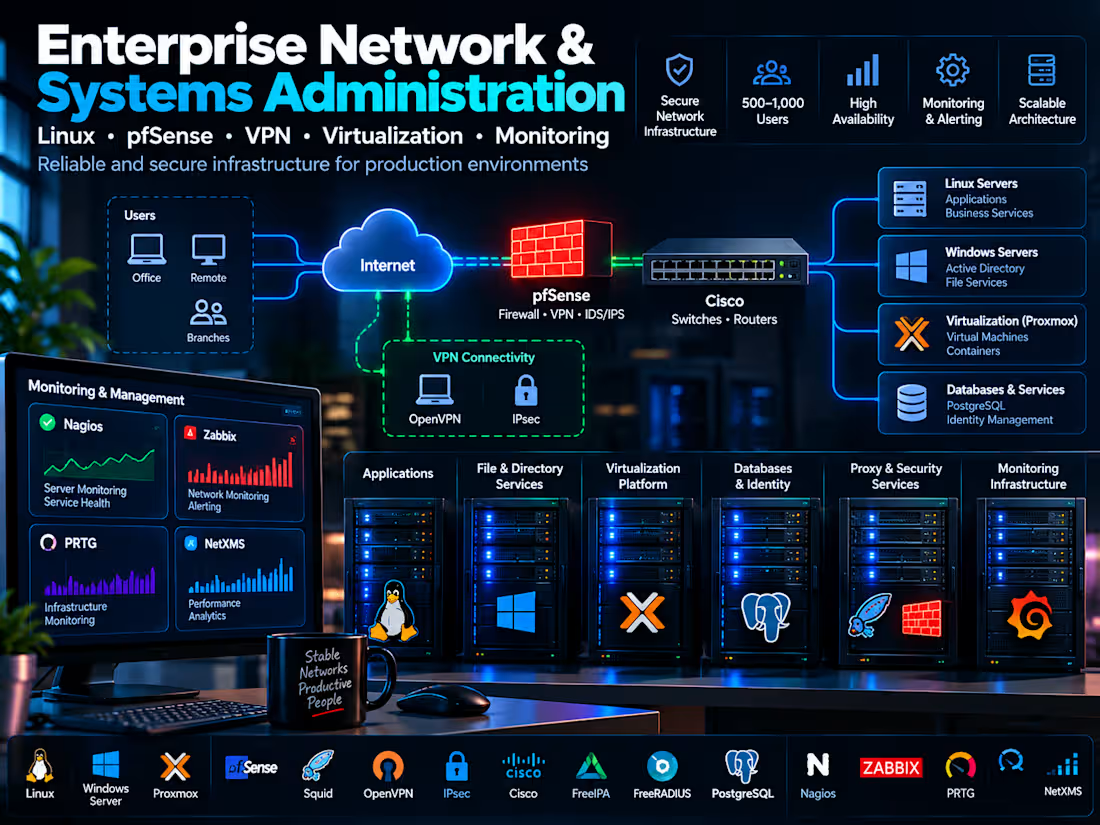
I have extensive professional experience administering enterprise production infrastructure supporting approximately 500–1,000 users.
My responsibilities included:
Linux & Virtualization: Administration of Linux and Windows servers, virtual machines, and Proxmox virtualization infrastructure.
Network Security: Installation, configuration, and maintenance of pfSense firewalls and Squid proxy services.
VPN Connectivity: Implementation and troubleshooting of secure OpenVPN and IPsec connections.
Enterprise Networking: Administration of Cisco switches, routers, and network infrastructure.
Identity Management: Configuration and administration of FreeIPA and FreeRADIUS for centralized authentication and access control.
Infrastructure Monitoring: Monitoring servers, networks, and critical services using Nagios, Zabbix, PRTG, and NetXMS.
Troubleshooting: Diagnosing connectivity, performance, authentication, and service availability problems.
This experience involved maintaining real organizational infrastructure, resolving operational incidents, and supporting reliable IT services in a production environment.
Technologies: Linux, Windows Server, Proxmox, pfSense, Squid, OpenVPN, IPsec, Cisco, FreeIPA, FreeRADIUS, Zabbix, Nagios, PRTG, NetXMS.
Professional experience showcase. Any accompanying architecture illustration is representative and does not disclose confidential employer infrastructure.
0
17

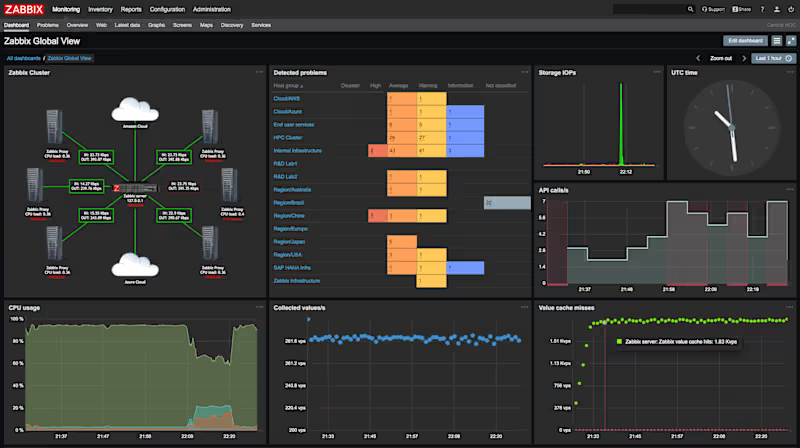
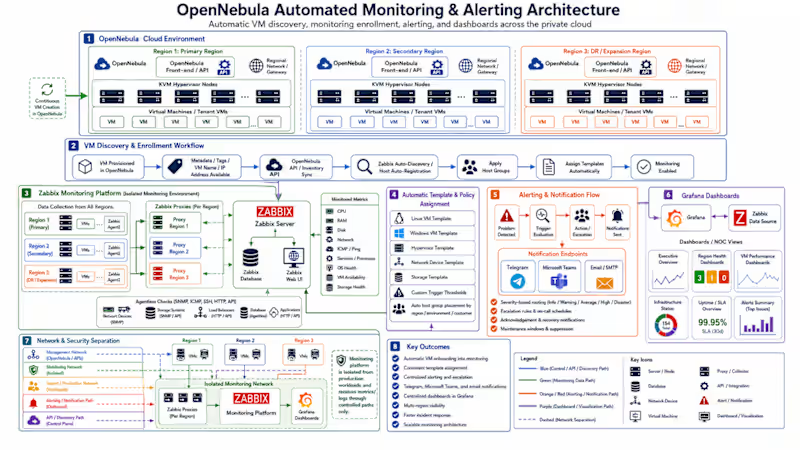
Automated OpenNebula Monitoring and Alerting Architecture
Designed an automated monitoring and observability architecture for a multi-region OpenNebula private cloud environment.
The solution automatically discovers newly created virtual machines through the OpenNebula API and registers them in Zabbix without requiring manual monitoring configuration. Once a VM is detected, it is assigned to the appropriate host group based on its region, environment, operating system, or customer.
Monitoring templates are then applied automatically for Linux, Windows, hypervisor, network, and storage systems. This ensures that every newly provisioned VM receives consistent monitoring, trigger thresholds, availability checks, and alerting policies from the moment it becomes active.
The architecture includes regional Zabbix proxies that collect monitoring data from each OpenNebula region and securely forward it to a centralized Zabbix Server. This reduces cross-region monitoring traffic and allows monitoring to continue locally during temporary network interruptions.
The platform monitors:
CPU and memory utilization
Disk capacity and performance
Network traffic and packet loss
Operating system availability
Services and running processes
VM uptime and availability
Hypervisor health
Storage availability and performance
Network devices using SNMP
Web services and APIs using HTTP checks
When a problem is detected, Zabbix evaluates the configured trigger and escalation policy. Notifications are then automatically routed to Telegram, Microsoft Teams, and email based on severity, environment, and operational responsibility.
Grafana is integrated with Zabbix as a centralized visualization platform. It provides real-time dashboards for infrastructure health, regional availability, VM performance, uptime, service-level objectives, resource capacity, and active alerts.
The monitoring environment is isolated from tenant and production networks using a dedicated monitoring network. Only controlled monitoring, API, and notification traffic is permitted between the cloud regions and the monitoring platform.
Key outcomes of the solution include:
Automatic VM discovery and monitoring enrollment
Consistent monitoring across all OpenNebula regions
Automated template and policy assignment
Centralized alerting and escalation
Telegram, Microsoft Teams, and email notifications
Real-time Grafana dashboards
Reduced manual administration
Faster incident detection and response
Scalable monitoring for future cloud expansion
This project demonstrates my ability to integrate OpenNebula, Zabbix, Grafana, API-driven automation, multi-region monitoring, centralized alerting, and secure network segmentation into a complete private cloud observability platform.
2
237
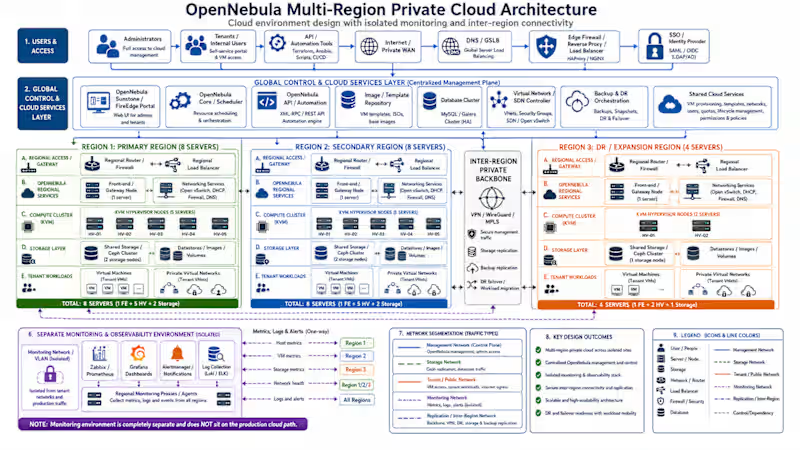
Designed a complete multi-region private cloud architecture using OpenNebula across three geographically separated regions with a total of 20 physical servers.
The solution provides centralized cloud management, regional workload isolation, secure inter-region connectivity, shared cloud services, disaster recovery, backup replication, and dedicated monitoring for the complete infrastructure.
The environment was structured as follows:
Primary Region: 8 servers
Secondary Region: 8 servers
Disaster Recovery and Expansion Region: 4 servers
Centralized OpenNebula management and scheduling
KVM-based virtualization across all compute nodes
Regional firewalls, routers, load balancers, and gateway services
Separate compute, storage, management, tenant, replication, and monitoring networks
Shared storage and Ceph-based storage architecture
Cross-region backup replication and workload failover
Centralized image, template, user, network, and lifecycle management
Secure administrator and tenant access through SSO and role-based access control
A dedicated monitoring and observability environment was also designed separately from the production cloud network. The monitoring stack included Prometheus or Zabbix for metrics collection, Grafana for dashboards, Alertmanager for notifications, and Loki or the ELK Stack for centralized log management.
Regional monitoring proxies and agents collect host, VM, storage, application, and network metrics from each region while keeping the monitoring infrastructure isolated from tenant and production traffic.
The architecture was designed to provide:
High availability across multiple regions
Centralized private cloud management
Secure workload and tenant isolation
Disaster recovery and regional failover
Scalable compute and storage capacity
Centralized monitoring, logging, and alerting
Infrastructure automation through APIs, Terraform, Ansible, and CI/CD pipelines
This project demonstrates my ability to design secure, scalable, highly available private cloud platforms using OpenNebula, KVM, software-defined networking, distributed storage, infrastructure automation, and enterprise monitoring technologies.
1
287