Freelance SEO Specialists in SydneyFreelance SEO Specialists in Sydney
Ghostwriter for Business & LinkedIn Copywriter for Founders
New to Contra
Ghostwriter for Business & LinkedIn Copywriter for Founders
Cover image for [PROBLEM]
Most organizations rarely fail because
[PROBLEM] Most organizations rarely fail because of a poor strategy. They fail because of poor alignment around that strategy. Leaders assume that once a vision is communicated, it’s understood—but communication is not comprehension. The default state of any company isn't unity; it's fragmentation. While the executive team sees a clear roadmap, the frontline is often operating on "narrative battlegrounds" where competing department stories quietly undermine execution. This "Strategic Blind Spot" is the silent killer of productivity and growth in modern enterprise. [SOLUTION] Strategic alignment is not a passive byproduct of a quarterly roadmap—it’s a weekly discipline of Contextual Stitching. I’ve architected a deep dive into how leaders can move beyond the "Illusion of Shared Understanding" to build a unified organizational narrative that actually scales. The Leader’s Blind Spot: Why Most Organizations Fail at Strategic Alignment "Strategic alignment is the most overused phrase in business and the least understood. Most leaders assume alignment is a natural byproduct of a good strategy. It isn’t. In fact, the default state of any organization is misalignment—and it spreads silently until it kills execution." We’ve all seen it: Finance tells a story of cost control while Product tells a story of experimentation. When your teams are operating on fragmented narratives, your strategy becomes mere noise. You aren't failing because the plan is bad; you're failing because your organization is a narrative battleground of competing priorities. " Alignment isn't a kick-off meeting; it’s a weekly discipline of Contextual Stitching. I’ve architected a deep dive into the "Leader’s Blind Spot," revealing how to move from the illusion of shared understanding to a unified strategic narrative that scales." It is not passive. It is not the default state of an organization. In fact, the default state is misalignment — and most leaders don’t realize how quickly it spreads, how quietly it compounds, or how deeply it undermines execution. The uncomfortable truth is this: organizations rarely fail because of poor strategy. They fail because of poor alignment around the strategy. And the root cause is almost always the same — a leadership blind spot around how humans interpret information, incentives, and narrative. 1. The Illusion of Shared Understanding Most leaders assume that once a strategy is communicated, it is understood. But communication is not comprehension. A strategy that feels obvious to the executive team often feels abstract, distant, or irrelevant to frontline employees. The further a message travels down the hierarchy, the more it fragments. This is not because employees are disengaged — it’s because humans interpret information through the lens of their role, pressures, and incentives. A product manager hears the strategy differently than a sales director. A customer success lead hears it differently than a finance analyst. Without deliberate translation, the strategy becomes a collection of competing interpretations rather than a shared mental model. Leaders underestimate how much contextual stitching is required to turn a strategic idea into a unified organizational narrative. 2. Narrative Fragmentation: The Silent Killer of Alignment Organizations are storytelling ecosystems. Every team tells a story about what matters, what success looks like, and how decisions should be made. When these stories conflict, alignment collapses. A company may claim to prioritize innovation, but if: Finance tells a story about cost control Operations tells a story about risk avoidance Marketing tells a story about speed Product tells a story about experimentation …then the organization becomes a narrative battleground. Alignment requires one coherent story — a strategic narrative that every team can translate into their own context without distorting the core message. Without narrative coherence, even the best strategy becomes noise. 3. The Priority Paradox: When Everything Matters, Nothing Does One of the most common leadership blind spots is the belief that more priorities create more progress. In reality, more priorities create more fragmentation. When leaders articulate too many priorities, teams default to local optimization: “What helps my department?” “What protects my metrics?” “What keeps my team safe?” This is how organizations drift — not through dramatic failures, but through thousands of micro‑decisions made in isolation. Alignment requires ruthless prioritization. Leaders must define: What matters most What matters next What doesn’t matter at all Without this clarity, teams fill the ambiguity with their own assumptions, and alignment dissolves. 4. The Missing Feedback Loop Most organizations treat strategy as a one‑way broadcast: leadership speaks, the organization listens. But alignment is not a speech — it’s a conversation. High‑alignment organizations build feedback loops that surface misalignment early: Are teams interpreting the strategy correctly? Are priorities understood the same way across functions? Are decisions being made in alignment with the narrative? Are incentives reinforcing or undermining the strategy? Without feedback loops, leaders operate in an echo chamber. They assume alignment because no one is telling them otherwise. But silence is not alignment — silence is a lack of psychological safety. 5. Cognitive Bias: The Leader’s Hidden Enemy Leaders often assume their perspective is the organization’s perspective. They underestimate how much context they possess and how little context others have. This creates a gap between intention and interpretation. Leaders think in frameworks. Teams think in tasks. Leaders think in horizons. Teams think in deadlines. Leaders think in narratives. Teams think in deliverables. Alignment is not achieved when leaders think clearly — it is achieved when everyone thinks clearly. And that requires leaders to decentralize understanding, not just delegate execution. 6. The Organizations That Get Alignment Right The companies that master alignment share three traits: A. They communicate strategy as a narrative, not a document. They don’t rely on slides. They rely on story. They articulate: the problem the stakes the opportunity the path forward the role each team plays Narrative creates coherence. Coherence creates alignment. B. They operationalize priorities with precision. They don’t say “everything is important.” They say “this is what matters now.” They define: the one priority that drives the next 90 days the metrics that matter the trade‑offs they are willing to make This eliminates ambiguity and accelerates execution. C. They build alignment as a continuous practice. Alignment is not a kickoff meeting. It is not a quarterly ritual. It is a weekly discipline. High‑alignment organizations: revisit priorities recalibrate narratives reinforce context adjust based on feedback communicate relentlessly Alignment is maintained through rhythm, not intensity. 7. The Leadership Imperative In a world where complexity is rising and attention is shrinking, alignment is no longer a “nice to have.” It is a competitive advantage. It determines: speed clarity execution quality employee engagement customer experience organizational resilience Leaders who master alignment build organizations that move as one — fast, focused, and confident. Leaders who ignore alignment build organizations that move in fragments — slow, confused, and reactive. The difference is not strategy. The difference is clarity. The difference is narrative. The difference is leadership. SHARE or forward the full Executive White Paper: [Insert Bitly Link] strategiccopywriting (https://contra.com/community/topic/strategiccopywriting) fintechdesign (https://contra.com/community/topic/fintechdesign) agenticarchitecture (https://contra.com/community/topic/agenticarchitecture)AI Agent Engineer (https://contra.com/community/topic/ai-agent-engineer)AI Automation (https://contra.com/community/topic/ai-automation)AI Fact Checking (https://contra.com/community/topic/ai-fact-checker) Google Gemini (https://contra.com/community/topic/google-gemini) Mural (https://contra.com/community/topic/mural) synthflow Ai (https://contra.com/community/topic/synthflow-ai)
1
125
Cover image for 14-Day Email Sequence & Nurture
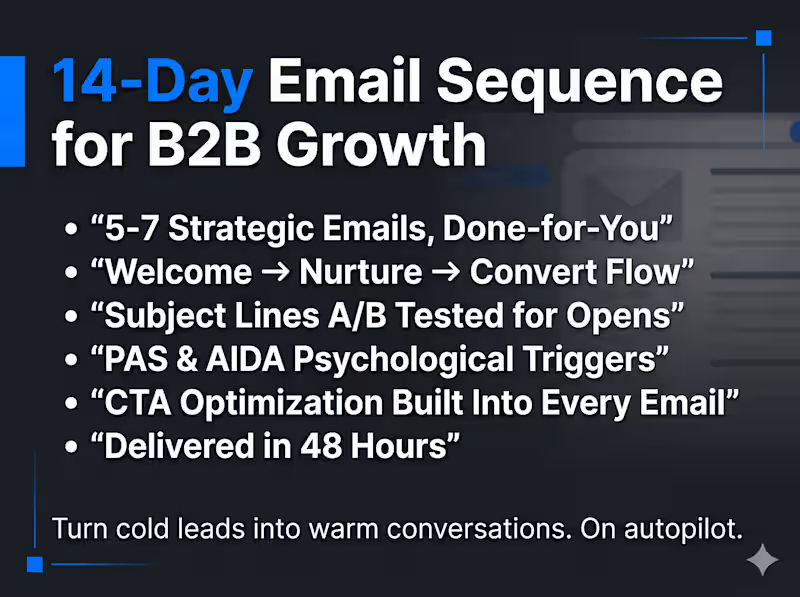
14-Day Email Sequence & Nurture Copy for B2B Growth You're getting leads. But they go cold before they buy. Someone visits your site, downloads your guide, books a discovery call, or signs up for your list. Then... silence. No follow-up. No nurture. No conversion. They forget you exist by Tuesday. The problem isn't your offer or your audience. It's that you have no system turning interest into trust, and trust into revenue. What I build for you A 14-day email nurture sequence engineered to take a cold lead from "who are you?" to "let's work together." Plus a 400-word anchor nurture piece (welcome email, lead magnet follow-up, or onboarding email) that sets the tone for the entire relationship. Every email is written with strategic intent: each one has a job, whether that's building credibility, handling objections, creating urgency, or driving a specific action. This isn't "just checking in" email. It's a conversion system. Built for B2B professionals who sell expertise This service is specifically designed for: Consultants & coaches who need to warm leads between discovery call and close Lawyers & accountants who want to nurture referrals and inbound inquiries without sounding salesy Real estate agents who need drip sequences that keep them top-of-mind through long buying cycles Small business owners who know they should be emailing their list but don't know what to say SaaS founders who need onboarding sequences that reduce churn and drive activation How it works Intake & Strategy: I learn your business, audience, and conversion goal. What action should the reader take by Day 14? We start there and reverse-engineer the sequence. Anchor Nurture Piece (400 words): I write your foundational email, the one that sets your voice, establishes authority, and frames the relationship. This is typically your welcome email or lead magnet follow-up. Short, sharp, and high-impact. 14-Day Email Sequence (14 emails, 150-200 words each): Each email is strategically sequenced using a trust-building arc: introduce, educate, prove, handle objections, create urgency, convert. Every email has a clear purpose and a single call to action. Delivery: Complete sequence delivered in a formatted Google Doc with subject lines, preview text, send-day recommendations, and CTA labels clearly marked. Ready to paste into Mailchimp, ConvertKit, ActiveCampaign, or any email platform. FAQs I'm not a tech company. Will this work for my industry? What email platform do I need? What's the difference between the anchor nurture piece and the 14-day sequence? Can you write for a specific conversion goal? What if I don't have a lead magnet or opt-in yet? Do I need to write anything myself? What if I want to adjust the tone or messaging?
0
38
Cover image for Your landing page exists. But
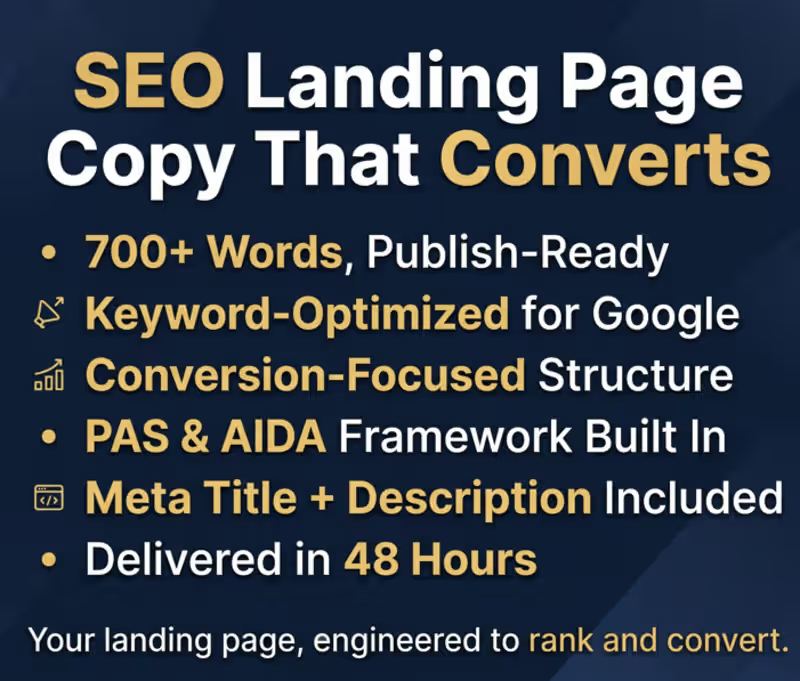
Your landing page exists. But nobody finds it. You built the product. You launched the site. But organic traffic is flat, bounce rates are high, and the page reads like it was written for a search engine from 2018. The problem isn't your offer. It's that your copy doesn't match what your buyer is actually searching for, and it doesn't move them once they arrive. What I build for you I write a conversion-focused SEO landing page grounded in real keyword research, not guesswork. Every headline, subhead, and paragraph is engineered to rank for the terms your buyers actually type, and structured to move them from curiosity to action. This isn't keyword stuffing. It's strategic copywriting built on proven psychological frameworks (PAS + AIDA) layered with SEO architecture so your page works for both Google and humans. I've done this for SaaS companies targeting competitive terms like "humanized AI" and delivered 2,000+ word pages built from multi-phase keyword research across intent clusters. You can see the full case study in my portfolio. How it works Keyword Research Phase: I research 3 primary keywords and 5 supporting sub-terms, analyzing search intent, competition, and opportunity. Structural Architecture: I map your page structure: H1 headline, 2-3 H2 subheads, body content, and meta description, all aligned to your keyword strategy. Copywriting Phase: I write 700+ words of conversion copy using PAS (Problem-Agitation-Solution) and AIDA (Attention-Interest-Desire-Action) frameworks. Q&A Section: 7 strategically written questions and answers that target long-tail search queries and reduce buyer objections simultaneously. Delivery: You receive the complete page copy in a clean Google Doc, ready to hand to your developer or paste into your CMS. Who this is for SaaS founders who need a landing page that ranks and converts Startups launching a new product or feature page Service businesses tired of paying for ads because organic isn't working Anyone who has a landing page that "looks fine" but generates zero inbound traffic FAQs - CHECK My Services for Answers Can you write for my specific industry or niche? What if I need more than 700 words? Do you just write copy, or do you also handle the SEO strategy? What do you need from me to get started? Can I get it faster than 2 days? What makes this different from hiring a regular copywriter? Do you offer revisions?
0
32
Communications & Social Media Guru