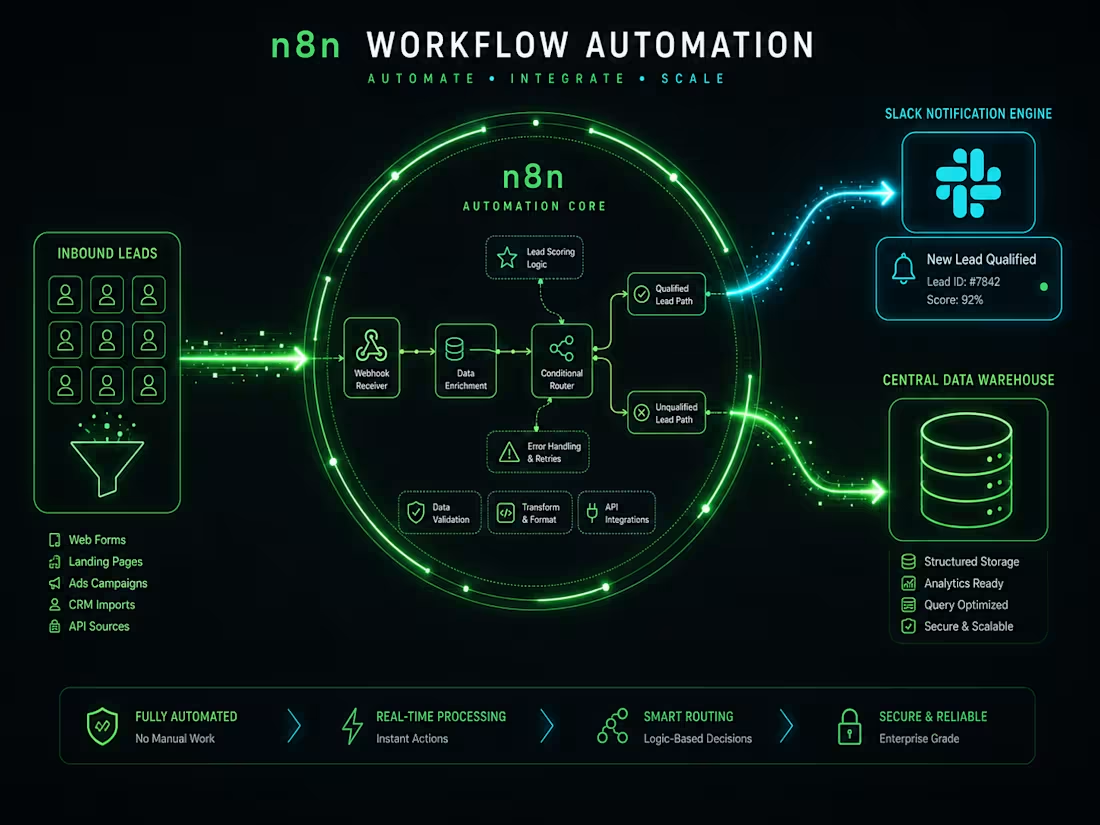
The client was losing high-value business leads due to delayed follow-ups and manual data entry across disconnected platforms (CRM, email, and advertising channels). The internal team was spending upwards of three hours a day manually copying lead data, resulting in data fragmentation and an average response time of over 12 hours.
The Tech Stack
1. n8n (Advanced Workflow Orchestration).
2. Webhooks & REST APIs (Data Ingestion).
3. PostgreSQL / Airtable (Centralized Data Warehouse).
4. Slack API (Instant Internal Notifications).
The Solution.
I engineered an autonomous, multi-stage lead processing engine using n8n. The system captures inbound leads via instant webhooks from front-end marketing platforms, normalizes and enriches the data using secondary API lookups, and instantly populates the centralized data warehouse. Simultaneously, the workflow routes the lead based on custom logic (such as budget or region) and fires an immediate, structured notification to the sales team's Slack channel, allowing for a sub-5-minute response time.
The Business Impact.
The automated pipeline eliminated manual data entry, recovering roughly 15 hours of administrative time per week for the internal team. More importantly, reducing the lead response time from 12 hours down to under 5 minutes directly improved lead-to-opportunity conversion rates by over 30%.
0
63
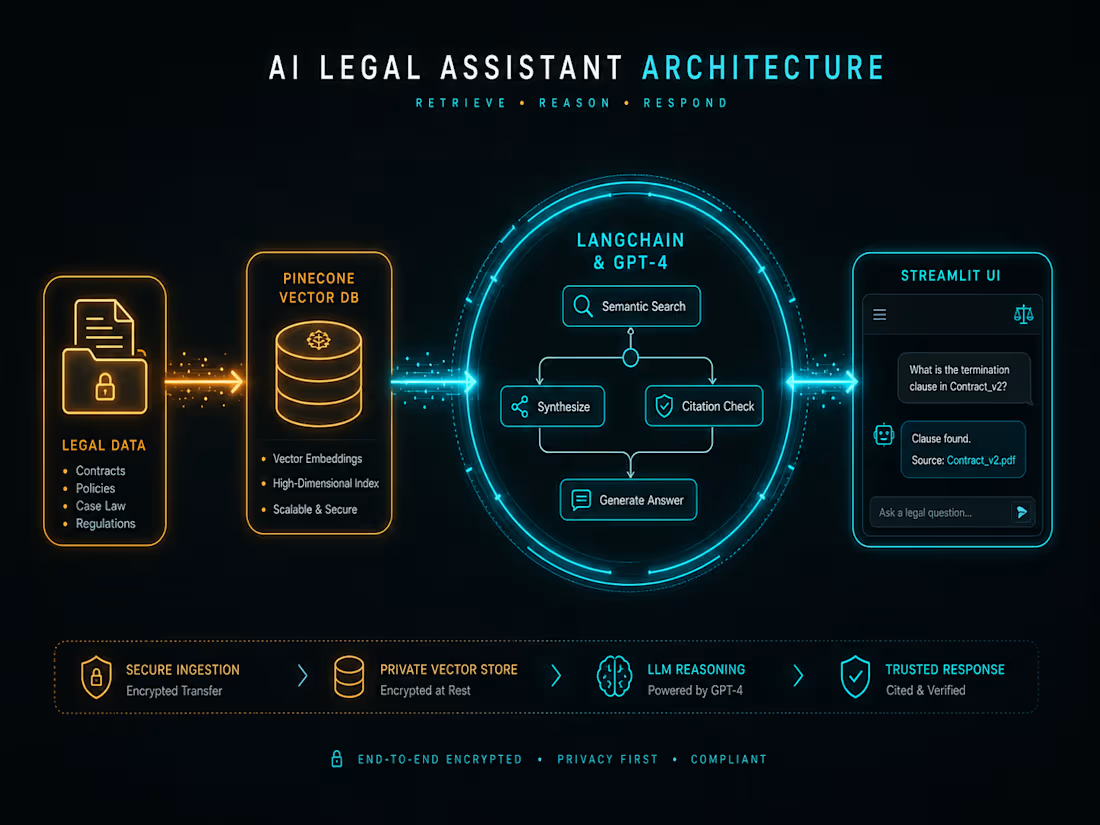
The legal services firm required a highly secure, instantaneous method for employees to query a massive internal knowledge base of over 200 complex contracts and compliance documents. The existing manual search process was highly inefficient, taking employees an average of 15 minutes per query and creating significant operational bottlenecks.
The Tech Stack
1. Python (Data Ingestion & Formatting).
2. LangChain (RAG Orchestration).
3. Pinecone (Vector Database).
4. OpenAI GPT-4 (Contextual Synthesis).
5. Streamlit (Custom Web Interface).
The Solution
I engineered a secure Retrieval-Augmented Generation (RAG) pipeline to automate document retrieval. The system ingests and chunks hundreds of legal documents, storing them in a Pinecone vector database. When an employee submits a query, the system retrieves the most relevant semantic chunks and uses GPT-4 to synthesize a coherent response. To ensure zero hallucinations regarding strict legal terminology, the retrieval pipeline is engineered to explicitly cite its sources (e.g., "According to NDA_Template.pdf, Page 4") for every generated answer.
The Business Impact
The chatbot successfully reduced the time employees spent searching for specific legal clauses from an average of 15 minutes per query down to mere seconds. This drastically improved team productivity, reduced billable hour bloat, and ensured absolute accuracy in document retrieval.
0
133