
Apps, AR Games & Films · Web, Snapchat, TikTok, VR
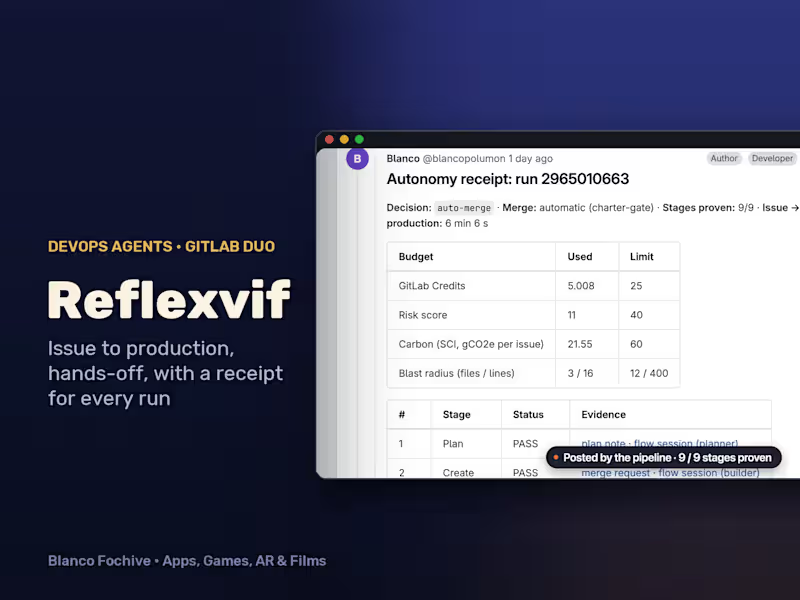
Reflexvif — autonomy with a budget for GitLab agents
Agents can already write code. What stops teams from letting them ship: how far can they go alone, and how do we know they stayed inside the lines?
What I built
• A written contract, CHARTER.yml, with four budgets: GitLab Credits, a deterministic risk score, carbon per issue, and the exact paths an agent may change
• Three GitLab Duo flows: Builder (issue to merge request), Medic (repairs failing pipelines), Chronicler (plain-language "What changed" note)
• A pipeline gate that reads the contract from the target branch, so a change cannot raise its own budget
• An autonomy receipt on every issue: nine lifecycle stages, each linked to its proof, plus a public run registry
Result
• Real run: issue to production in 6 min 6 s, no human action after the assignment, receipt 9/9
• Medic repaired a deliberately broken merge request in about 3 minutes; a change to a protected path was escalated and nothing shipped
• Built for the GitLab "Life After Code" hackathon, open source (MIT)
My role: Product design, agent and pipeline architecture, DevOps, demo film
Stack: GitLab Duo Agent Platform, GitLab CI/CD, Node.js, OpenTofu, GitLab Pages
Code: https://gitlab.com/gitlab-ai-hackathon/transcend-october-2026/25059446/showcase
0
9
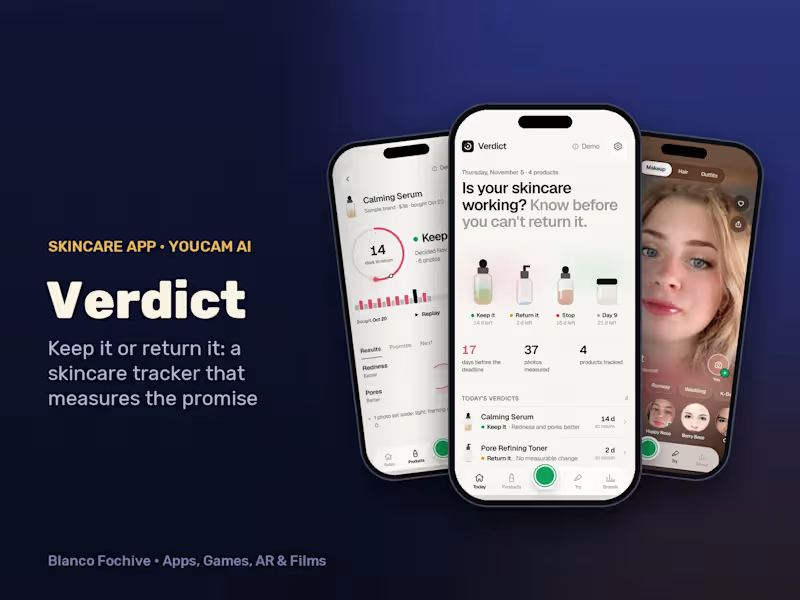
Verdict — know if your skincare works before you can't return it
You buy a serum that promises "less redness in 14 days". On day 27 of a 30-day return window you still can't tell. Verdict measures only what the product promises and tells you to keep it or return it, in time.
What I built
• Label scan: the camera reads the product's promise and keeps only the concerns it makes
• Guided camera: on-device face tracking checks framing, angle and light, and takes the photo itself when it is comparable
• YouCam AI Skin Analysis on the promised concerns, plus Skin Simulation of the promised result on the same photo
• A daily verdict (Keep it, Return it, Stop using) computed on the raw scores against a noise floor, with a day-by-day replay
• Virtual try-on (makeup, hair, outfits) on your own photo, and a Brands view of which claims deliver
Result
• Live YouCam API integration with real analysis, simulation and try-on calls, and a unit budget that cannot be drained
• 83 automated tests, iPhone, iPad and desktop layouts, light and dark mode
• Built for the YouCam API Skin AI & eCommerce hackathon
My role: Product design, UX/UI, front-end, back-end, API integration, demo film
Stack: Next.js, React, TypeScript, YouCam AI Skin Analysis, Skin Simulation and virtual try-on APIs, MediaPipe, Gemini, Vercel
Watch the demo: https://youtu.be/n5KUtNIoHUs | Code: https://github.com/blanco1er/verdict
1
0
71
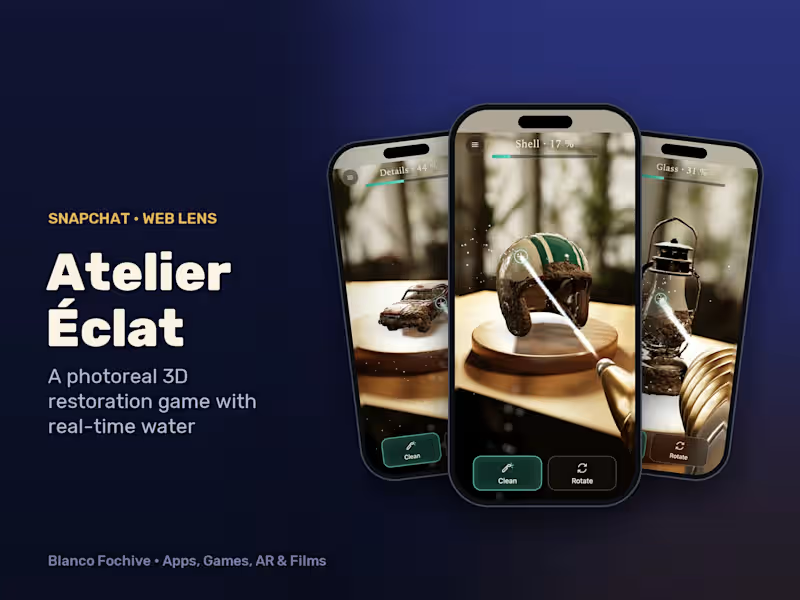
Atelier Éclat — a photoreal restoration game inside Snapchat
Most cleaning games fake it with flat images. I wanted the real thing: a muddy collector's object in true real-time 3D, running inside Snapchat with no download.
What I built
• A photoreal workshop scene: real-time 3D objects with clean and dirty materials, studio lighting and a turntable you rotate by hand
• Thumb-anywhere aiming of a brass pressure lance; the water stops at the first surface it hits, splashes and leaves wet, shining areas that dry over time
• Six collector objects for Season 1 (helmet, radio, model coupé, lantern, watering can, mantel clock), unlocked one by one
• Per-part progress to 100%, a hold-to-compare before/after view, English and French, progress saved with Snap storage
• Each object optimized to about 1 MB so the whole season fits Snapchat's 8 MB Web Lens limit
Result
• Published on Snapchat as a public game Lens (October 2026); Season 1 update with all six objects delivered to Snap
• Submitted to the Snap × Lenslist Web Lens Game Challenge
My role: Game design, 3D asset pipeline, gameplay and rendering code, UI/UX, launch film
Stack: three.js, TypeScript, Vite, Blender, Snapchat Web Lens API
Play: https://www.snapchat.com/lens/ae28ccd7037c41589c4b95dbc56241e8
0
17
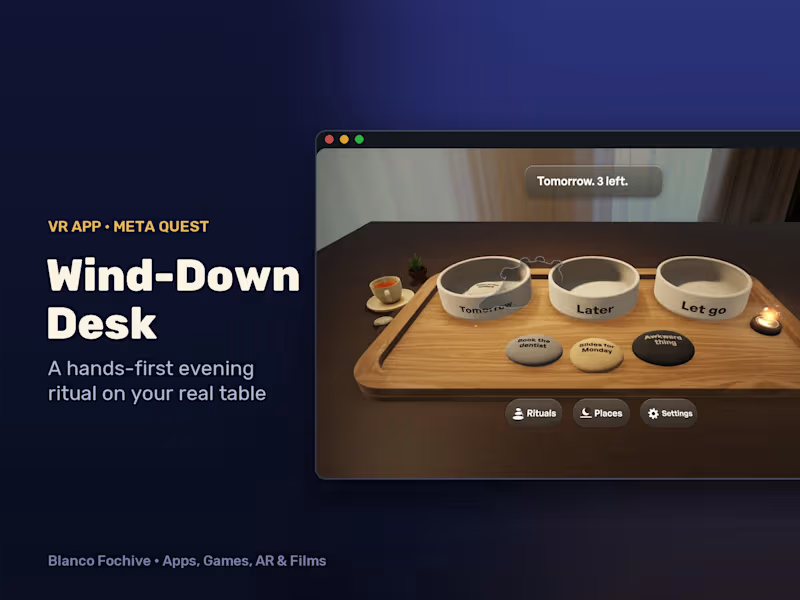
Wind-Down Desk — a hands-first evening ritual for Meta Quest
At 11 p.m. the head is still at work: the landlord, the dentist, Monday's slides. Wind-Down Desk turns that loop into a short seated ritual, with your hands, on your real table.
What I built
• Each worry becomes an engraved stone you pinch into a bowl: Tomorrow, Later or Let go
• Six optional rituals, from Release (a stone sinks into black water) to Breathe and Keep
• A glass lamp that proposes tonight's ritual, then waits; its memory stays on the device
• The tray lands on your real table, good things glow on your walls, stars rise to your ceiling
• Hands only, end to end, with a voice or gaze twin for every action
Result
• Measured in Meta's Quest 3 emulator: 15 to 24 draw calls per eye, under 100k triangles, frame script p95 under 10 ms with a throttled CPU
• A scripted hands-only evening completes every ritual with no miss; 304 automated tests
• Built for the Meta VR Start competition
My role: Product design, interaction & spatial design, front-end, back-end, sound, demo film
Stack: Meta Immersive Web SDK, WebXR, three.js, TypeScript, Vite, GLSL, Web Audio, Google Gemini, Blender
Watch the demo: https://youtu.be/rYFgbrXtsBY | Code: https://github.com/blanco1er/wind-down-desk
0
15
