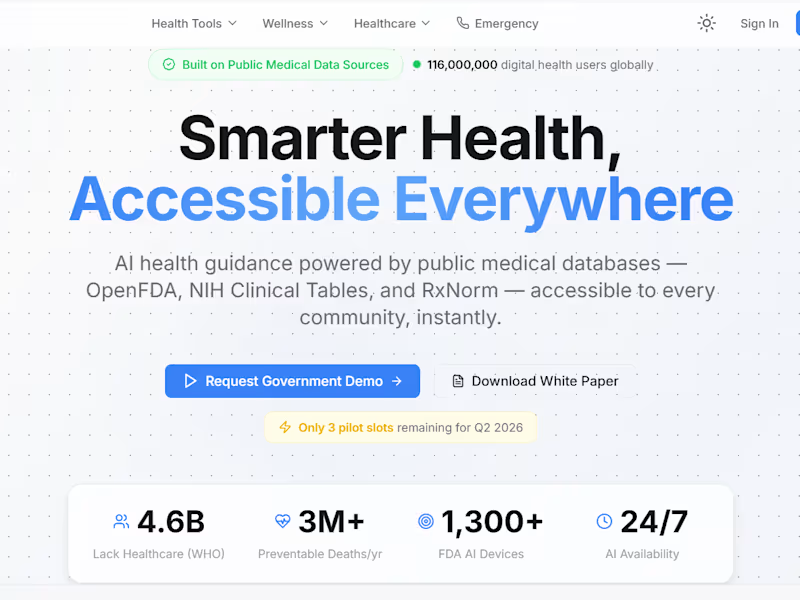
Projects using Vercel in PunjabProjects using Vercel in PunjabI designed and built a full-stack AI healthcare platform from the ground up integrating 6 external medical APIs, real-time AI-powered consultations and a production-grade frontend with smooth animations. This is the kind of intelligent and scalable system I can build for you in healthcare, education or any data-driven domain.
Live Demo: healix.vercel.app (http://healix.vercel.app)
What Healix Does
4.6 billion people worldwide lack access to essential health services. Healix bridges that gap by putting an AI health companion in every citizen's pocket backed by trusted data from WHO, NIH and the FDA. It delivers 24/7 health guidance, reduces unnecessary ER visits and extends the reach of overstretched healthcare systems.
Core Features I Built
AI Health Chat - 24/7 intelligent consultations with multi-language support powered by Google Gemini
Symptom Checker - Interactive symptom analysis with triage recommendations using NIH Clinical Tables
Drug Interaction Checker - Cross-checks multiple medications for dangerous interactions via OpenFDA
Medicine Search - Detailed drug profiles including side effects and usage guidelines from OpenFDA and RxNorm
Health Dashboard - Personalized health overview with activity tracking and chronic disease management
Additional modules include mental wellness tracking, nutrition logging, lab results management, vaccination records, appointment booking and a community health forum.
Tech Stack
Next.js 15 and React 19 frontend styled with TailwindCSS and animated with Framer Motion. Python FastAPI backend powered by Google Gemini AI with fallback handling. Integrated with OpenFDA, NIH Clinical Tables, PubMed, RxNorm and WHO data sources. Supabase authentication with Google OAuth. SQLite for development and PostgreSQL for production. Deployed on Vercel.
What This Demonstrates
Complex multi-API orchestration with error handling and fallback logic
AI integration with prompt engineering for accurate medical responses
Clean component architecture with 30+ routes and reusable UI components
Full authentication flow with role-based access
Responsive design optimized for mobile-first healthcare access
Production deployment with real users in mind
Looking to build an AI-powered platform for your industry? Whether it's healthcare, education, finance or operations I can architect and ship intelligent systems like this end to end. Let's talk. Memento — A Notes App Where Memories Decay
Live app: https://memento-navy.vercel.app
Every notes app treats a thought from three years ago identically to one from this morning. Memento doesn't.
Notes decay visually from the moment they're created — across typography weight, contrast, border integrity, and color temperature — until they become near-invisible archaeological artifacts. A note from today is sharp and vivid. A note from six months ago is a ghost. The archive isn't a list. It's fog. Pinning a note revives it — it returns warm and glowing, carrying the memory of having faded.
Eight decay states. One continuous system. The interface is alive because time is acting on it constantly — even while you sleep.
—
HOW I USED STITCH
I've been using Stitch since it first launched, and this project pushed it harder than anything I've built with it.
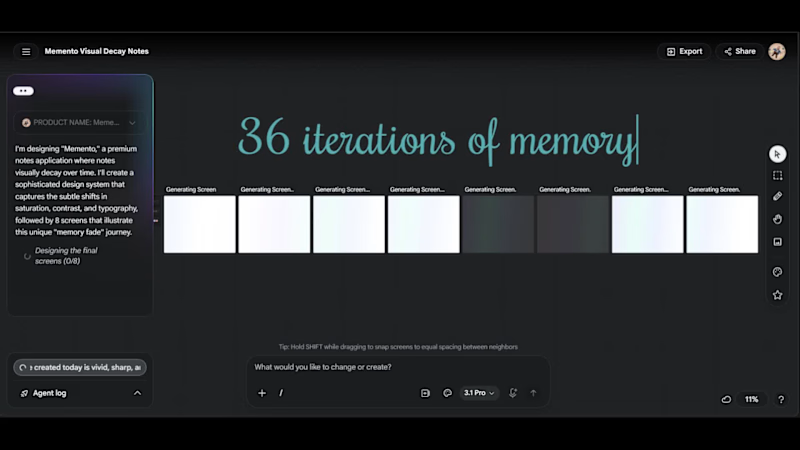
The entire visual system — all 8 decay states — was designed simultaneously on Stitch's infinite canvas using multi-screen generation. I wrote a single detailed prompt specifying exact hex values, typography weights, opacity levels, and border behavior for each state, then used targeted follow-up prompts to refine individual screens without disrupting the system. The workflow was: Stitch for the full design system → HTML/CSS export → Antigravity to build the functional React/Next.js app using Stitch exports as visual reference → deployed on Vercel.
The most interesting challenge was making decay feel considered rather than broken — Stitch's rapid iteration helped me find the line between "elegantly faded" and "unreadably dark" faster than any other tool would have.
—
FEEDBACK ON STITCH
I've used Stitch across several projects since launch and it's genuinely changed how I approach UI work — the speed from concept to exportable interface is unlike anything else available.
One honest observation: visual continuity across screens can drift, particularly on the Flash model. When generating a system of related screens, subtle inconsistencies in spacing, border radius, and color values creep in between generations. The Pro model handles this significantly better, but it's worth noting for anyone building multi-screen products.
That said — Stitch moves the bottleneck from "can I design this" to "can I think clearly about what I want." That's exactly where the bottleneck should be.
Brass & Hide: Online Watch Store
I designed and built Brass & Hide, an e-commerce website for a small-batch watch and accessories brand. The site has a dark, luxury look and a simple ordering flow, so customers can place orders directly on the website instead of only through WhatsApp messages.
Customers can browse a numbered collection of 18 watches and filter them by category: Divers, Chronographs, Square Collection, Heritage and Gold Editions. Each product card has an image slider with material, size and care details. Customers add pieces to the cart, change quantities, then log in or sign up with their phone number and email. At checkout they enter a delivery address and confirm the order, and an email receipt is sent to them right away. A "How to Order" section explains the steps, and a WhatsApp chat button is there for any questions before ordering.
Key features: filterable product catalog, cart with quantity controls, customer login and sign-up, checkout with delivery address, email order confirmation, and WhatsApp chat.