

Your Equipment Rental Business Doesn't Need More Spreadsheets. It Needs a Smarter System.
One double-booked machine can disrupt an entire rental schedule. One missed return can affect your next customer.
If you run an equipment rental business, you already know how difficult it becomes to manage machinery, customers, contracts, payments, and maintenance across disconnected systems.
The problem isn't necessarily your team. It's the software they're forced to work with.
The Hidden Problems Slowing Down Rental Businesses
Double Bookings: Equipment availability isn't updated across teams in real time.
Manual Rental Contracts: Staff repeatedly enter customer and equipment details.
Missed Returns: Overdue equipment goes unnoticed without proper tracking.
Disconnected Payments: Invoices, deposits, and rental records aren't synchronized.
Maintenance Conflicts: Equipment gets booked when it should be under inspection or repair.
Limited Visibility: Managers struggle to see active rentals, available assets, and outstanding payments.
The Solution: Custom ASP.NET (http://ASP.NET) Core Rental Management Software
I can design and develop a centralized equipment rental management platform using ASP.NET (http://ASP.NET) Core, C#, and SQL Server, tailored to your actual business operations.
Instead of switching between spreadsheets, emails, and separate tools, your team gets one connected system.
Core Features:
Equipment inventory and availability tracking
Customer registration and rental management
Reservation conflict prevention
Digital rental contracts and approval workflows
Automated invoice and payment-status tracking
Equipment return and maintenance scheduling
Role-based access for administrators and staff
Real-time operational dashboards and reporting
REST API integrations with accounting and payment systems
How the System Works
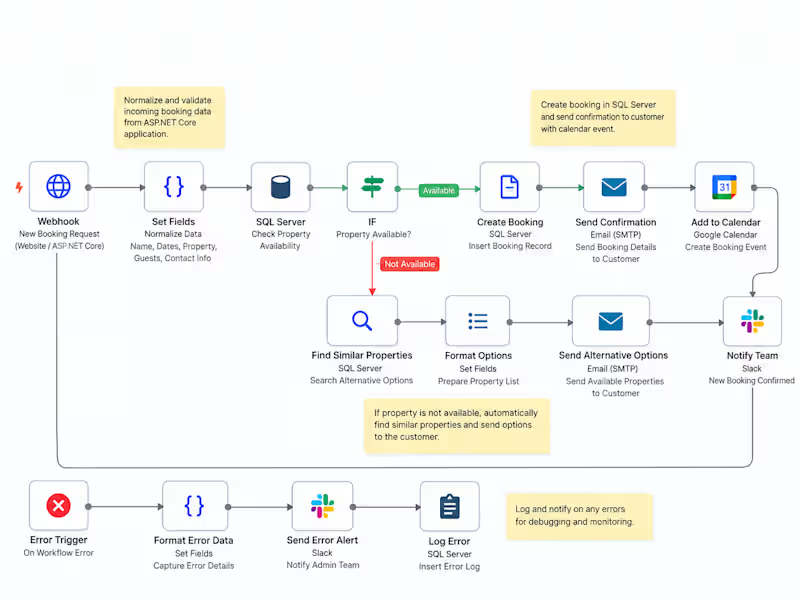
Customer Request → Availability Check → Reservation → Contract Approval → Equipment Dispatch → Return Inspection → Invoice Settlement → Inventory Update
1. Customer Request: A customer submits an equipment rental request through the web portal.
2. Availability Validation: The ASP.NET (http://ASP.NET) Core backend checks inventory, existing reservations, and maintenance restrictions.
3. Reservation Management: An available asset is reserved through a database transaction designed to prevent conflicting bookings.
4. Contract Processing: Staff review the rental agreement and approve dispatch.
5. Equipment Tracking: Rental status, due dates, and return details are maintained centrally.
6. Automated Notifications: Background services can send reminders for upcoming returns and overdue rentals.
7. Return and Billing: Staff inspect returned equipment, finalize charges, and update inventory availability.
Why This Matters for Your Business
A properly designed rental management system can help you:
Reduce repetitive administrative work.
Minimize preventable scheduling conflicts.
Improve equipment utilization visibility.
Organize rental contracts and financial records.
Provide customers with clearer booking updates.
Support additional branches and equipment categories as the business grows.
The goal isn't simply to build another dashboard.
It's to create business software that makes your daily operations easier to manage.
Let's Build the Right Solution
Already know what your business needs? → Share your requirements, and let's discuss developing your custom ASP.NET (http://ASP.NET) Core rental management platform.
Not sure where to start? → Tell me how you currently manage equipment, bookings, and payments. I'll help you identify the right software architecture and features.
SEO Keywords
ASP.NET (http://ASP.NET) Core Development • ASP.NET (http://ASP.NET) Developer • C# Developer • .NET Web Application • Equipment Rental Software • Rental Management System • Fleet Management Software • Custom Software Development • Enterprise Web Development • SQL Server Development • Inventory Management System • Asset Tracking Software • Equipment Booking System • Rental Contract Management • REST API Development • Business Process Automation • Custom ERP Development • Admin Dashboard Development • Rental Scheduling Software • Database Development • Role Based Access Control • Backend Development • Full Stack .NET Developer • Equipment Maintenance Tracking • B2B Software Development
Result: A proposed centralized ASP.NET (http://ASP.NET) Core rental management platform designed to organize equipment bookings, prevent reservation conflicts, streamline rental administration, and improve operational visibility.
#ASPNetCore #DotNetDeveloper #CSharp #ASPNetDeveloper #DotNetDevelopment #WebDevelopment #CustomSoftwareDevelopment #EquipmentRental #RentalManagement #FleetManagement #InventoryManagement #AssetManagement #SQLServer #EnterpriseSoftware #FullStackDevelopment #BackendDevelopment #RESTAPI #ERPDevelopment #BusinessAutomation #SaaSDevelopment #RentalSoftware #SoftwareEngineering #B2BSoftware
3
2
310
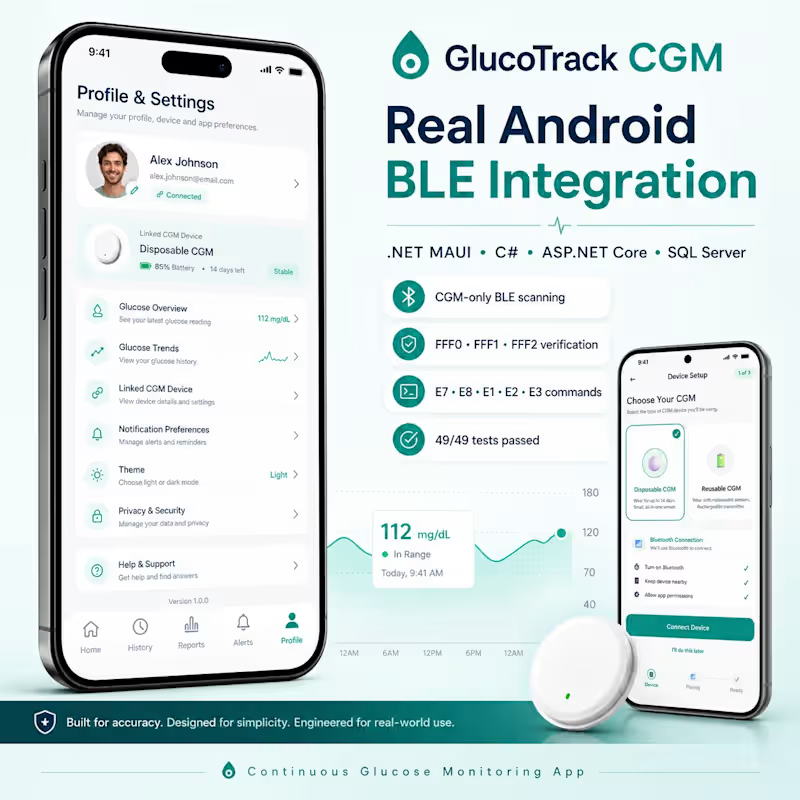
CGM Patient Application — Smart Glucose Monitoring Platform
Overview
A healthcare mobile application designed to help patients monitor glucose levels, receive alerts, and manage their health data through a secure digital platform.
I developed the mobile application and backend ecosystem, focusing on patient experience, secure authentication, real-time data handling, and scalable healthcare workflows.
My Role
Full-Stack Mobile Developer
Responsible for:
Mobile application development
Backend API development
Database architecture
Authentication system
Healthcare data workflows
Notification and alert systems Key Features 📱 Patient Mobile Application
User registration and authentication
Personalized patient profile
Glucose monitoring dashboard
Health insights and summaries
PDF health report generation 👨👩👧 Family Monitoring
Family member connection system
Referral code-based joining
Shared glucose alerts
Individual alert preferences 🔔 Smart Alert System
Glucose threshold monitoring
Notification management
Background alert processing 🔐 Secure Backend
JWT authentication
Role-based access
Secure API communication
Database-driven healthcare records Technology Stack Mobile
.NET MAUI
C# Backend
ASP.NET (http://ASP.NET) Core .NET 8
REST APIs
Entity Framework Core Database
SQL Server / MySQL Additional
JWT Authentication
Background Workers
Push Notifications
BLE Device Integration (planned) Project Challenge Building a healthcare platform required handling sensitive patient data, designing reliable data workflows, and creating an architecture that can support future integration with continuous glucose monitoring (CGM) devices. Outcome Created a scalable foundation for a CGM ecosystem that connects patients, healthcare data, alerts, and future wearable device integrations in one platform
0
52
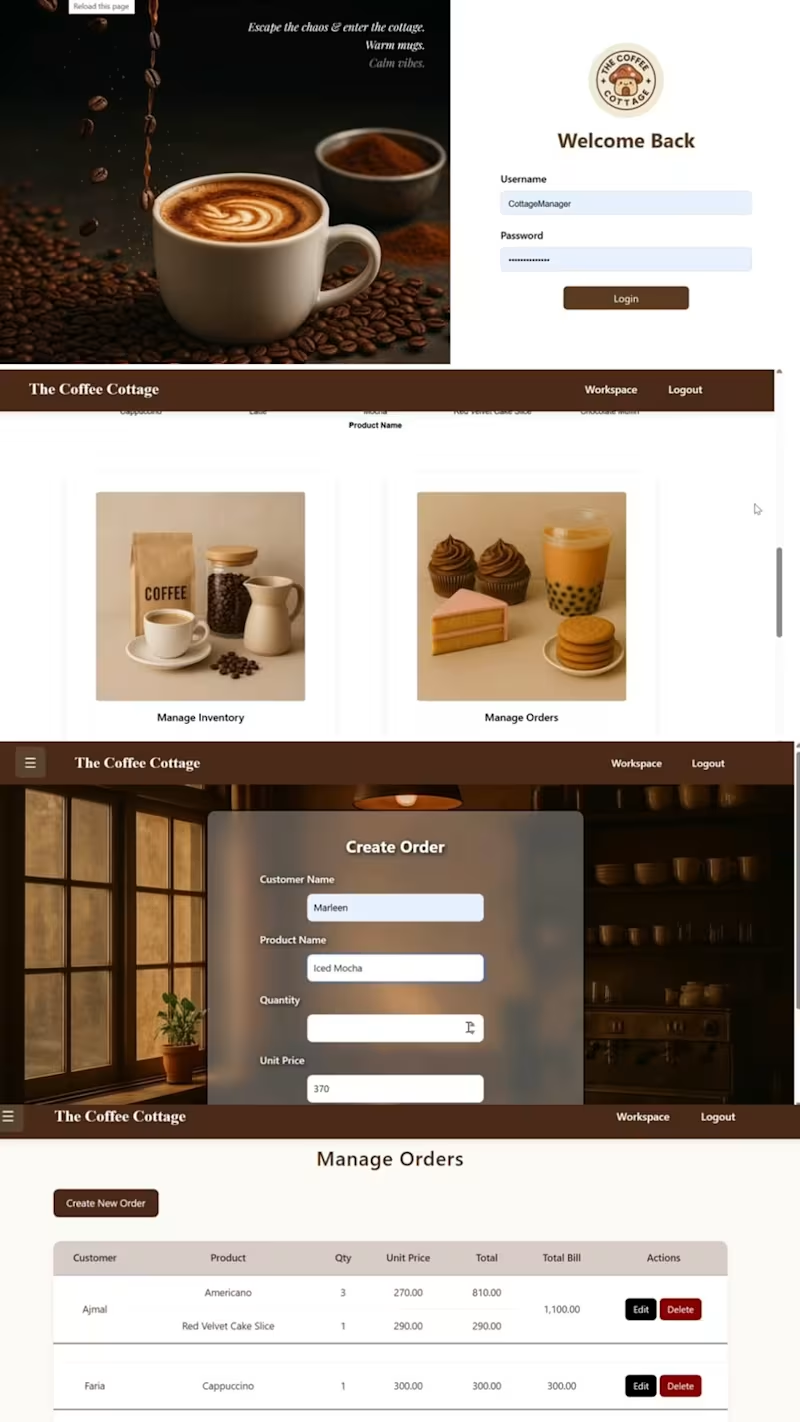
The Coffee Cottage - Coffee Shop Management System
The Coffee Cottage is a user-friendly coffee shop management system developed using ASP.NET (http://ASP.NET) MVC and SQL Server. The project was designed to simplify daily coffee shop operations by providing an efficient platform for managing customer orders, monitoring inventory, tracking sales, and generating useful business insights.
The system includes features such as inventory management to keep track of available products and stock levels, order processing for managing customer purchases, and sales reporting with dashboard analytics to help staff understand business performance. It also includes secure admin authentication to ensure controlled access to management features.
Built with ASP.NET (http://ASP.NET) MVC, C#, SQL Server, and Entity Framework, the application focuses on clean architecture, responsive design, and efficient data management. This project demonstrates the implementation of a complete web-based management solution with database integration and a focus on improving operational efficiency.
0
140

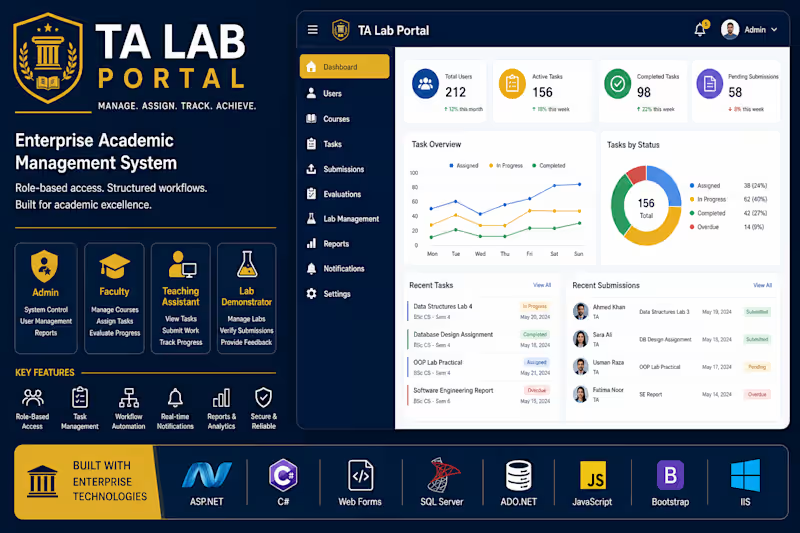
This is a classic enterprise academic portal, but built solid. It uses Web Forms, ASP.NET, C#, and SQL Server. The main challenge was role based access control because you have admins, faculty, TAs, and lab demonstrators all needing different permissions. I designed a three tier architecture with stored procedures and optimistic concurrency control so data doesn’t get messed up when people edit at the same time. Over 200 users per semester use it for task assignments and progress tracking. It’s not flashy, but it works perfectly.
For more details, please visit: https://arham-nexus.vercel.app/work/talabportal
0
67
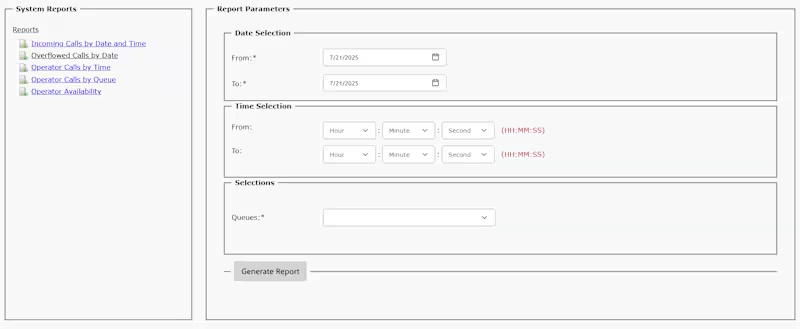
Cisco Unified Attendant Console Advanced (CUACA) is an enterprise-grade application designed for advanced reporting, call handling, operator management, and comprehensive reporting in large-scale communication systems. It supports real-time monitoring, detailed analytics, and high availability, making it critical for enterprise environments.
0
48
Responsive travel booking platform and destination discovery web application built with modern JavaScript, PHP, and relational databases.
Key Contributions:
• Built real-time reservation booking engine with dynamic pricing calculations and automated invoicing.
• Developed responsive destination discovery catalog with custom filters and search capabilities.
• Structured normalized relational database schemas in MySQL for fast query execution.
• Implemented cross-browser responsive interfaces with zero layout shift.
Live Portfolio: abdullaharshad.dev (http://abdullaharshad.dev)
0
26
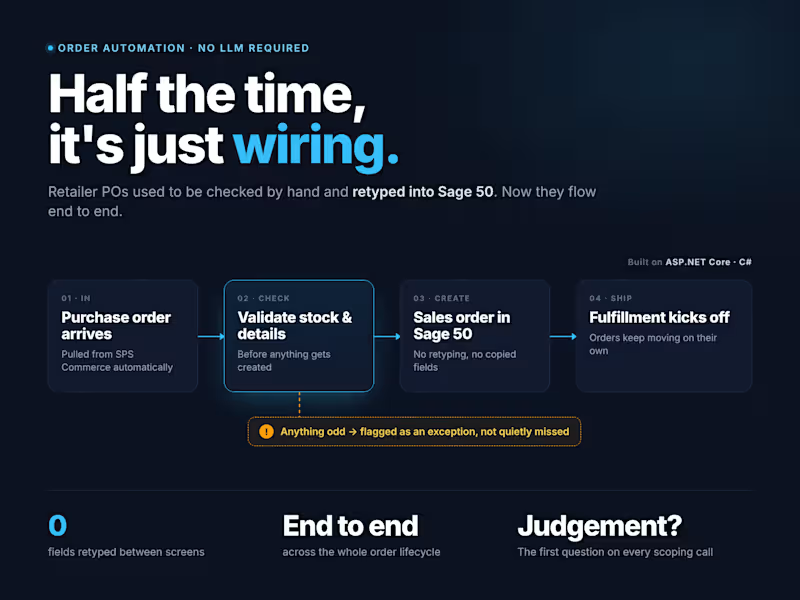
Not every automation needs an LLM. A B2B business was receiving purchase orders from retailers through SPS Commerce.
Someone on the team then checked stock by hand, retyped each order into Sage 50 as a sales order, and kicked off fulfillment.
We built a platform on ASP.NET (http://ASP.NET) Core and C# that handles it end to end.
→ Purchase orders come in through SPS Commerce automatically
→ Stock and order details are validated before anything is created
→ Sales orders land in Sage 50 without retyping
→ Anything odd is flagged as an exception instead of quietly slipping through Less manual work across the whole order lifecycle, cleaner data, and orders that keep moving without anyone copying fields between screens.
I build a lot of AI agents now. But the first question on every scoping call is still the same.
Does this need judgement, or does it just need wiring? Half the time it's wiring.
0
61