
AI Automation, Websites & No-Code Web Apps for founders

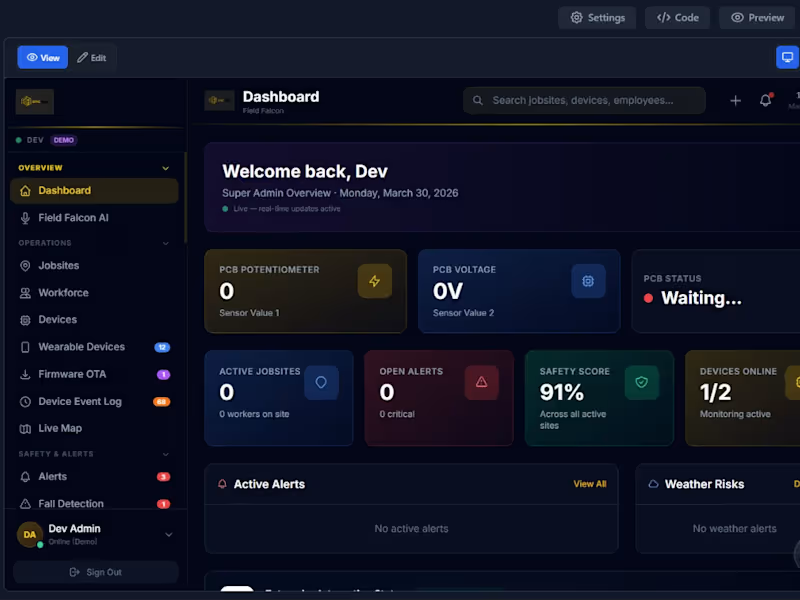
Reactive Safety Shell: Zero-Latency Infrastructure Monitoring
I was tasked with turning a standard monitoring dashboard into a mission-critical safety tool. The goal wasn't just 'data visualization', it was 'hazard prevention'.
In high-stakes environments, accountability is a technical requirement. I implemented a layer where every alert must be manually acknowledged by an operator. This isn't just a UI feature; it’s an immutable log for regulatory compliance and liability protection.
The Outcome:
Latency: Reduced from seconds (standard polling) to milliseconds (reactive push).
Reliability: 100% alert delivery through browser audio-engine hardening.
Scalability: Built on a modular Supabase/React architecture, ready for global deployment.
2
2
333
In industrial hardware, a "ping" is too slow. When a critical thermal threshold is hit, every millisecond is a $10,000 risk. I built this system to move safety logic from the human eye to an autonomous, sub-200ms recovery loop.
Watch: A live demonstration of the custom C-engine communicating with the Famous.ai (http://Famous.ai) dashboard. Notice the instantaneous transition to a "CRITICAL" state the moment the sensor hits 75°F.
The Architecture:
The Engine: Custom C-based handshake to bypass legacy cloud latency.
The Intelligence: Autonomous thermal guarding with real-time risk ID.
The Forensic Trail: High-frequency telemetry logged to Supabase for 100% audit compliance.
The Interface: High-fidelity monitoring deployed via Famous.ai (http://Famous.ai).
The Milestones
Latency: Achieved <200ms response (faster than a human blink).
Integrity: 100% data packet retention for mission-critical forensics.
Outcome: "Working perfectly now. We hit every target before the deadline." - Larry, Enterprise Client.
I’m currently documenting more of these edge-to-cloud benchmarks as I scale this architecture.
If you’re working on similar hardware constraints or just want to talk through the latency hurdles of your own stack, feel free to shoot me a message.
I’m happy to share what I’ve learned.
1
293

A beautiful UI is just a statue. An integrated backend is a living entity."
I have officially completed the Frontend Architecture (The Body) for Synapse and successfully established the primary Data Bridge.
The Current Status:
The 16-column grid and kinetic UI components are now successfully pushing real-time data to the backend. This "handshake" marks the transition from a design artifact to a functional system.
What’s Next (The Momentum):
We are now moving into the Autonomous Nervous System phase. I am currently architecting the orchestration layer in n8n that will take these basic data inputs and transform them into intelligent outcomes, automating lead enrichment, complexity scoring, and CRM protocols.
The Goal: > A zero-latency environment where the website doesn't just display information, it processes it.
Building for speed. Engineering for scale.
8
3
390

"The web is crowded with clones. Synapse is the antidote."
I am finishing the front-end architecture for Synapse, a high-density, brutalist SaaS environment engineered for VC-backed infrastructure. This build isn't designed to be 'clean'; it's designed to be Hardened.
Core Architectural Primitives:
The Terminal Hero: An asymmetric Serif/Mono split that abandons the centered stack for a CLI-inspired control bar.
Reactive Telemetry: I’ve implemented a Refractive Glass Overlay on the data tables. Hovering over a project (Helios, Cipher Mesh, Atlas) triggers a magnetic, blurred panel that displays unique, real-time schematics and metric-gain visuals.
Intel Feed: An intelligence-report style grid where every card is anchored by a [COMPLEXITY_INDEX] and [DATE_ISO] metadata header.
What’s Next:
We are transitioning into the Backend & Automation Phase. We’re integrating n8n and Supabase to ensure the user journey feels as premium and automated as the UI.
Want a private walkthrough of the Telemetry logic? Drop a comment.
2
128


Virtual Nook | Executive Hands
Virtual Nook | Executive Hands




View more →