SEO Writing Projects in New South WalesSEO Writing Projects in New South WalesGOOGLE GEMINIS summary of My InfoVid. 😉
The speaker describes their professional role and methodical approach to content creation:
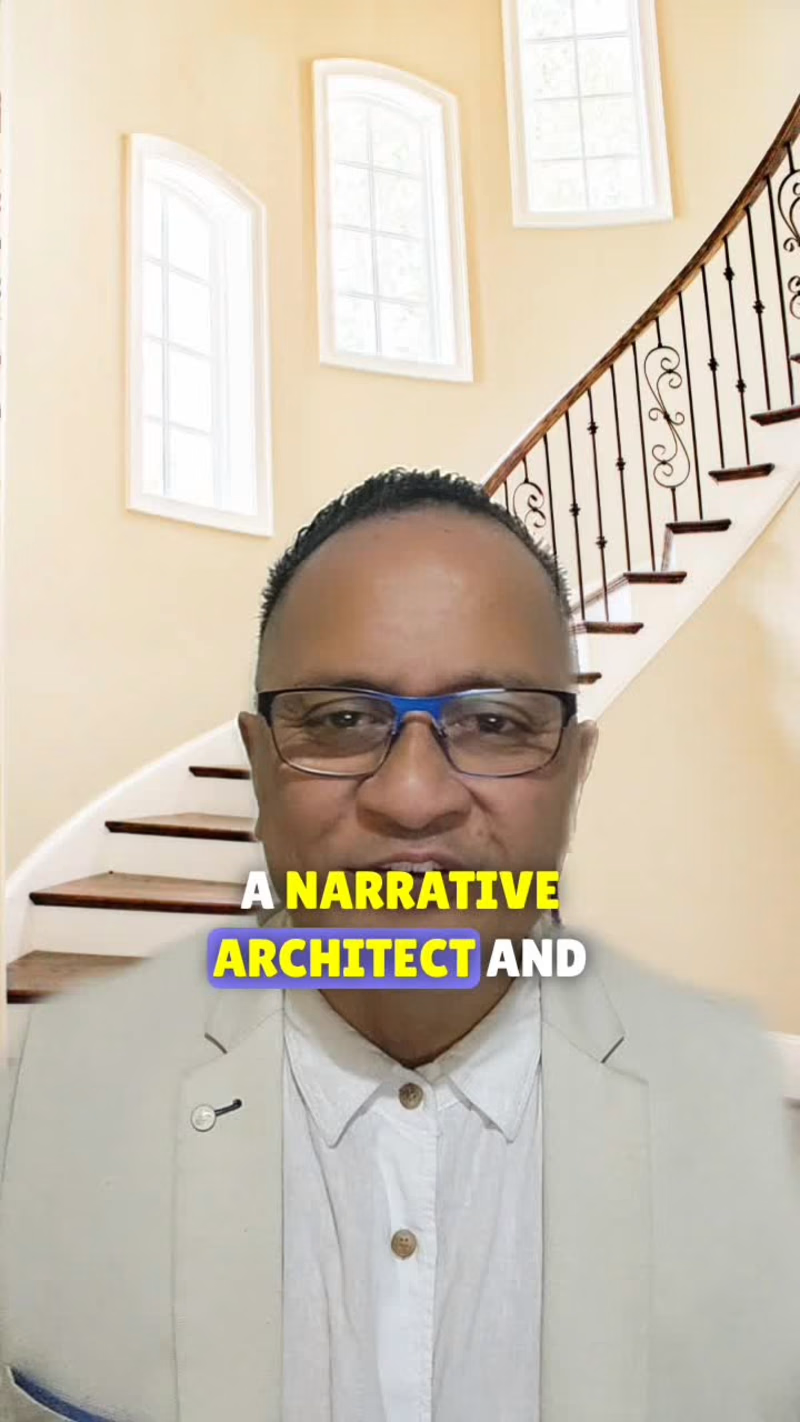
Professional Identity: The speaker is a narrative architect and multiplatform content operator who specializes in transforming complex or disorganized information into structured, clear content systems.
Methodology: Drawing from a professional background in finance and accounting, the speaker applies a disciplined, data-driven process to content development.
Workflow: Each week, the speaker collects various raw materials—including founder notes, transcripts, AI drafts, and product documentation—to generate cohesive content.
Platform Specialization: This process produces high-performing content across three main channels:
LinkedIn: Authority posts and long-form founder essays.
YouTube: Talking head videos and high-retention scripts.
Website: Agency clarity, narrative hierarchy, and semantic structure.
Objective: Beyond mere creation, the speaker builds systems designed to ensure that messaging remains consistent, scalable, and searchable across platforms.
Here are samples of my Work:
700 word article & case study on Singapore regulatory framework
https://bit.ly/Singapore-MAS-ACRA-JoeyL
Why Founders Plateau with Content
https://bit.ly/KingTwins-Founders-vid
Turning Vision into clarity YT script
https://bit.ly/MomentOfClarity-Script
The AI Literacy Divide, Why Large Companies struggle with Agentic Systems (https://app.bitly.com/Bl95awHAFfJ/links/bit.ly/AILiteracyDivide/details)
bit.ly/AILiteracyDivide (https://bit.ly/AILiteracyDivide)
Check out my Portfolio Dashboard for 20+ articles and written posts on Agentic and AI intelligence and though leadership content. Most founders and creators know what they want to say — but not how to say it with clarity, authority, and narrative precision.
That gap costs them opportunities, weakens their message, and buries their ideas under noise.
Platforms move fast. Attention is brutal. And unclear writing gets punished instantly.
SOLUTION ?
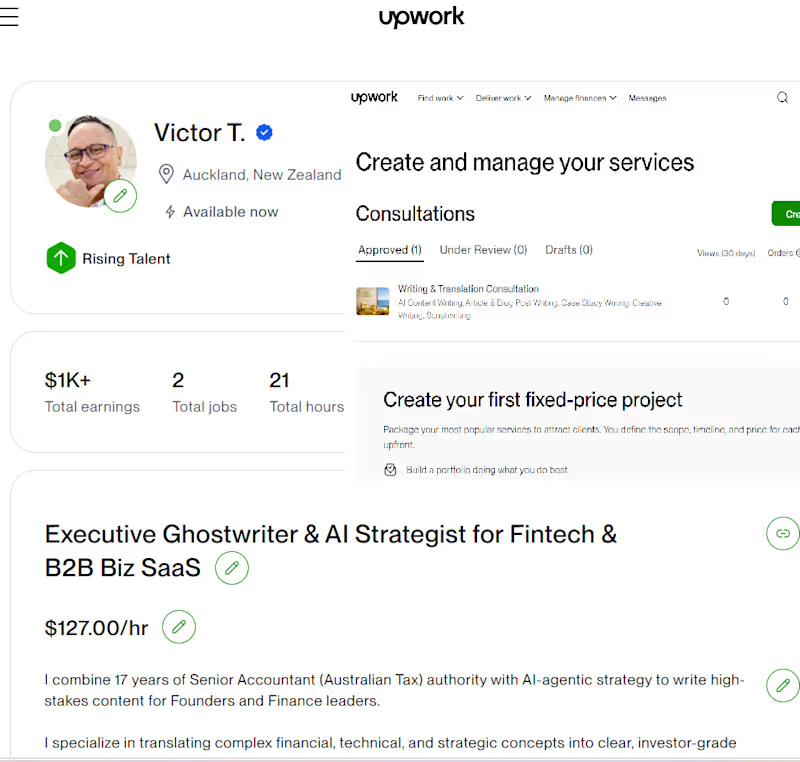
I’ve now been officially recognised by Upwork as both a 'Rising Talent' and an "Approved Consultation Provider", validating the clarity systems I’ve been building behind the scenes.
I help founders, operators, and creators transform messy ideas into clean, structured, high‑impact writing that moves like strategy.
If you need clarity, narrative structure, or a professional second brain for your content : My talent & professionalism is where we begin.
Message Me and I will elevate your Voice with Your Message, to a whole new Level.
─────────────────────────────────────
Victor TYan
MIB,BCom,:Narrative Architect & Founder‑Voice Ghostwriter .The Future of Blog Images — Why Flora + SDXL Is the New Creative Pipeline**
In the last two years, the way companies produce blog images has shifted from manual prompting and inconsistent visuals to automated, brand‑safe pipelines powered by workflow engines like Flora and image models like Stable Diffusion XL (SDXL). This shift isn’t just technological ; t’s operational.
It changes how content teams think, plan, and scale.
Most companies today still generate images the old way:
someone opens an AI tool, writes a prompt, tweaks it, regenerates, downloads, crops, and hopes the final result matches the brand. It’s slow, inconsistent, and impossible to scale across dozens of posts per month.
Flora changes that.
Flora is a workflow‑native system designed for creative logic. It doesn’t generate images - it orchestrates them. It takes a blog summary, routes it through SDXL, generates multiple visual directions, lets the user choose, and then produces a full set of final images. The result is a repeatable, automated pipeline that removes the manual friction from content‑ops.
SDXL is the perfect engine for this. It’s open, customizable, and capable of producing consistent, brand‑aligned visuals when fine‑tuned. Unlike closed models, SDXL can be shaped to match a company’s identity ; colors, textures, tone, and visual language. When paired with Flora, it becomes a scalable image factory.
The real power is in the logic:
input → direction generation → selection → final images → QC → output.
This structure ensures every blog post receives images that feel intentional, cohesive, and aligned with the brand. No more random styles. No more mismatched tones. No more manual prompting.
For companies publishing at scale — especially in technical fields like cloud security; his workflow becomes a competitive advantage. It reduces production time, increases consistency, and frees teams to focus on strategy instead of image generation.
Flora + SDXL isn’t just a toolchain.
It’s the new creative pipeline for modern content teams.
⚙️ Stable Diffusion XL — The Engine Behind Modern Creative Automation
If Flora is the conductor, Stable Diffusion XL (SDXL) is the orchestra. It’s the model that turns creative logic into visual reality — the engine that powers automation, consistency, and scale for modern content teams.
Before SDXL, image generation was chaotic. Each prompt produced a different style, tone, and texture. Teams spent hours tweaking outputs, chasing brand alignment that never quite landed. SDXL changed that forever.
Released in mid‑2023 by Stability AI and the CompVis research group, SDXL became the first open‑source model capable of producing high‑resolution, brand‑consistent visuals at scale. It wasn’t just an upgrade — it was a philosophical shift.
Instead of “prompt and pray,” SDXL introduced control, fine‑tuning, and repeatability.
Companies could now train SDXL on their own brand assets — colors, typography, lighting, tone — and generate hundreds of images that looked like they came from the same designer. It turned AI art from novelty into infrastructure.
The magic lies in its architecture:
a dual‑encoder system that understands both semantic meaning and visual composition, allowing it to interpret complex prompts with precision. When paired with workflow engines like Flora, SDXL becomes a creative factory — producing multiple image directions, refining them through logic, and delivering final outputs that feel intentional.
For blog teams, this means no more mismatched visuals.
For founders, it means brand consistency without design bottlenecks.
For agencies, it means scalable creative production that feels human.
SDXL isn’t just an image model.
It’s the engine of creative automation — the silent powerhouse behind every modern workflow that values speed, consistency, and brand identity.