Projects using ChatGPT in New DelhiProjects using ChatGPT in New DelhiARE WE POSTING TO IMPROVE OUR
SKILLS OR FOR VALIDATION?
My opinion: For both.
Because only if we get validation will we have the motivation to improve our
skills.
“So now, we need to pause here to understand the trap.”
Why do we post?
For skill building.
But why and how does validation addiction happened beyond skill building?
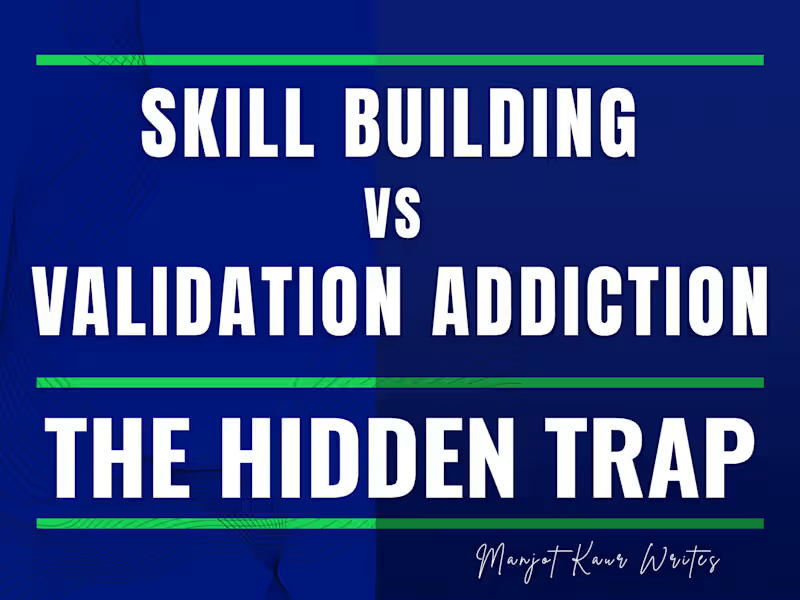
SKILL BUILDING
VS
VALIDATION ADDICTION
What is skill building?
Our work, our learning, our growth. Here, our motivation is completely
internal, where we get inspired by seeing our own growth, learning and clarity
about our work.
What is validation addiction?
How many reactions or likes I get, how many comments come to my post, thinking
about follower growth, mentions and shares of our posts.
Our mood mostly depends on this
kind of recognition. If we do not get this external approval, the satisfaction of
internal skill building fades, replaced by self-doubt and demotivation.
How Do We Get Stuck in The Trap of Validation, Moving Away from Skill Building?
We need to understand the real purpose of skill building is and how it is different from validation addiction.
The core of skill building is to focus only on the work, instead of counting the number of likes. It is a process of taking a step forward in the journey.
In this journey, we do not get instant results, but every effort we make contributes to enhancing our growth. We simply need more practice and consistency for improvement.
The role of feedback is also important, but internally, like, when we question ourselves:
“Have I expressed my content technically and strategically?”
External approvals are optional in this phase because these are the patterns of the foundation period.
Observing the Foundation and Fundamentals:
‘What is working and what is not’, analysing our own strengths and weaknesses, and then making improvements strengthens the Growth Mindset.
When our foundation is strong, we build trust in ourselves, and that builds confidence.
According to my experience, if we work on our own skills, we gain independence in the form of self-satisfaction.
As a result, this change comes from self-improvement, not external validation.
LET’S TAKE ‘WRITING’ AS AN EXAMPLE:
Suppose we started posting on different platforms like Instagram, LinkedIn or any other platform. Our initial goal is to improve our skills.
We started writing and sharing our ideas on active platforms.
Here, our motivation is completely internal, because we only want to understand our own content. By analysing the points:
‘We can write well’, ‘How we can grow in the long term’ and ‘Whether the content we are creating should be clear and meaningful’.
Till here, we are purely motivated by skill building, without any demand or need for validation.
How does the shift from skill building to validation addiction happen?
When we start our work, we also start posting at the same time.
After posting, we get our ‘first feedback’ and ‘recognition’.
For example: Likes, Comments, Repost or Share.
Internally, this gives us an indication of visibility, and we become curious for more feedback.
It is natural, this happens with everyone.
But when this process starts, we observe that our mood begins to depend on these External Validations and Reactions.
After posting, if the post performs well, then our mood is happy, otherwise, we feel internally demotivated.
This is a very subtle shift because usually, Internal Motivation is weaker as compared to External Motivation. Gradually, we get used to it. This is the pattern of shifting from skill building to validation addiction.
SIGNALS THAT INDICATE ABOUT THE SHIFT TOWARD VALIDATION ADDICTION.
1. Measuring ourself based on our peer’s engagement:
Peer’s Engagement: Comparing our progress or abilities with others responses.
FOR EXAMPLE: Comparing the likes and comments of our post with others and thinking, “that my content is weak” and “because of this, our confidence and mood start fluctuating.” Getting stuck in our own thoughts, and start measuring our self-assessment and our growth by other people engagement numbers.
2. Not being able to feel satisfaction without reactions or comments on a post:
Ignoring our day-by-day learnings, improving skills and still comparing our work just based on numbers. Even if our work is technically perfect, we still feel demotivated when the numbers do not
reflect.
3. Feeling anxious about the outcome of every post:
Before or after publishing every post, we create a picture in our mind:
‘Will this post perform well?’
‘Will people like it?’
This anxious feeling kills internal motivation, and our focus shifts from Skill Building to outcome obsession in the form of Validation.
4. Taking feedback not for learning, but for comparison:
We do not use feedback or analytics to improve our skills, but to see,
“How did my post perform compared to others’ posts?”
This shift of comparing our work with others work takes us away from Skill Building and leads us toward Validation obsession.
HOW TO AVOID THIS TRAP?
We can avoid this trap with the right approach.
Right approach does not only mean “Having Confidence,” but its deeper meaning is understanding the process of our work and building trust in it.
“Of course, comments, likes, shares and reposts and validation is important for us. Because these are the indicators of our post’s reach.”
“Increase in impressions is a part of reach, which helps us understand that our content has reached to how many people.”
“But being confident and motivated about our own work, so that along with us, others can also feel motivated.”
When we work on improving our skills, whether it is writing or any other skill, we should clearly know:
“What we are learning?”
“How we are improving?”
“Whether our current state is better than our previous state or not?”
After feeling these positive changes and self-assessment is what it means to grab the fundamentals.
This clarity builds internal confidence.
AT THIS STAGE, THE ROLE OF VALIDATION CHANGES.
Earlier, we were using validation to judge our value.
But now, we are using it only as an indicator of reach and visibility.
With this, our confidence is not getting harmed or affected.
In short, if likes or comments are higher, it simply means the content has reached to more people, that is it.
We do not decide from this whether our work is good or bad.
The real shift happens here:
The Source of Motivation Comes from Within, Not from Outside.
When our published posts do not perform well,
‘No likes,
‘No reach’
Even then our consistency and practice do not break.
This part becomes the real turning point for Growth along with Skill Building.
Because this time our focus has shifted away from reactions towards Learning and Improvement.
Now we see every post as a part of Creativity, Enhancing, Showing Up and Consistency, which is an ‘Experimental Learning Phase’.
Gradually, when we keep working in this way, we develop sustainable skills for the long term, which do not fluctuate with likes or comments.
CONCLUSION
According to my learning and experience, when we are internally stable then our content also becomes more genuine and clearer, because we are not writing to impress, but to express.
Interestingly, in this phase, our content also connects with the Readers and Audience.
Because it is not created for Validation, but from real understanding and
experience. That is why it naturally connects with others.
#ArticleWriting #FreelanceWriter #ContentStrategy