

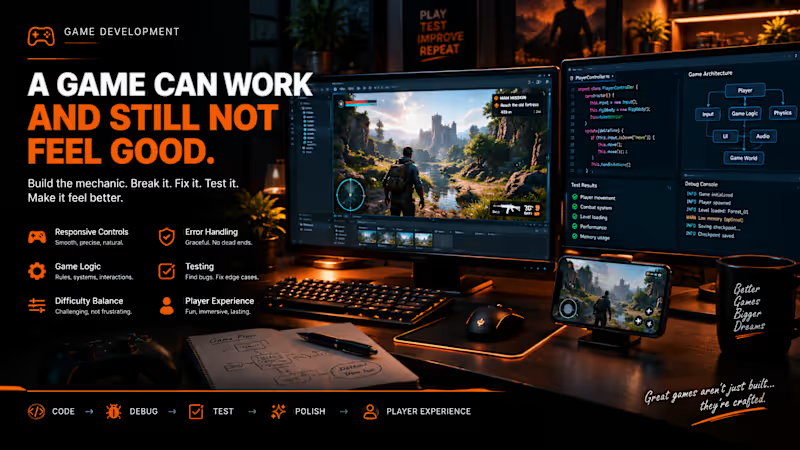
A GAME ISN’T FINISHED WHEN THE CODE WORKS.
One of the biggest lessons I’m learning from game development:
Getting the game to run is only the first milestone.
The real work starts when you ask:
👉 Does the movement feel right?
👉 Do the missions behave correctly?
👉 What happens when the player does something unexpected?
👉 Does the game stay smooth under pressure?
👉 Can I reproduce and fix bugs consistently?
That’s why my workflow is becoming:
BUILD → PLAY → BREAK → DEBUG → TEST → POLISH → REPEAT
I’m paying more attention to the things players might never consciously notice — input responsiveness, game logic, loading, error handling, performance, and how everything connects together.
Modern game-development guidance also puts strong emphasis on testing, profiling, debugging, and monitoring rather than waiting until the end of development.
Because a game can have beautiful graphics and still feel frustrating if the underlying experience isn't solid.
The goal isn't just to make a game that runs.
The goal is to make a game that feels right. 🔥
What’s the first thing you notice when you play a new game?
3
55

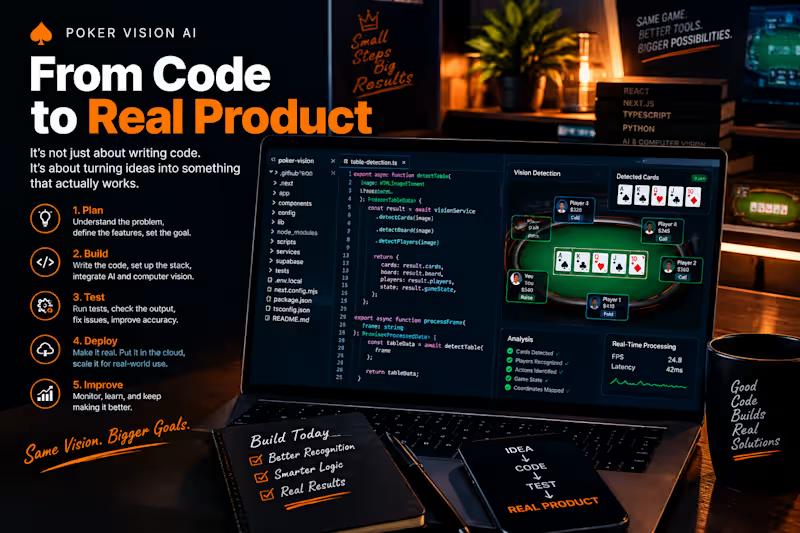
From Code to a Real Product That’s Where the Real Work Begins.
A lot of projects start with a simple idea:
“What if we built this?”
But turning that idea into something people can actually use is a completely different challenge.
With my current project, I’m going beyond writing components and making the UI look good.
I’m working through the entire process:
Plan Understand the problem and define what the product needs to do.
Build Turn the idea into real application logic, integrate the right technologies, and connect the different pieces.
Test Break the system, inspect the output, find edge cases, and fix what doesn't behave as expected.
Deploy Take it out of the development environment and make it accessible as a real product.
Improve Monitor what happens, identify weaknesses, and keep iterating.
The biggest lesson I'm learning is this:
A project isn't finished when the code works on your computer.
It's finished when the product works for the person using it.
That's why I'm becoming more interested in the parts of development that happen after the first successful build:
Testing the real workflow.
Handling unexpected input.
Improving reliability.
Making the experience smoother.
And turning a collection of code into something that actually solves a problem.
AI can help me move faster.
But building the right thing, validating it, and taking it all the way to a usable product is still the real challenge.
Idea → Code → Test → Deploy → Real Product.
That's the journey I'm documenting.
What do you think is the biggest difference between a working project and a real product? 👇
3
174
-- INFO
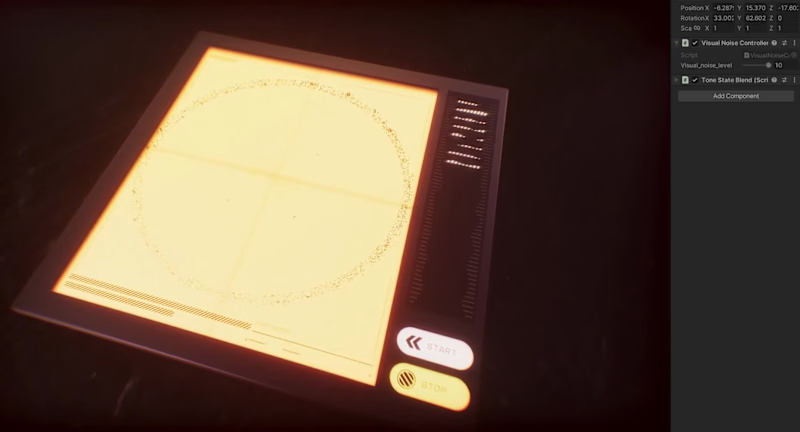
"Variable Density Controller"
(Proof of concept)
A single slider is used to control multiple aesthetic qualities in a realtime scene. The slider affects:
> UI density
> Particle effect density
> Lighting temperature
> Music fidelity (HiDef Stereo -> Bitcrushed Mono)
-- TAGS
( #unity | #gameDevelopment | #prototype | #creativeTechnology )
-- AUDIO
Original composition
29
155