Systems Engineering Projects in KarachiSystems Engineering Projects in KarachiProject Overview:
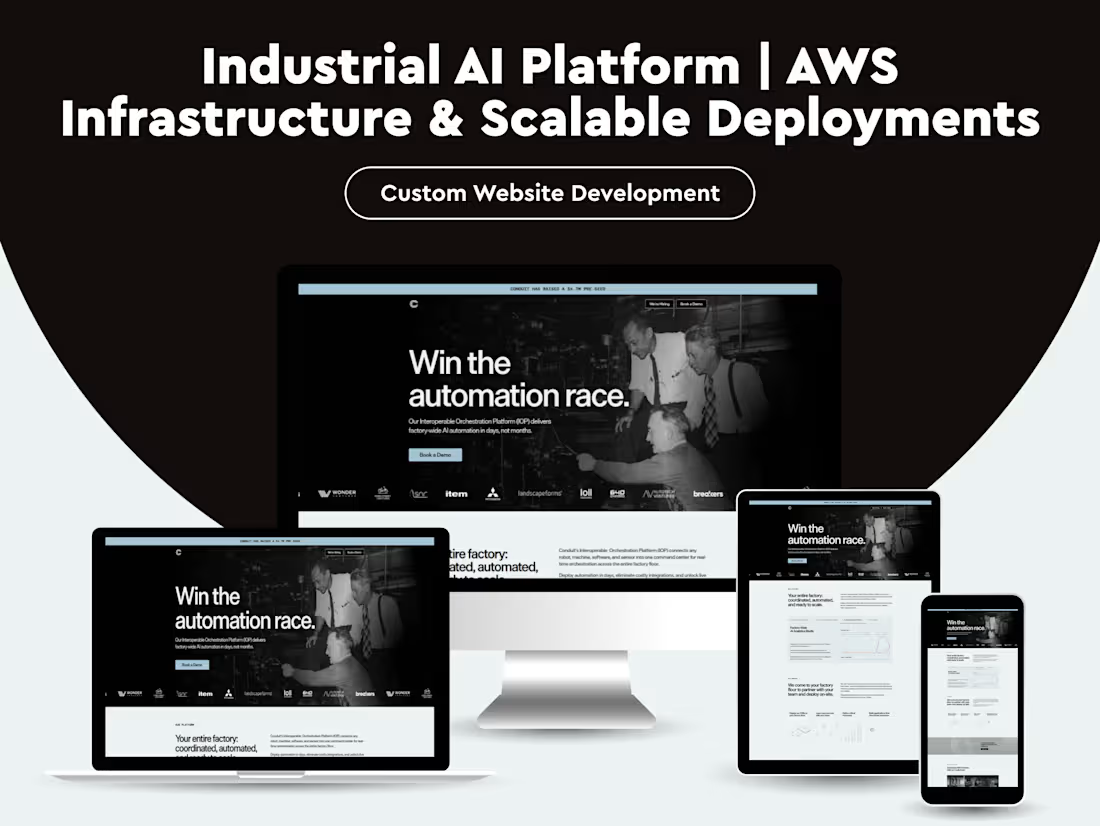
Conduit's Interoperable Orchestration Platform (IOP) seamlessly connects robots, machines, software, and sensors into a unified command center, enabling real-time factory floor automation and intelligence. It accelerates deployment, reduces integration costs, and transforms operations into fast, resilient, high-output systems.
The Challenge
Factory automation is often limited by:
1. Fragmented systems: Robots, machines, and sensors operate in silos, complicating coordination.
2. High integration costs: Connecting diverse equipment requires custom, expensive solutions.
3. Lack of real-time insights: Without live data, decision-making is slow, reducing efficiency and output.
The Solution
Conduit's IOP streamlines factory operations by:
1. Unified orchestration: Connects any robot, machine, software, or sensor into a single command center.
2. Rapid deployment: Automation workflows can be implemented in days, not months.
3. Live factory intelligence: Provides real-time insights to optimize productivity, reduce downtime, and enhance resilience.
4. Landing Page Description
Conduit's Interoperable Orchestration Platform (IOP) connects every robot, machine, software, and sensor into a single command center. Deploy automation in days, gain real-time factory insights, and transform your operations into a fast, resilient, high-output powerhouse.
What Our Client Got:
We delivered a fully functional Conduit IOP with:
- A unified command center connecting all robots, machines, software, and sensors.
- Rapid deployment tools for automation workflows in days.
- Real-time dashboards and analytics for actionable factory insights.
Results Achieved:
- 70% faster automation deployment across the factory floor.
- 60% reduction in costly system integrations.
- 85% improvement in operational efficiency and uptime.
Conduit IOP is now transforming factories into high-output, resilient, and intelligent operations.
Vexis is a custom x86-64 binary analysis and reverse-engineering platform I built from the ground up in Rust, with a .NET desktop frontend for interactive analysis.
Instead of wrapping an existing disassembly library, I implemented the core instruction-decoding pipeline myself, including legacy and REX prefixes, ModR/M, SIB addressing, RIP-relative addressing, instruction boundaries, and control-flow instructions.
From that decoded instruction stream, Vexis reconstructs basic blocks, functions, and typed control-flow graphs, calculates cyclomatic complexity, identifies anti-disassembly patterns, and generates structured analysis reports.
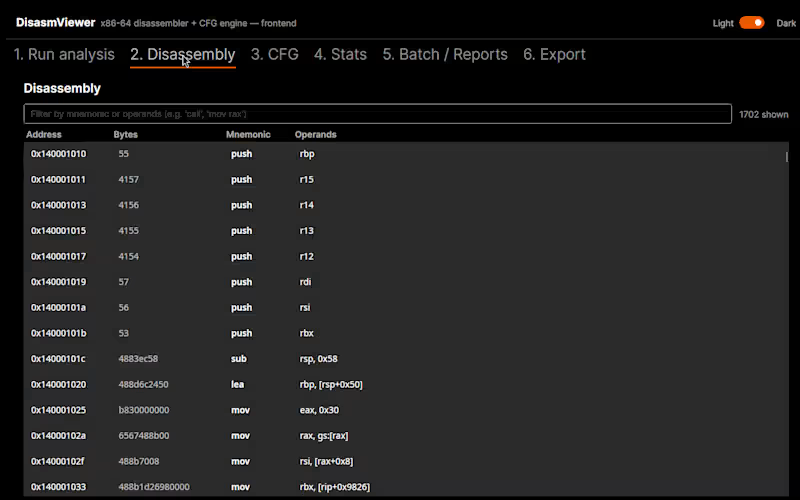
The visual frontend turns the analysis engine into a usable product: users can inspect full disassembly, explore function-level CFGs, review complexity and control-flow statistics, and analyze entire batches of binaries from one interface.
Key engineering work included:
Custom x86-64 instruction decoder written in Rust
Linear-sweep and recursive-descent analysis strategies
Basic-block and function recovery
Control-flow graph generation and visualization
Cyclomatic complexity and binary statistics
Anti-disassembly detection
Batch analysis across multiple binaries
JSON, Markdown, and Graphviz reporting
Differential testing and fuzz testing of the decoder
.NET GUI communicating with the Rust engine across a clean process boundary
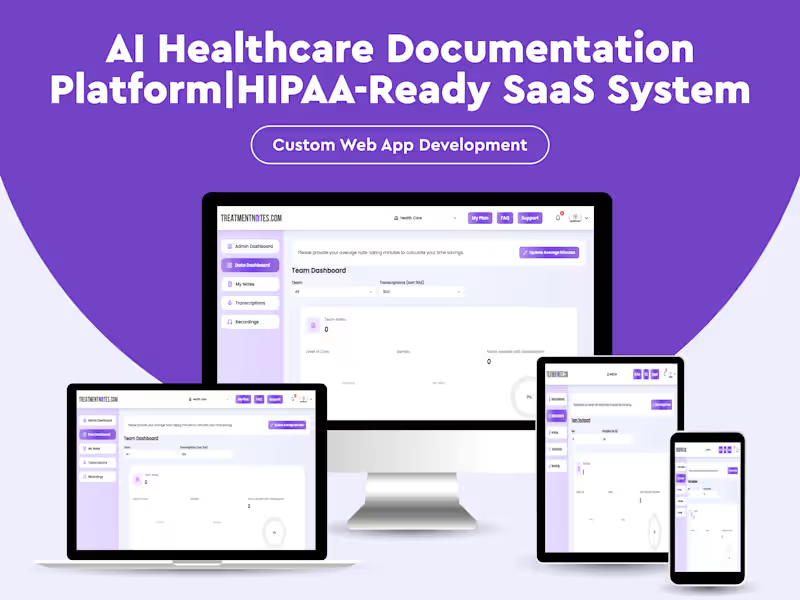
The result is more than a frontend demo: it is a complete analysis pipeline that goes from raw PE64 machine code to searchable disassembly, recovered program structure, visual control flow, and automated reports. 😍 This the best I have done in health industry - A SaaS platform: https://treatmentnotes.com/
🚀 Built an AI-powered behavioral health documentation platform designed for real clinical workflows. The system supports AI generated notes from live conversations, uploaded transcripts, and custom knowledge-base logic tailored to mental health and addiction treatment. It was designed for secure, scalable healthcare use with HIPAA ready architecture and EMR integration support.
💯 Complete Tech Stack:
AI Summarization, Clinical Nuance Detection, FastAPI, Vite, React, AWS Bedrock, Anthropic Claude, PostgreSQL, pgvector, Vector Database, Retrieval-Augmented Generation (RAG), AI Agent Architecture, HIPAA Compliant Cloud, Speech-to-Text API, LLM Fine-tuning, Healthcare Interoperability, HL7/FHIR Integration, Serverless Backend, Semantic Search, Private LLM Deployment, Encryption at Rest, Python Backend Development.
🧠 What do you say Contra Community?