Innovative Solution-Driven Developer
- $1k+
- Earned
- 1x
- Hired
- 4.9
- Rating
- 1
- Followers
Innovative Solution-Driven Developer




AI/ML Engineer | Generative AI Expert | Python & Full Stack
AI/ML Engineer | Generative AI Expert | Python & Full Stack

View more →

i am a student of ai and ml
i am a student of ai and ml



Creative Developer
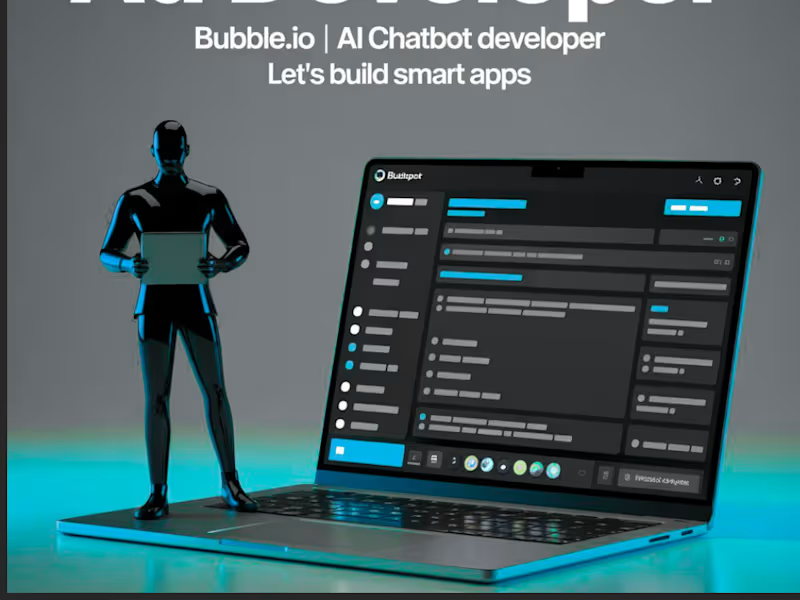

ADsolve is my portfolio, built to show how I work with founders and growing businesses.
I help turn ideas and problems into working digital products, AI integrations and automation.
What you will find inside:
NowTutors, a tutoring marketplace built with Bubble
GreenLawn and FitForge, interface and frontend work
Experiments with AI and automation
A 50 second film where you can meet me
My approach is simple. Understand the problem first. Then engineer the solution. Then keep improving it.
Have an idea to build or a process to connect? Send me a message.
1
0
71

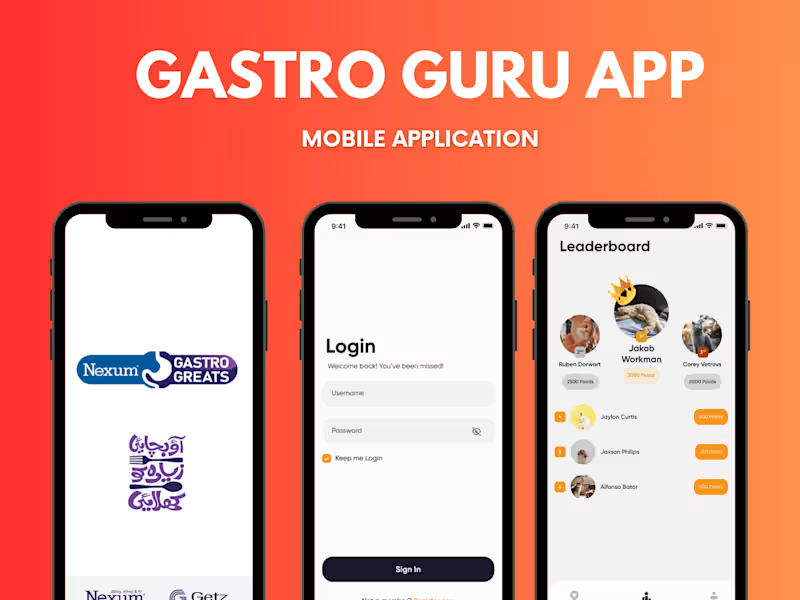
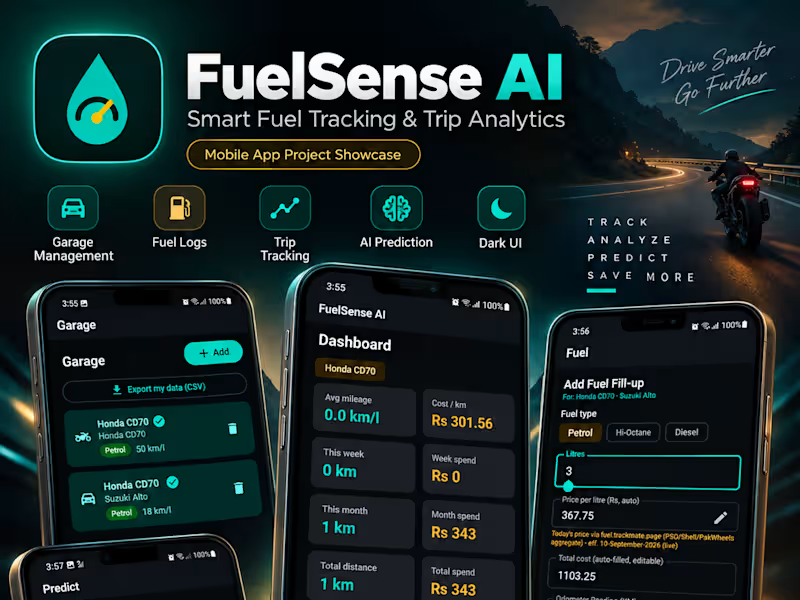
FuelSense AI: A Smarter Way to Track Vehicle Expenses
Overview
FuelSense AI is an Android application I built to make vehicle fuel management easier. It brings vehicle records, fuel expenses, trip tracking, and driving analytics into one place.
The Problem
Fuel costs can be difficult to track over time. Drivers may struggle to keep their fuel records organized, understand their mileage, and estimate the cost of their next refill.
What I Built
I developed a mobile app with the following features:
Vehicle Management: Manage cars and motorcycles in one place.
Fuel Tracking: Record refills, fuel prices, and odometer readings.
Trip Tracking: Track journeys using GPS.
Driving Analytics: Review distance, fuel expenses, and mileage trends.
Refill Estimates: Calculate estimated remaining driving range and refill costs from recorded data.
My Approach
I focused on bringing these everyday tasks into a single workflow. The app combines fuel records, trip data, and expense analytics to help users understand their driving costs.
Current Status
FuelSense AI is currently in development and has not been publicly deployed. I am continuing to test the calculations and improve the tracking experience.
Project Focus
This project demonstrates my approach to building practical mobile applications around real-world problems, connecting multiple features, and exploring useful data-driven functionality.
2
1
144

Lead Full Stack Developer | AI/ML Engineer | Data Scientist
New to Contra
Lead Full Stack Developer | AI/ML Engineer | Data Scientist

I am a senior full-stack developer and technical lead with 8 years of experience building scalable web and mobile applications. My expertise includes AI/ML-powered solutions, LLM integrations, automation, and AI-assisted development. I work with React, Next.js, Node.js, Express, Angular, Python, Go, TypeScript, JavaScript, MongoDB, PostgreSQL, etc. I am pursuing a master's in AI. I build cross-platform mobile apps using React Native & Flutter, solving complex technical problems.
0
90


Python and AI/ML Engineer turning ideas into working code
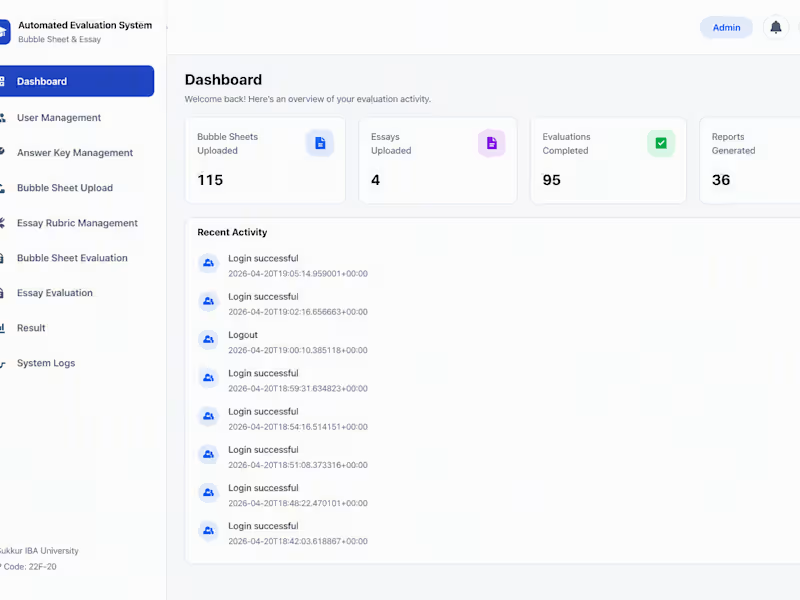
I developed an AI-powered Automated Bubble Sheet & Essay Evaluation System to modernize academic assessment by reducing manual grading effort, improving evaluation consistency, and enabling faster result processing.
This system combines Computer Vision, Optical Mark Recognition (OMR), Optical Character Recognition (OCR), Machine Learning, Deep Learning, and Natural Language Processing (NLP) into one end-to-end assessment workflow. It evaluates both objective bubble-sheet responses and descriptive essay answers using a modular, scalable, and cost-efficient architecture.
Key Features:
• Automated OMR-based bubble sheet grading using image preprocessing, thresholding, fold detection, and answer-mark recognition.
• CNN-based classification model for accurate bubble detection, with the best model achieving 98.2% accuracy.
• OCR-based text extraction using Google Cloud Vision API for processing scanned/written essay responses.
• AI-assisted essay evaluation using GPT-4.1 for rubric generation, semantic analysis, relevance checking, and automated scoring.
• Modular architecture with separated OMR, OCR, ML, and NLP layers for better maintainability, scalability, and future enhancement.
• Support for structured academic evaluation workflows, including answer key comparison, scoring logic, and result generation.
0
51
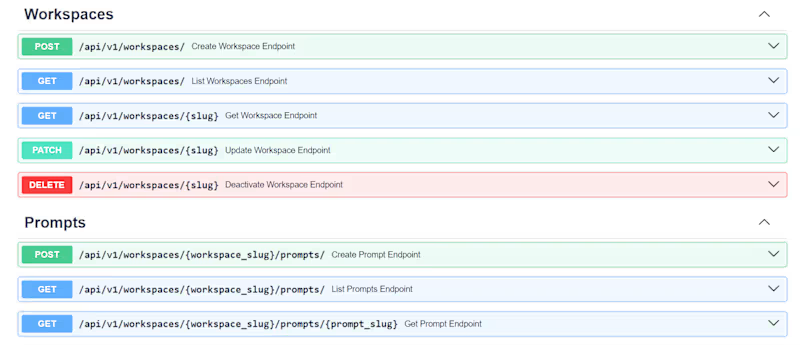
PromptVault is a production-grade AI Prompt Lifecycle Management API backend designed to help teams store, organize, evaluate, and monitor AI prompts as structured, testable assets. I built this project as a backend engineering portfolio system using FastAPI, PostgreSQL, async SQLAlchemy, Alembic, Redis, Celery, Apache Airflow, Docker, GitHub Actions, and structured JSON logging.
The system provides RESTful APIs for workspace and prompt management, including CRUD operations, Pydantic validation, pagination, soft deletion, and scalable database modeling. PostgreSQL handles persistent storage, while Redis implements a cache-aside strategy for faster API responses, TTL-based expiry, and cache invalidation.
PromptVault includes asynchronous background evaluation workflows using Celery with Redis as the broker and result backend. Users can trigger prompt evaluation jobs through the API, receive an immediate job ID, and poll for job status and results. Apache Airflow DAGs automate scheduled prompt regression checks and weekly cleanup workflows.
To make the project production-ready, I added async testing with pytest, fakeredis, and integration tests using a dedicated test database, achieving around 63% test coverage. The application is fully containerized with Docker Compose, running FastAPI, PostgreSQL, Redis, and Celery Worker as separate services.
Key engineering challenges solved included PostgreSQL enum/default issues, Alembic migration debugging, WSL2 PostgreSQL access configuration, Airflow metadata database separation, SQLAlchemy version conflicts, async pytest connection handling, and Docker dependency separation using requirements.docker.txt.
This project demonstrates backend API development, distributed systems, caching, background task processing, workflow orchestration, DevOps, CI/CD, and observability best practices for AI/LLM application infrastructure.
0
27

AI Engineer
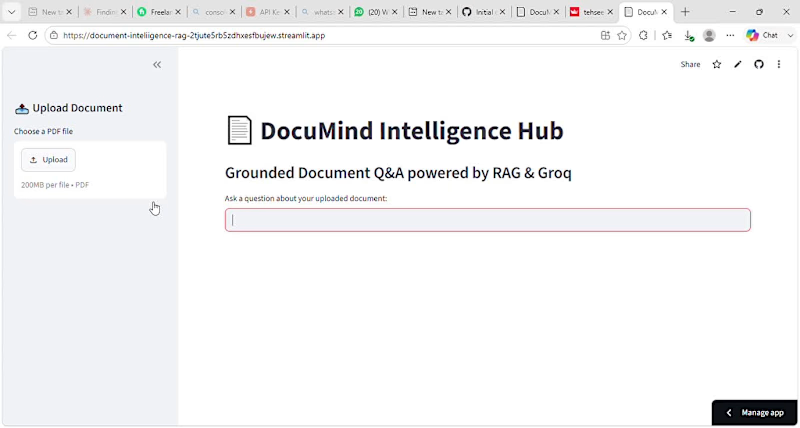
⚡ DocuMind Intelligence Hub — RAG System
A lightweight, modern Retrieval-Augmented Generation (RAG) system designed for instant PDF querying and semantic document analysis.
✨ Key Features
🚀 Blazing Fast Answers: Powered by Groq Llama 3.1 8B Instant LLM.
🔍 Semantic Vector Search: In-memory ChromaDB integration for exact context retrieval.
📍 Source Citations: Grounded answers with page-level document citations to prevent hallucinations.
🎨 Modern UI: Responsive and clean interface built with Streamlit and custom styling.
🛠️ Tech Stack
Frontend: Streamlit
Vector Database: ChromaDB
LLM Engine: Groq API (Llama 3.1)
PDF Parser: PyPDF
https://document-inteliigence-rag-2tjute5rb5zdhxesfbujew.streamlit.app/
(https://document-inteliigence-rag-2tjute5rb5zdhxesfbujew.streamlit.app/)https://github.com/tehseenaizaz2/document-inteliigence-rag.git
0
64
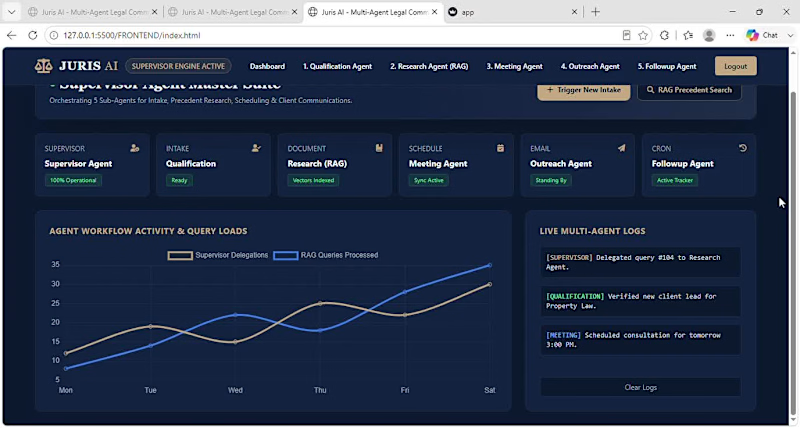
Juris AI — Multi-Agent Legal Command Center
A supervisor-orchestrated AI system that automates client intake, legal research, scheduling, and follow-up for law firms.
Overview
Juris AI is a full-stack legal-tech dashboard built around a Supervisor Agent architecture — one central engine that delegates work across five specialized sub-agents, each handling a distinct part of a law firm's client pipeline. Instead of a single chatbot, this is a coordinated multi-agent workflow: intake, research, scheduling, outreach, and follow-up all operating under one live control center.
Core Features
🧠 Supervisor Agent Engine
Central dashboard that monitors and orchestrates all five sub-agents in real time, with live status indicators (Operational / Ready / Active / Standing By) for each one.
📋 Qualification Agent (Client Intake)
Captures client name, email, and practice area, then runs an AI evaluation on case details to classify eligibility and route new leads automatically.
📚 Research Agent (RAG-Powered)
A retrieval-augmented generation engine connected to an internal case-law vector database. Lawyers can query legal precedents in plain English and get relevant results pulled directly from indexed case law.
📅 Meeting Agent
Schedules attorney–client consultations directly from the dashboard, capturing date, time, and client details, and syncing them to an availability log.
✉️ Outreach Agent
Generates personalized client email drafts from a few key talking points — ready to review and dispatch without starting from a blank page.
🔔 Followup Agent
Tracks clients with pending responses or outstanding document signatures and triggers automated reminder emails/SMS with one click.
📊 Live Analytics Dashboard
Visualizes supervisor delegations and RAG query volume over the week, plus a live multi-agent activity log showing every action each agent takes in real time.
Tech Stack
Frontend: Custom HTML/CSS/JavaScript dashboard — dark command-center UI with a modular card layout
Backend: Python
AI Layer: RAG (Retrieval-Augmented Generation) pipeline over an internal legal document vector store
Architecture: Supervisor–sub-agent orchestration pattern (one router agent delegating to task-specific agents)
What's Included
Full multi-agent dashboard (Supervisor, Intake, Research, Meeting, Outreach, Followup)
RAG-based legal precedent search connected to a case-law database
Real-time activity logging across all agents
Responsive, professional dark-themed UI built specifically for legal workflows
Clean, modular codebase — easy to extend with new agents or connect to a real case-management backend
Ideal For
Law firms and legal-tech startups looking to automate repetitive parts of client intake and case management — or as a foundation to extend into a full practice-management platform.
Available Add-Ons
Real user authentication & role-based access (partners, associates, paralegals)
Integration with a live case-management database
Custom sub-agents (billing, contract review, e-discovery, etc.)
Deployment & hosting setup
0
27
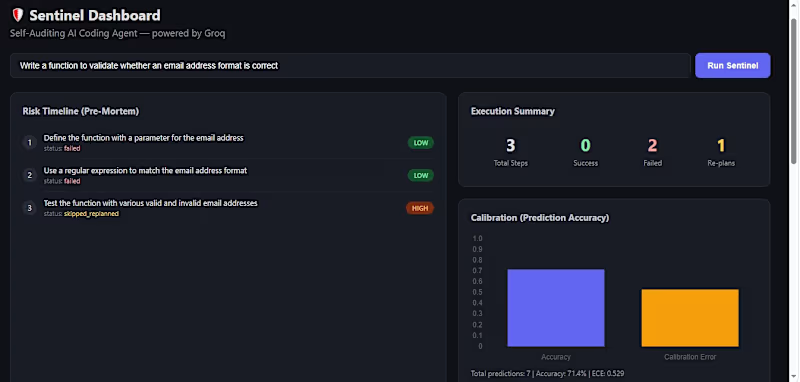
:→ A Coder agent writes the actual implementation
→ A Reviewer agent — a completely separate AI persona — reviews it for correctness, edge cases, and security issues
→ If rejected, the Coder revises based on specific feedback (up to 3 rounds)
→ Once approved, a Tester agent writes real pytest tests from scratch
→ Tests run in a sandbox. If they fail, the Coder fixes the code and the cycle repeats
0
43
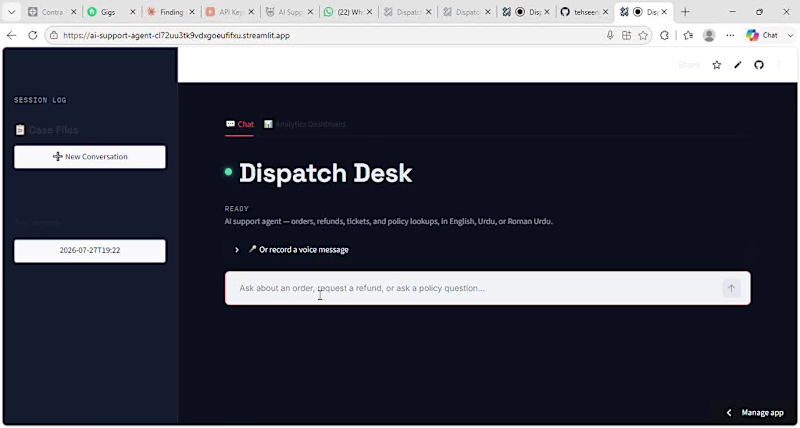
I built an AI agent that doesn't just chat — it actually does things. 🛰️
Most "AI chatbot" projects stop at answering questions. I wanted to go further, so I built an autonomous customer support agent that can:
✅ Look up real orders from a database
✅ Calculate and process refunds — with a confirmation step before anything is committed
✅ Create support tickets automatically
✅ Search actual policy documents (RAG) instead of guessing answers
✅ Detect when it's stuck and escalate to a human
✅ Understand English, Urdu, and Roman Urdu — automatically
✅ Take voice input and reply back with voice
✅ Resist prompt-injection attempts
It's powered by Groq (Llama 3.3 70B) with real function-calling — not hardcoded if/else logic. The agent decides which tool to use, when to chain multiple tools together, and when a human needs to step in.
I also built a live analytics dashboard on top of it, so every ticket, refund, and escalation is tracked in real time.
This project taught me more about how production AI agents actually work than any tutorial could — tool orchestration, guardrails, and the messy reality of getting LLMs to behave reliably.
🔗 Code on GitHub: https://github.com/tehseenaizaz2/ai-support-agent.git
(https://github.com/tehseenaizaz2/ai-support-agent.git)🎥 Demo: https://ai-support-agent-cl72uu3tk9vdxgoeufifxu.streamlit.app/
#AI #MachineLearning #LLM #Groq #Python #AIAgents #OpenToWork #Freelance #Streamlit
0
46

AI Engineer building intelligent chatbots, RAG systems, and
New to Contra
AI Engineer building intelligent chatbots, RAG systems, and
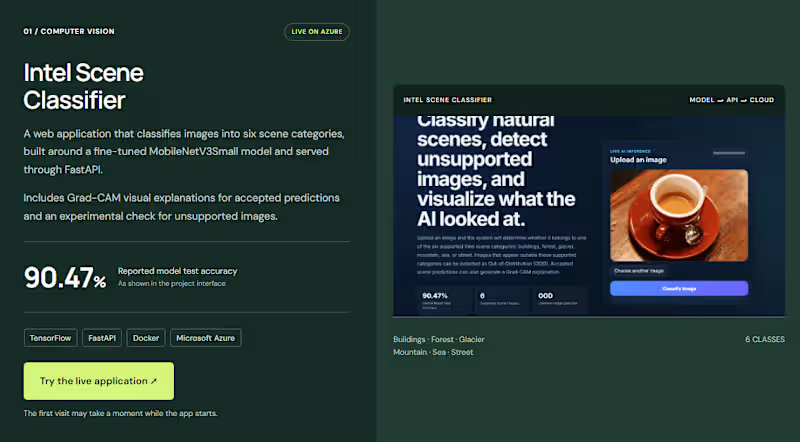
The Intel Scene Classifier is a end-to-end computer vision web application designed to classify natural scenes across six distinct categories: Buildings, Forest, Glacier, Mountain, Sea, and Street. Built around a fine-tuned MobileNetV3Small deep learning architecture, the application achieves a 90.47% test accuracy while maintaining lightweight inference times suitable for cloud deployment.
To enhance transparency and reliability, the system integrates Grad-CAM visual explanations, heatmapping the exact regions of an image the neural network focuses on during inference. Additionally, it features experimental Out-of-Distribution (OOD) detection to identify and handle unsupported image uploads cleanly.
0
13
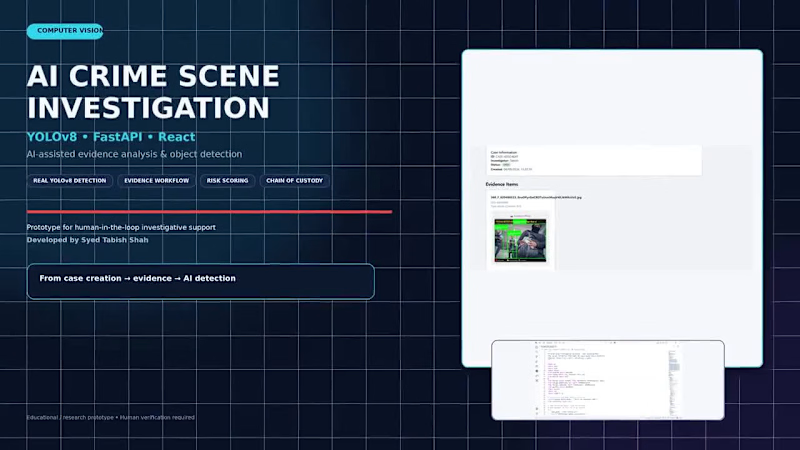
An experimental case-management and evidence-analysis application using YOLOv8 object detection. A FastAPI backend and React interface support evidence uploads, annotated results, timelines, reports, and chain-of-custody workflows.
Its GitHub Actions CI/CD pipeline tests and builds the React frontend, builds and scans the Docker image with Trivy, then uses passwordless Azure OIDC to publish to Azure Container Registry and deploy to Azure Container Apps.
0
22
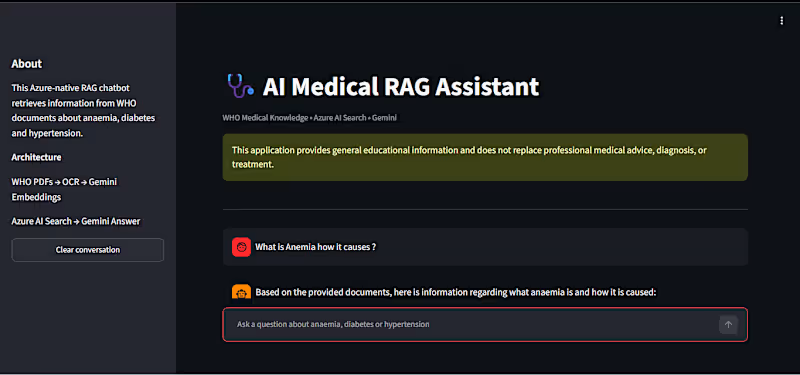
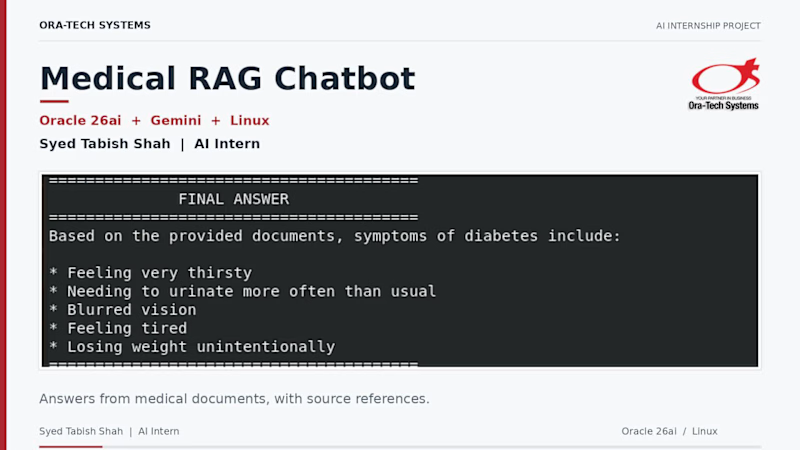
Built an Azure-native RAG medical assistant that answers health questions using WHO documentation on anaemia, diabetes, and hypertension. Pipeline: WHO PDFs → OCR → Gemini embeddings → Azure AI Search for retrieval → Gemini generates grounded answers with inline source citations. Includes a clean chat interface and a medical-disclaimer banner for responsible use.
0
24