Projects in KalixProjects in KalixI don't start with design.
I start with questions.
Every project I take on begins the same way, and it's not in Framer.
Before I open a design tool, I want to know:
Who's actually going to land on this site? What are they unsure about before they contact you? What do you want them to do once they're there?
Sounds obvious. But most sites I look at skip it. They tell you what the company does, and never get around to why you'd pick them over the other five tabs you have open.
So the order I work in is:
Figure out who we're talking to and what they need to hear
Decide what goes first on the page, what goes second, and what gets cut
Map out the sections and pages, still no visuals
Then design it, type, colour, spacing, the whole feel
Then build it in Framer and get it fast and findable
Design comes fourth on purpose. If the thinking behind it is solid, design makes it feel trustworthy and easy to act on. If it isn't, you just end up with a nice-looking site that doesn't do anything.
The upside is the build goes quick. By the time I'm designing, there's nothing left to argue about.
If you're planning a site and haven't worked out the first two steps yet, that's the bit I'd want to start with. TEA Payments — Website & Visual Identity
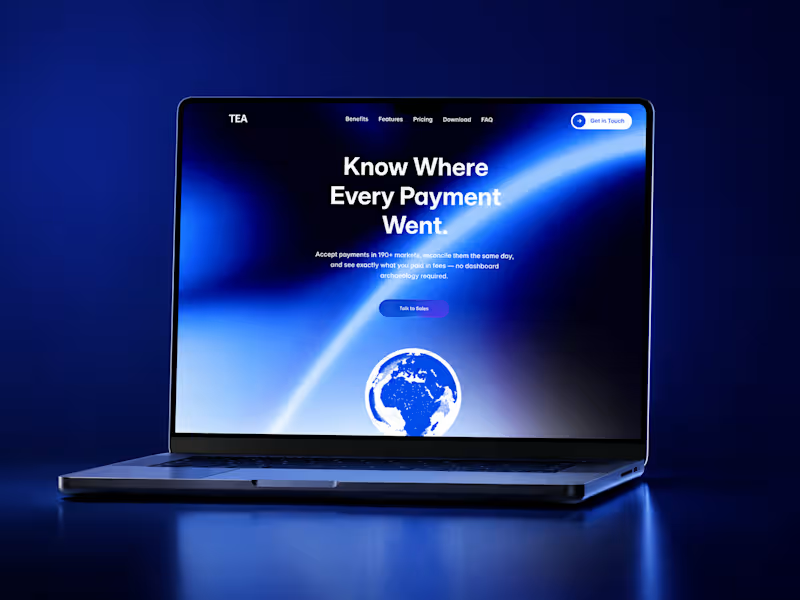
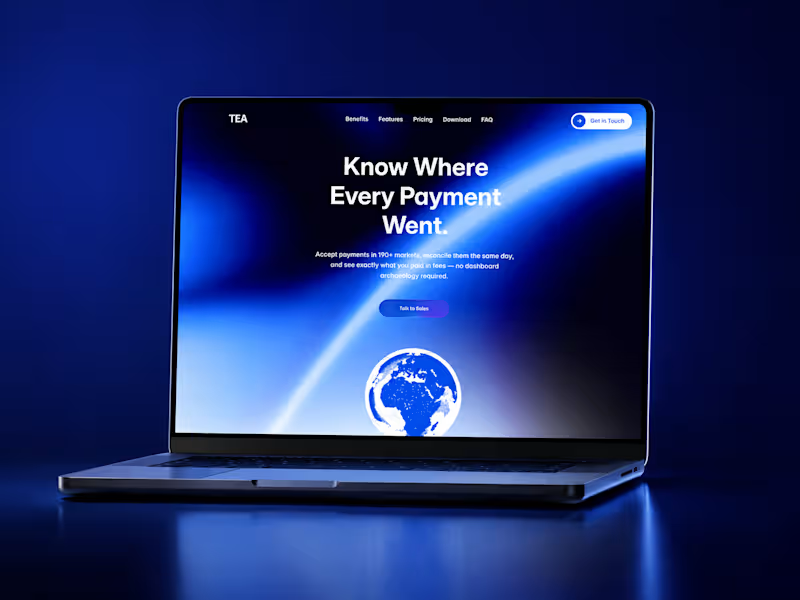
A marketing site for a B2B payments platform, built around one question most competitors avoid: where did the money actually go?
Project description
Payments companies almost all sell the same thing — volume, speed, uptime. Open five of their sites and you'll get five variations of the same throughput number above the fold.
TEA's actual advantage was quieter. Not that it moves money faster, but that you can see what happened to every transaction, the day it settles. So the site leads with that instead: "Know Where Every Payment Went." Every section after it earns that claim rather than restating it — reconciliation that finishes the same day, one stated rate per transaction, 190+ markets under one contract.
I wrote the site end to end alongside designing it. Positioning, headlines, pricing tiers, FAQ, error states, the wording inside form buttons. Copy and layout were never handed off between two stages — the "no dashboard archaeology required" line in the hero exists because the layout had room for one more clause, and the pricing tiers are three because the product genuinely has three shapes of customer, not because three columns fill a grid nicely.
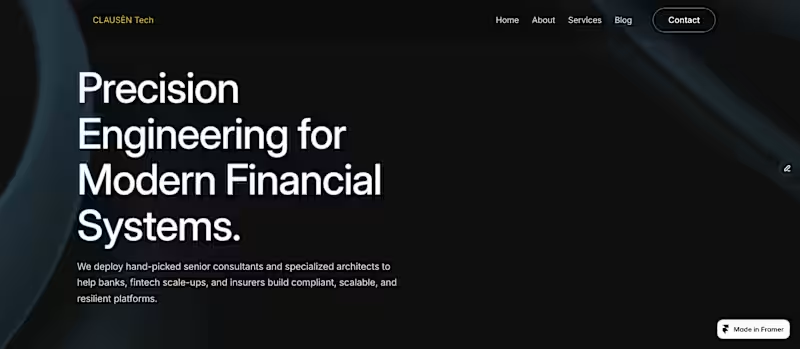
Identity. A single blue does the work — #1D4ED8, deep navy beneath it, white above. Finance sites reach for either sober navy or startup gradient soup; this sits between, saturated enough to feel current, disciplined enough to sign a contract in front of.
Motion. The heroes run a live liquid-gradient shader rather than a static image — slow enough to read as expensive, not as a screensaver. The centrepiece is a particle globe with the currencies plotted as real markets, USD in New York through AUD in Sydney, with flight paths tracing between them. It's the argument made visually: money crossing borders and staying accounted for.
Systems. Built in Framer as components with variants throughout — pricing cards, hover feature cards, an accordion where each open state is its own wired variant. Every section responsive across desktop, tablet and phone, with the components carrying breakpoint-specific geometry rather than being squeezed.
The curiosity showing up most is in the small decisions. The globe's hotspot labels pair each country with its currency instead of its capital, so the mark doubles as a coverage map. The subscribe button has written success and failure states, because a form that says nothing when it breaks is a design that stopped early.
Details block
Role , Design, front-end build, copywriting
Built with , Framer, custom shaders, code components
Deliverables , Marketing site (multi-page, fully responsive), visual identity direction, full site copy, motion design
Skills / tags
Web Design · Framer · Brand Identity · UX Writing · Motion Design · Design Systems · Fintech · Responsive Design TravelKing — AI-Powered Travel Commerce Platform
Overview
TravelKing is a full-stack travel commerce platform built to turn travel search, content, and affiliate monetization into one scalable system.
Instead of relying on thin affiliate widgets, TravelKing combines live booking experiences with an AI-powered content engine, destination architecture, automated internal linking, and centralized affiliate management.
The result is a platform designed to continuously expand its content footprint while turning every relevant page into a potential booking journey.
The Challenge
Most affiliate travel websites are built around the same limitations: generic widgets, thin destination pages, disconnected content, and little infrastructure for scaling SEO.
TravelKing was designed differently.
The goal was to create a system where content, search, monetization, and discovery work together — allowing the platform to grow without creating an increasingly complex editorial workload.
The Experience
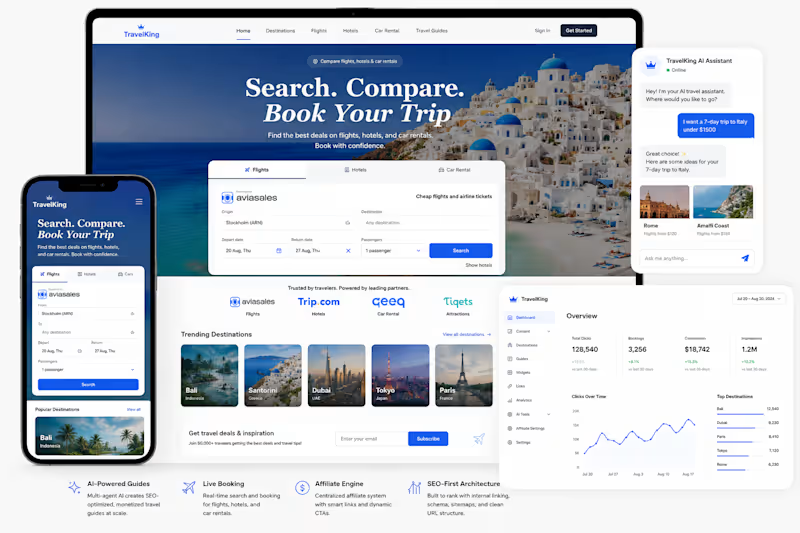
The homepage brings the core booking experience forward with dedicated search flows for:
Flights
Hotels
Car rentals
Live partner integrations connect travelers directly to booking inventory, while trending destinations, guides, and editorial content create additional discovery paths.
The destination architecture then expands into country pages, destination pages, attractions, travel guides, and editorial content — all connected through a structured internal-linking system.
A persistent AI travel assistant gives users another way to explore destinations, answer trip questions, and discover relevant booking options.
Built-In Affiliate Infrastructure
TravelKing treats affiliate monetization as infrastructure rather than an afterthought.
Affiliate configuration is centralized, allowing partner IDs and destinations to be managed from the admin system rather than hardcoded throughout the application.
Context-aware affiliate placements can also be embedded directly into guides, automatically transforming content into relevant booking opportunities.
Every outbound partner interaction passes through a trackable redirect system, creating a cleaner and more measurable monetization layer.
AI Content Engine
The platform includes a multi-agent AI pipeline designed to turn a topic into a structured, monetized travel guide.
The workflow combines:
SEO Planning → Content Architecture → Affiliate Strategy → Writing → SEO Optimization
Generated guides are delivered directly into the CMS as structured drafts, ready for review and publishing.
An additional SEO Command Center allows operators to manually initiate the same workflow by defining a topic and content direction.
This turns content production from a repetitive editorial process into an extensible publishing system.
SEO Architecture
SEO was treated as a product architecture problem rather than a metadata checklist.
TravelKing uses dynamic destination and guide pages, structured metadata, FAQ schema, automated sitemap generation, and a bidirectional internal-linking system connecting related destinations, attractions, and guides.
The objective is simple:
No valuable page should exist in isolation.
Every piece of content creates another path through the platform — improving discovery while creating additional opportunities for monetization.
Admin & Operations
A protected CMS gives operators control over the entire platform without requiring code changes.
The administration layer includes:
Content management
Destination management
Guide management
Affiliate settings
Booking widgets
Link management
Analytics
SEO Command Center
AI guide generation
This makes TravelKing less like a traditional website and more like a content-driven travel commerce operating system.
Technology
React · TypeScript · Vite · Tailwind CSS · shadcn/ui · Framer Motion · Supabase · PostgreSQL · Edge Functions · Gemini AI
The platform combines a modern frontend with a database-driven backend, authentication, serverless AI workflows, and affiliate infrastructure.
What I Built
An end-to-end travel platform engineered around three interconnected systems:
Discovery — destinations, guides, SEO architecture, and AI assistance.
Conversion — live flight, hotel, car rental, and attraction booking journeys.
Monetization — centralized affiliate infrastructure, contextual CTAs, and trackable outbound links.
TravelKing was built not as a collection of pages, but as a scalable digital system designed to continuously attract, convert, and monetize travel demand.